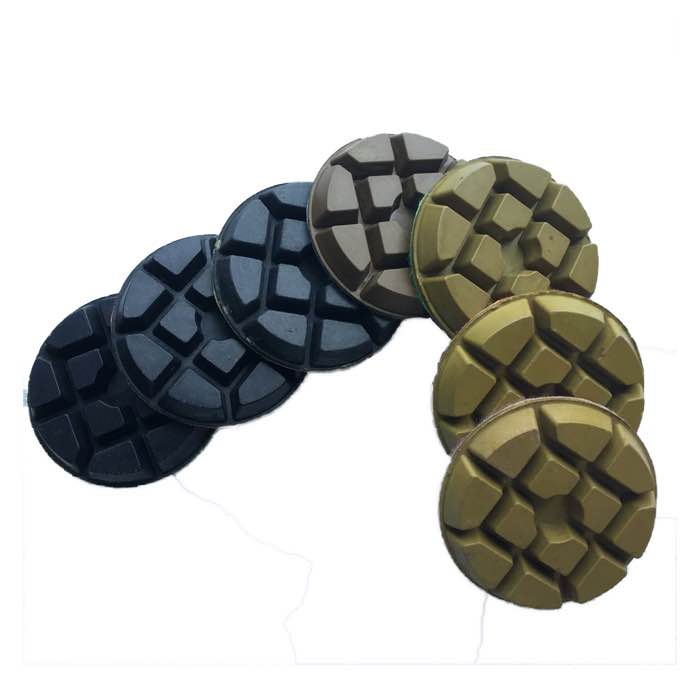
A 3-step system (typically 50/100#, 200/400#, 800/1500#) delivers a satin-to-semi-gloss finish quickly and economically, while a 17-step system (metal bond through resin bonds up to 3000#) produces a high-gloss, mirror finish. For warehouses and standard floors, 3 steps are enough; for polished-concrete showrooms and retail, you need the full sequence.
| System | Typical Grit Path | Finish | Best For |
|---|---|---|---|
| 3-Step | 50/100 → 200/400 → 800/1500 | Satin / semi-gloss | Warehouses, garages, economical work |
| 17-Step | Metal 30-400 → Transitional → Resin 800-3000 | High-gloss, mirror | Retail, showrooms, polished concrete |
You cannot skip from metal bond straight to 3000# resin — every grit step must erase the scratches of the one before it. That is why the full 17-step sequence produces a true mirror, while a 3-step resin system stops at satin.
Our Diamond Resin Polishing Pads cover the resin steps from 100# to 3000#, and Ceramic Bond Transitional Pads bridge metal to resin.
No — 3 resin steps reach a satin/semi-gloss at best. True high gloss needs the full sequence including finer resin grits (1500–3000#).
A 3-step grind-and-seal or 3-step resin polish is standard for warehouses — the finish is durable, easy to maintain, and much faster to produce.
Use matched pads and don't skip grits: metal bond to level, transitional to refine, resin 800–3000 to gloss, plus a densifier before the resin steps.
Choose the process by the finish you need: 3 steps for satin and economy, the full 17-step sequence for mirror gloss. Grit jumps are the enemy of a clean finish — build the sequence in order. JOY TECH supplies complete pad sets for both systems.
