Average response time: under 24 hours
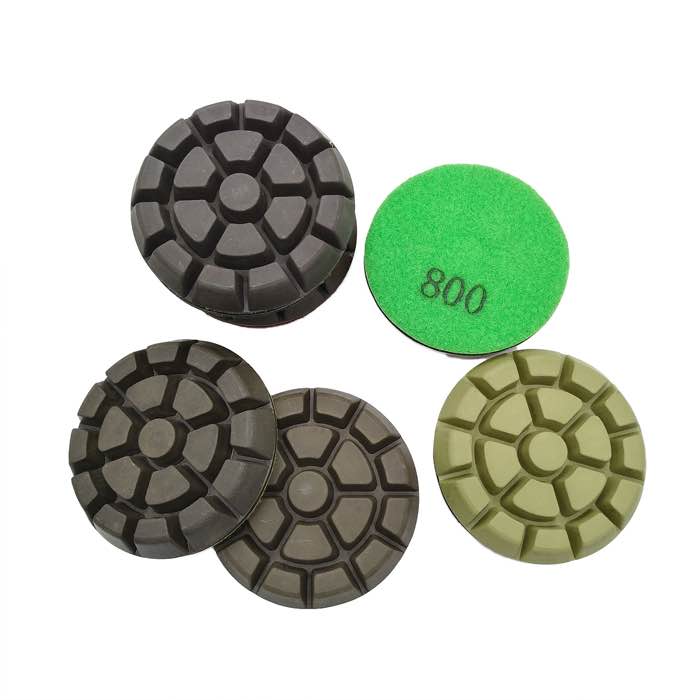
Budget diamond tooling as USD 1.5-USD 4.0 per square meter for a standard grind-and-polish concrete floor, and USD 0.15-USD 0.40 per linear meter for saw cutting. The formula is simple: tooling cost per m² = (tool purchase price / expected life in m²). A grinding plate set that costs USD 120 and lasts 500 m² is USD 0.24/m². A resin pad set that costs USD 300 and lasts 2,000 m² is USD 0.15/m². A 350 mm blade that costs USD 60 and cuts 150 linear meters is USD 0.40/m. Add 15-20% for wear variation on hard concrete or rebar. Get this number right and you stop losing money on fixed-price floor jobs. For our earlier calculation, see estimating tool cost per m² and grinding cost per m².
Every tool has two numbers: unit price, and expected life in m² (for grinding/polishing) or linear meters (for sawing). Divide them.
| Tool | Unit price (USD) | Expected life | Cost per unit |
|---|---|---|---|
| 350 mm laser blade | 60 | 150 linear m | 0.40 / m |
| Trapezoid grinding plate (46 grit) | 40 | 300-500 m² | 0.08-0.13 / m² |
| Resin pad (set 50-3000) | 300 / set | 1,500-2,500 m² | 0.12-0.20 / m² |
| PCD coating remover | 120 | 800-1,500 m² of coating | 0.08-0.15 / m² |
| Wet core bit (100 mm) | 80 | 80-150 holes | 0.50-1.00 / hole |
These are typical ranges on medium-hard (35-45 MPa) concrete without rebar. On hard concrete (>50 MPa) or with rebar, life drops 30-50%. On soft/green concrete, life increases 20-30% but bond selection changes.
Let's price a 1,000 m² retail floor, grind-and-seal, medium hardness:
| Step | Tooling | Cost (USD) |
|---|---|---|
| Metal-bond grind 30 grit | 3 plates x USD 40, life 300 m² each = 900 m² covered; 1 spare | 160 |
| Metal-bond grind 70 grit | 3 plates x USD 40, life 400 m² each | 120 |
| Resin transition 150 grit | 1 driver + pads, life 2,000 m² | 80 |
| Resin polish 300 / 800 / 1500 / 3000 | 1 set, life 2,000 m² | 240 |
| Blade (control joint cutting, 200 m) | 1 blade x USD 60 | 60 |
| Waste / breakage reserve (15%) | 100 | |
| Total tooling | 760 | |
| Per m² | 0.76 / m² |
That is the direct tooling cost. Add labor, machine depreciation, densifier, and sealer, and the job lands at USD 15-USD 30/m² all-in. But tooling is the line item contractors most often underestimate — bidding at USD 0.40/m² tooling when you actually consume USD 0.90/m² on hard concrete is where margin leaks.
Three factors dominate the spread:
The manufacturer's claimed life is a starting point. Your real life is what matters. Track it:
Most contractors discover that a more expensive blade that lasts 200 m is cheaper per meter than a cheap blade that lasts 80 m. The PDP should show both price and life — see pricing diamond tools. For grinding plate wear specifically, see estimating grinding wear per m².
When you price a floor job, line up three numbers:
Add machine depreciation (USD 1-USD 3/m²), overhead, and margin, and you have a bid. Tooling is usually only 5-10% of the total, but it is the easiest 5-10% to get wrong — and the easiest to fix once you track it.
A: More. Hard concrete wears diamond tools faster (the diamonds fracture more quickly and the bond has to work harder). Increase tooling budget by 30-50% for slabs over 50 MPa, or where you see hard aggregate in the cut.
A: USD 0.30-USD 0.60 per linear meter for plain concrete, USD 0.80-USD 1.50 per linear meter where the cut passes through rebar. A 350 mm blade that costs USD 60 and cuts 150 m is USD 0.40/m; that is the median.
A: Often yes. A blade that costs USD 100 and cuts 250 m is USD 0.40/m; a blade that costs USD 40 and cuts 80 m is USD 0.50/m. The premium blade is cheaper per meter even though it costs more up front. Always compare per-meter cost, not unit price.
A: PCD tools cost more up front (USD 80-150 each) but remove coating 5-10x faster than metal-bond diamond. Budget USD 0.15-USD 0.30 per m² of coating removed. The savings in labor time dwarf the tooling cost.
Cost per square meter is the only number that matters for tooling budget. Unit price is a distraction. Track your real life on each SKU, adjust for concrete hardness and rebar, and bid with a 15% contingency. Done this way, tooling stops being a surprise expense and becomes a known line item. Pair your floor with the right resin pad set and ask us for the per-m² estimate for your specific slab.
Written and reviewed by JOY TECH — an SGS & BV audited, CE/RoHS certified diamond tools manufacturer founded in 2004, exporting to 50+ countries.
Our factory and QMS are audited by SGS and Bureau Veritas. Products meet CE/RoHS requirements and every piece is 100% inspected before packing.
Verified Certificates
