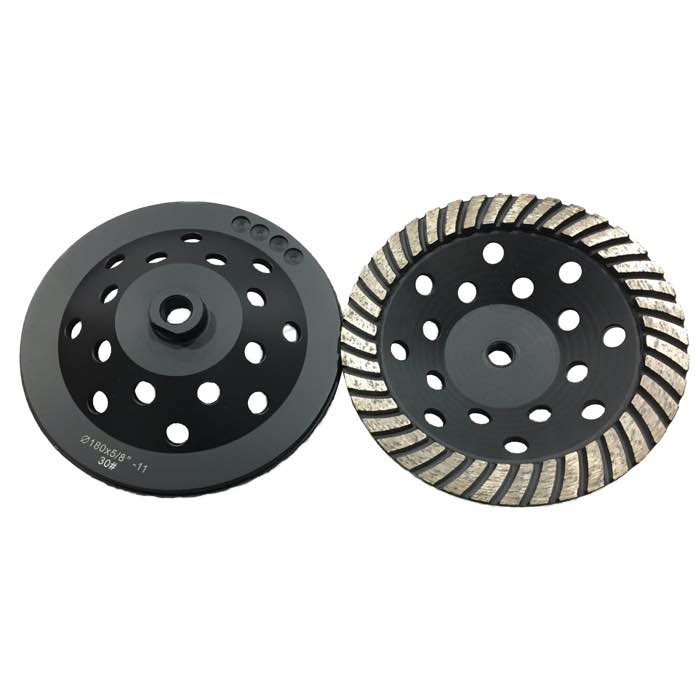
Yes, you can grind small areas of concrete with an angle grinder fitted with a diamond cup wheel. It works for removing high spots, cleaning edges, smoothing patches and light surface prep. However, it is slow, hard on your arms, and leaves swirl marks that a walk-behind floor grinder avoids. For areas larger than 10-15 m², renting a floor grinder is almost always worth it.
Use a diamond cup wheel — never an abrasive masonry disc, which glazes and loads in seconds. A turbo or segmented cup wheel like the turbo cup wheel cuts fast; a single/double-row wheel like the double-row cup wheel gives a cleaner finish.
Angle grinders remove material in a circular swath, so large open floors end up with overlapping swirls and waves. You cannot produce a flat, polished floor by hand. You also cannot remove deep mastic or heavy epoxy without PCD tooling — a standard cup wheel loads up. For those, use a PCD cup wheel.
Make overlapping passes, let the tool do the work — pressing harder just glazes the wheel and digs gouges. Grind with a sweeping side-to-side motion rather than dwelling in one spot. After leveling, switch to a finer cup wheel or hand resin pads to smooth out swirl marks.
An angle grinder is right for trip-hazard removal on driveways, smoothing patch edges, cleaning glue off walls, and small garage corners. It is wrong for whole rooms — you will spend two days and leave a wavy floor. Rent a 250 mm walk-behind grinder for anything over 15 m²; the daily rental pays back in saved labor.
Let the wheel do the cutting. Pressing harder generates heat, glazes the segment, and digs gouges. Make side-to-side sweeps, overlapping by a third, and keep the wheel flat. Tilt the corner of the wheel only for tight corners. Stop frequently and feel the motor — if it is hot, you are pushing too hard.
Aggressive cup wheels leave circular scratch marks. If the area will be coated, that profile is fine. If it will be seen bare, follow with a finer cup wheel or 4-inch resin pads on a backing holder to smooth the swirls. Skip this and the finished patch will show.
If your angle grinder cannot keep up, rent a floor grinder for a day. Most rental yards deliver and pick up. A 250 mm grinder covers a garage in an afternoon; the same area by angle grinder takes two days. For homeowners doing a one-time job, rental is the economical choice.
Replace the cup wheel when segments wear unevenly or the wheel starts to wobble. A worn cup wheel leaves gouges. Keep a spare wheel on hand — grinding stops dead if a wheel fails mid-job.
Because an angle grinder is hard to shroud fully, expect more dust than a walk-behind machine. Have the HEPA vacuum running while you work, and wear a P100 mask. Afterward, wipe walls and sills — concrete dust settles everywhere. For a small patch job, this cleanup is often longer than the grinding itself.
If your arms ache after an hour and the floor shows only a small swath, stop. Rent a floor grinder. It is not worth two days of hand work when a half-day rental finishes the room flat.
A: A couple of millimeters in repeated passes. It is not a replacement for a floor grinder on a whole slab.
A: No — a thin cut disc is unsafe sideways and can shatter. Use a proper cup wheel.
A: Not if you keep it flat and avoid deep cuts, but aggressive angling can chip edges.
A: Dozens of hours on typical residential concrete; much shorter on hard aggregate or over coatings.
An angle grinder with the right diamond cup wheel is a practical DIY and edge tool, not a floor grinder. Keep it for patches and perimeter work. Contact JOY TECH to choose the right cup wheel size and segment for your grinder.
