Average response time: under 24 hours
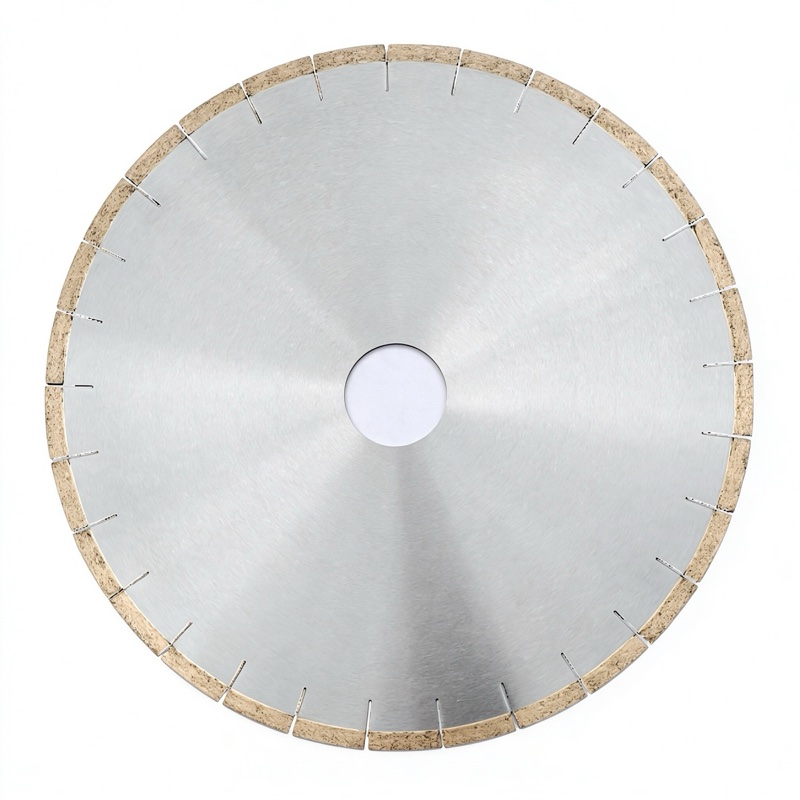
Cold-pressed diamond blades wear faster in hard aggregate because the cold-pressing process produces a less dense metal bond that does not grip the diamond crystals as tightly. When the concrete contains hard, silica-rich aggregate such as quartzite, flint, or granite, the abrasive particles knock weakly-held diamonds out of the segment before the crystal is worn down. The result is a segment that looks empty on top, wears down in hours, and stops cutting. This is not a defect in the blade; it is the known limit of the cold-pressing route. Use cold-pressed blades on tile, marble, and soft stone; move to a hot-pressed or laser-welded hard-bond blade on hard concrete.
In cold pressing, the diamond grit and metal powder are compacted at room temperature and then sintered in a tunnel furnace without applied pressure. Without pressure during sintering, the segment shrinks but does not fully densify. The finished bond has small pores and lower hardness than a hot-pressed segment of the same powder mix. The diamonds sit in a softer matrix that yields more easily under load. That is fine on soft materials, but on hard aggregate the matrix yields too fast.
The diamonds themselves are not different. What changes is how well the metal bond grips each crystal. In a hot-pressed segment, the powder flows around the diamond under heat and pressure, wrapping the crystal tightly. In a cold-pressed segment, the bond only contacts the diamond where powder particles happened to sit during compaction. When a hard quartz grain scratches across the segment, it pries at the weakly-held diamond and pops it out whole. Operators see this as a row of empty holes across the segment face.
Walk through what happens on a hard, silica-rich slab:
Look at the segment face under a light. A segment that is cutting correctly shows fresh, partially-buried diamond crystals evenly spread across the face. A segment in pull-out mode shows round pits where whole crystals used to sit, often surrounded by polished bond. These pits are the signature of low-density retention on hard aggregate. Once you see them on more than half the segment, the blade has entered its fast-wear phase.
On a cold-pressed blade in hard aggregate, the sides of the segment wear down faster than the top. That side wear widens the kerf, reduces segment height, and leaves a thin ridge of bond in the middle of the face. A hot-pressed blade on the same job wears the top and sides roughly evenly. If you run your finger along the segment side and feel a sharp undercut, you are seeing the cold-pressed failure mode, not normal wear.
By the time the segment is half gone, the cut rate is a fraction of what it was on the first cut. This is the classic cold-pressed failure on hard aggregate: not glazing, but diamond pull-out and side wear.
On soft concrete, limestone, or marble, the abrasive load is low enough that even a weakly-held diamond stays in place until it wears down. The cold-pressed blade feels fast, leaves a clean edge, and lasts a reasonable amount of time. This is why cold-pressed segments such as the JOY MS-ST marble blade work well in stone shops: marble is soft, the bond wears at the right rate, and the low price makes economic sense. Move that same blade onto a quartzite-rich concrete driveway and the picture changes completely within the first day.
Match the manufacturing route to the aggregate. The decision tree is straightforward:
The diamond saw blade catalog lists each blade by process, bond hardness, and recommended material. If you are starting a new job and the aggregate is unfamiliar, send a small chunk of the concrete to the supplier and ask for a bond recommendation; guessing here is the most expensive mistake a saw crew makes. When you are not sure whether your aggregate is hard, run a 30-meter test cut on a cold-pressed blade and inspect the segment. If diamonds are already missing from the face on day one, switch to a harder bond. Treat whole crystals missing from the face as the trigger to stop, not slow down.
Some operators try to extend a cold-pressed blade's life on hard concrete by cutting slower, running dry to heat the bond, or pressing harder. None of these work once diamonds are dropping out, because the bond itself is the weak link. Cutting dry only burns the remaining diamonds; cutting slower just means the same number of diamonds pop out over a longer cut. If the segment has pulled out diamonds across more than half its face, retire the blade. For the next job, pick a hot-pressed segment sized for your aggregate. If you need help matching bond to aggregate, contact the JOY TECH application team with the concrete strength and aggregate type, and they will spec a blade that lasts. The cost per cut is always lower when the process matches the material. Treat diamond pull-out across the segment face as the stop signal, not the warning light.
Written and reviewed by JOY TECH — an SGS & BV audited, CE/RoHS certified diamond tools manufacturer founded in 2004, exporting to 50+ countries.
Our factory and QMS are audited by SGS and Bureau Veritas. Products meet CE/RoHS requirements and every piece is 100% inspected before packing.
Verified Certificates
