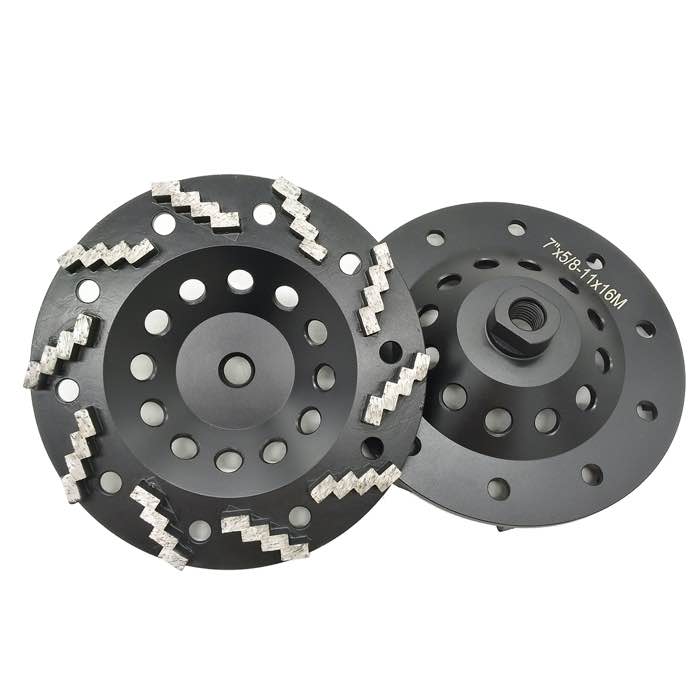
Grinding and polishing are two stages of one process. Grinding uses metal-bond diamond discs to flatten the slab, remove defects and create a uniform scratch pattern. Polishing uses resin-bond diamond pads on a flat, densified surface to refine scratches and build gloss. You must grind first — polishing cannot fix a rough or uneven floor. A "polished concrete" job always starts with grinding.
Grinding removes material. It uses hard metal-bond segments at 6-150 grit on a walk-behind grinder. Goals include leveling trowel marks, removing coatings, exposing aggregate, and opening pores. At this stage the floor looks rough and scratched, even after several passes. Tools are trapezoid or Redi-Lock metal discs, e.g. a HTC double-arrow disc.
Polishing removes scratches, not material. It uses flexible resin pads at 150-3000 grit on a velcro backing, usually after a densifier has hardened the surface. Goals are reflection, smoothness and stain resistance. Tools look like thin flexible discs rather than chunky metal segments — e.g. resin polishing pads.
| Grinding | Polishing | |
|---|---|---|
| Bond | Metal | Resin / hybrid |
| Grits | 6-150 | 150-3000 |
| Removes | Millimeters of material | Microns of scratches |
| Densifier | Before/after mid-grind | Essential before high grits |
| Result | Flat, open surface | Glossy, smooth surface |
Polishing is a refining process — it removes microns, not millimeters. If the floor is troweled, wavy or coated, polishing pads cannot flatten it; they just follow the waves and haze. Grinding first creates the flat canvas. The two-stage sequence is non-negotiable.
After the metal grind, the paste is open and weak. Densifier reacts to harden it before the resin stage. Without densifier, resin pads burnish the surface but the underlying cream remains soft and dusts under traffic. This is why a "polished" floor that dusts a year later was usually densified too late or not at all.
A ground-only matte floor is the cheapest polished-concrete option. Each resin step adds labor and pads. Mirror finish costs roughly double a ground-only floor. Match the finish to the space: high-gloss for showrooms, satin for homes, matte for warehouses.
Tell the client: grinding is the rough cut, polishing is the sanding and varnish. You cannot skip sanding after a rough cut. The price difference between a ground and polished floor reflects extra grit steps and densifier. Set expectations early so they understand why "just grinding" does not look glossy.
Pour a small concrete sample and grind it to different sheens. Show the client ground, satin, polished and mirror. This prevents arguments about the final look. Concrete varies by pour — samples are the only honest preview.
Metal grinding is the labor-heavy stage. Resin polishing adds consumable cost. Densifier adds material but little labor. High-gloss burnish adds a machine rental. Break the quote into these stages so the client sees where the money goes.
Polished concrete needs annual burnishing, not re-coating. A ground matte floor needs sealer reapplication. Set expectations so the client is not surprised by either cost.
Garages and workshops: stop at 150-300 grit matte — grippy and forgiving. Living areas and basements: 400-800 grit satin, easy to clean and not too reflective. Retail and showrooms: 1500-3000 grit for the wow factor. Do not let a client over-spec a mirror finish in a high-traffic shop — every scratch shows.
Put both stages in the contract. "Grind to flat, densify, polish to 800 grit." If the client only budgeted for grinding, they will be disappointed by the matte result. Set expectations up front with a sample board.
Grinding and polishing are not competing methods — they are steps on the same path. A successful floor always starts with grinding and ends with polishing. Once you explain that sequence clearly, clients understand the price and the result.
A: No. A dulling pad on a rough floor just smears and haze. Start with metal grinding.
A: Matte ground floors are grippy; high-gloss polished floors can be slippery when wet — use anti-slip additive outdoors.
A: Densifier is recommended anywhere you want dustproofing, even at low sheen.
Grinding dominates time; polishing is faster because little material comes off.
Think of grinding as preparing a canvas and polishing as painting the finish. Both are required for a professional result. Contact JOY TECH for matched metal and resin sets for any finish level.
