Average response time: under 24 hours
A standard concrete polishing progression runs 25 (or 40) coarse metal bond → 50 → 100 → 200 → 400 → 800 → 1500 → 3000 resin bond, with a densifier applied after the 400-grit pass. Coarse metal-bond grits flatten and open the surface; the resin grits progressively refine the scratch pattern until the surface reflects light. The rule is simple: never skip a grit, never switch before the previous scratches are fully removed, and apply densifier once the surface is flat, around the 200-400 stage.
Each grit leaves scratches of its own size. A 50-grit pad leaves scratches that only a 100-grit pad can remove; skipping to 400 leaves the 50-grit scratches visible under the shine. The progression is a staircase: each step removes the marks of the step before and lays down smaller ones, until the final step's scratches are too fine to see. Rushing the early steps guarantees a wavy, hazy result later — the polish magnifies every mistake.
Between every pass, vacuum and wipe the floor. Slurry from one grit carrying into the next re-scratches the surface and undoes the step — the most common reason home polishes fail.
Apply densifier after the surface is flat — typically after the 200 or 400 pass. Densifier needs an open, clean surface to penetrate; applied too early it soaks into laitance that is about to be ground away, applied too late the surface has closed and it sits on top. After application, let it dry per the product instructions, then continue the sequence. On soft concrete, densifier makes the difference between a matte floor and a real shine; on very hard concrete it matters less. For a matte or low-sheen finish, stop the sequence at 400-800 and seal — see how to get a matte finish on concrete.
A grit is done when the surface shows a uniform scratch pattern from that grit and none of the previous grit's marks remain. Check at an angle with a bright light: if you see deeper scratches, stay on the current grit. Also check flatness with a straightedge during the metal-bond stages — flatness cannot be fixed by finer grits, only by going back to coarse. If you find a wave after polishing, the only fix is to re-run the coarse stages on that area.
Choose pads matched to the machine and surface — diamond resin floor polishing pads cover the 400-3000 stages on floor machines, and a hand polisher with the same pad family finishes edges and small areas.
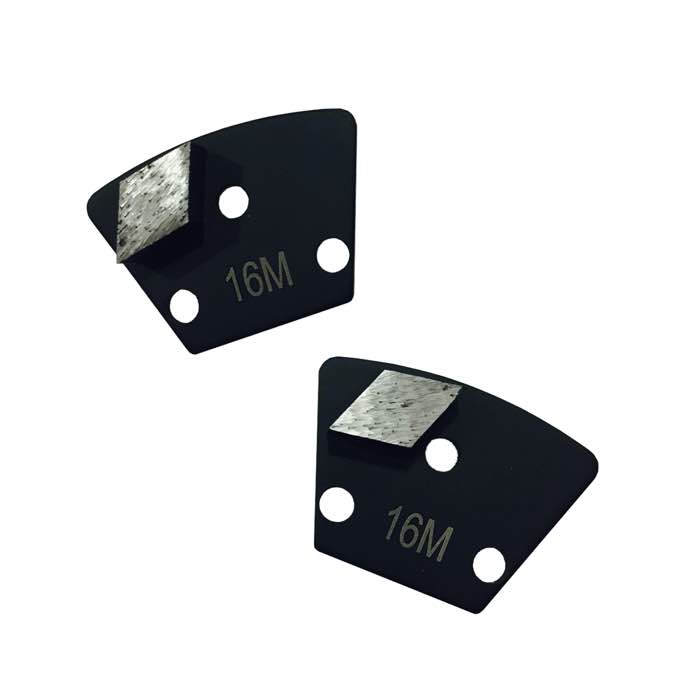
Refine the top-end steps with triangular diamond resin polishing pads that reach every part of the floor.
25/40 metal bond → 50 → 100 → 200 → 400 → 800 → 1500 → 3000 resin bond, with densifier after the 400 pass. Adjust the start grit to the floor condition but never skip grits.
After the surface is flat and open, usually after the 200 or 400 grit pass. Densifier penetrates best on a clean, open surface and hardens it before the fine grits develop the gloss.
No. Each grit removes the scratches of the previous one. Skipping leaves coarse scratches under the final gloss, producing a hazy or streaky finish.
When the current grit has removed all the previous scratches — check with a bright light at an angle. If any deeper marks remain, stay on the current grit.
Concrete polishing is a staircase you cannot skip: coarse metal bond flattens and opens, densifier hardens the flat surface, and the resin grits refine scratches to a mirror. Clean between every pass, check the scratch pattern before moving on, and apply densifier at the right moment. Follow the progression and the floor builds gloss evenly — skip a step and it shows forever.
Written and reviewed by JOY TECH — an SGS & BV audited, CE/RoHS certified diamond tools manufacturer founded in 2004, exporting to 50+ countries.
Our factory and QMS are audited by SGS and Bureau Veritas. Products meet CE/RoHS requirements and every piece is 100% inspected before packing.
Verified Certificates
