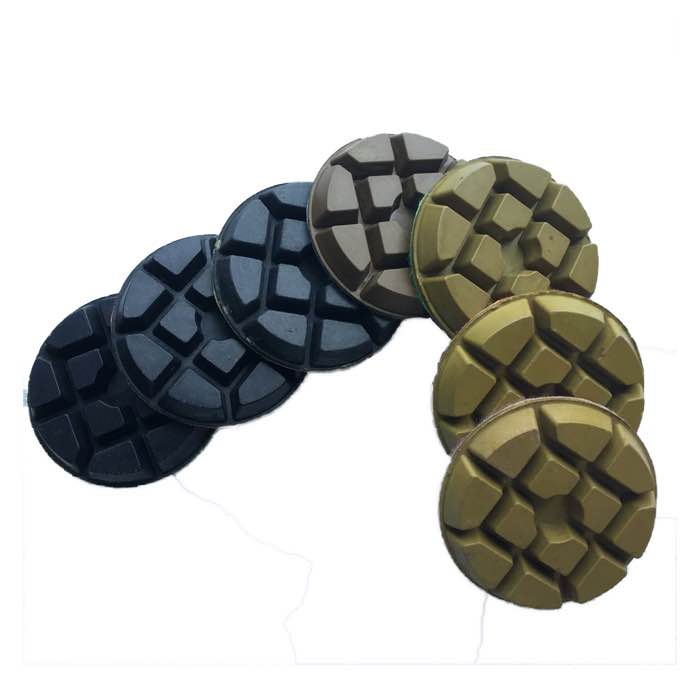
A standard concrete polishing grit sequence runs 50 - 100 - 200 (metal bond) then 400 - 800 - 1500 - 3000 (resin bond). You should not skip grits: each step removes the scratches left by the previous one. Skipping from 100 to 800, for example, leaves deep scratches that will show through the final gloss.
Diamond tools cut by scratching. A coarse grit makes deep, wide scratches; the next finer grit makes shallower scratches that replace them. If you skip a grit, the remaining deep scratches never get removed and the floor looks hazy even at 3000 grit. The sequence is the recipe for a uniform, glossy surface.
| Stage | Grit | Bond | Goal |
|---|---|---|---|
| Coarse grinding | 50 - 100 | Metal | Level, open surface |
| Transition | 200 | Metal / resin | Remove metal scratches |
| Honing | 400 - 800 | Resin | Refine, prepare |
| Polishing | 1500 - 3000 | Resin | Build sheen |
Switch after the 200-grit metal pass, when the surface feels even and has no visible grinding marks. From 400 grit onward, resin-bond polishing pads or resin floor polishing pads give a finer finish and better gloss. Some contractors add a 50-grit metal pass after 200 if the concrete is soft or the surface still shows scratches.
A: No. Skipping leaves deep scratches that reappear as haze at high gloss. If time is tight, skip from 1500 to 3000 rarely, but never skip the coarse stages.
A: Yes for best results - apply a lithium densifier after the 200-grit pass so the surface hardens before resin honing. It improves dust control and gloss.
A: A full set covers 50 to 3000 (usually 7-8 pads). For a one-off small floor, a 3-step resin set (200/400, 800/1500, 3000) is a practical minimum.
The grit sequence is the difference between a dull, patchy floor and a professional gloss. Follow 50 - 3000 without skipping, switch to resin at 400, and densify on schedule. Browse our polishing pad sets for your project size.
