You technically can polish concrete without a densifier, but the result is a disappointment. The floor may look glossy immediately after polishing because you have mechanically smoothed the surface, but the cement paste remains soft and porous. Within weeks or months, traffic grinds that soft top layer away, the floor starts dusting, and the gloss fades into a dull, powdering surface. A densifier chemically hardens and densifies the paste so it can be polished into a durable, wear-resistant layer - it is not optional on a floor expected to last.
A densifier (usually lithium, sodium or potassium silicate) penetrates open concrete and reacts with free lime (calcium hydroxide) to form calcium silicate hydrate (CSH) crystals. This fills the capillary pores and turns the soft surface cream into a hard, dense layer that can take a high polish. Without it, you are polishing a layer of loose, dusty cement cream that wears under foot and wheel traffic.
On a very hard, dense, low-water mix that is already well cured, the difference can be less dramatic - but even then, you lose long-term performance. On soft, dusty, or old concrete, skipping densifier is essentially throwing away the polishing cost. The densifier is cheap relative to the grinding labor; it is the step that makes the investment last.
| Condition | With densifier | Without densifier |
|---|---|---|
| Initial gloss | Deep, clear | Present but shallow |
| After 6 months | Holds shine | Dusts, dulls, stains |
| Maintenance | Burnish restores | Surface wears away |
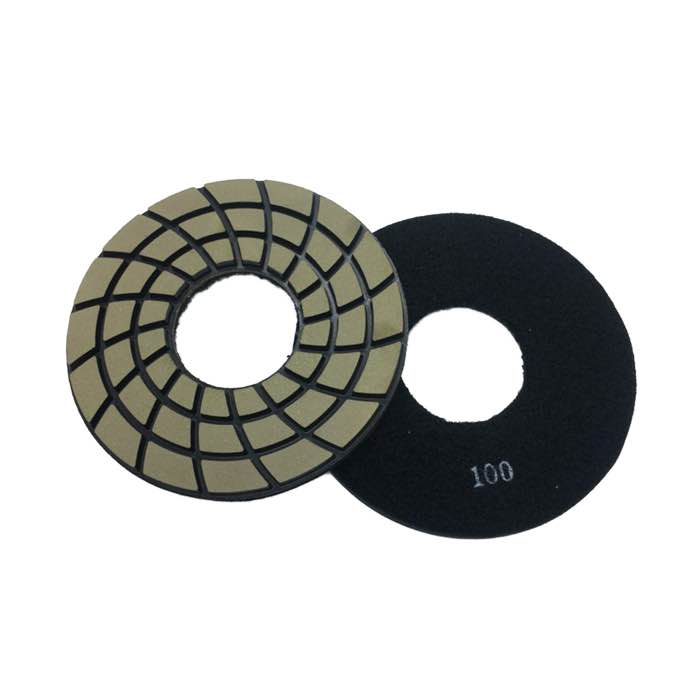
Once you do densify, the full resin sequence matters - pads such as our White Resin Polishing Pads refine the hardened paste to a clean, non-staining gloss. A transitional copper pad like this copper-bond hybrid eases the metal-to-resin transition on densified slabs.
It helps to understand the chemistry. Raw concrete paste is a tangle of loosely bound cement particles. A densifier reacts with free lime to grow additional CSH crystals inside the pores, turning a soft, dusty surface into a hard, wear-resistant matrix. No amount of mechanical polishing can create that mineral cross-linking - polishing only smooths whatever is already there. That is why a densified floor resists abrasion while an undensified one wears away.
If you already skipped densifier and now have a dulling, dusting floor, your options are limited. You can try to densify the surface now, but because the polished layer is dense, penetration is weak and results are modest. The reliable fix is to re-open the floor to around 150 grit, apply densifier while it is open, then re-polish. Learn from it on the next job: densify while the slab still breathes.
On high-traffic warehouses, retail floors and anywhere durability is promised, densification is non-negotiable. It is also what allows a polished floor to be marketed as low-maintenance. Skipping it to save money on one job risks callbacks that cost far more than the product ever did.
For budget-conscious owners, explain the trade-off up front: a floor without densifier may look fine at handover but will need recoating or re-polishing within a couple of years.
If budget forces a shortcut, at least apply a densifier after the floor opens during grinding. The small product cost buys years of durability.
A: Partially. Once polished, the surface is closed and densifier penetrates poorly. It is best applied while the slab is still open (around 150-200 grit).
No. Densifier penetrates and hardens; sealer sits on top and wears off. A polished floor can be left without topical sealer once densified.
Lithium densifier is nearly invisible; some sodium products can lighten or leave residue if not rinsed.
Polishing without densifier buys a temporary shine at the cost of long-term durability. Spend the time and product to densify while the slab is open, then refine with proper resin pads. The takeaway is that densification is the step that makes a polished floor durable. Skip it and you save a little now, but pay dearly in dusting and gloss loss later. Densify while the slab is open. Contact JOY TECH for a quote on the resin and transitional pads that deliver a lasting polished floor.
