Average response time: under 24 hours
Concrete Surface Profile (CSP) is the roughness of a prepared slab, measured from CSP 1 (very fine) to CSP 10 (very rough). Most coatings, sealers, and overlays need between CSP 2 and CSP 4: epoxy and thin resins need CSP 2-3, cement overlays and self-levelers need CSP 3-4, and thick broadcast systems need CSP 4-5. Too smooth and the coating will delaminate; too rough and the coating cannot wet out the peaks. Match your grinding tooling to the CSP level the coating manufacturer specifies, not to what looks good.
CSP is not how clean the slab is, and it is not how flat it is. It is the amplitude and spacing of the roughness peaks left after preparation. A slab that looks smooth under lights may have a CSP of 1 (trowel finish), which is too smooth for almost any coating. A slab that has been shot blasted or acid etched may sit at CSP 3, which is the sweet spot for most epoxy. The International Concrete Repair Industry publishes physical comparison chips, and any competent floor prep contractor carries them on the job.
The mistake most owners make is judging profile by eye. A floor that looks rough to the eye may be CSP 4, while a floor that looks dull may be CSP 2. The only reliable way to measure CSP is to compare the slab to the chip set, or to use a profile tape or replica putty. A coating failure is almost always traced back to a mismatch between the profile and the coating's documented requirement.
CSP 1 is a trowel-finished, polished, or very smooth surface. It has almost no mechanical tooth. Use CSP 1 only for a seaker or a penetrating sealer that does not rely on mechanical adhesion. For anything thicker, CSP 1 is too smooth: an epoxy applied to a CSP 1 slab will peel off in sheets because there is nothing for it to grip. To raise a CSP 1 slab to CSP 3, grind with a 30/40 grit metal-bond diamond puck or shot blast it.
CSP 2 is a light grind that removes the trowel cream and exposes a fine sand texture. You can feel it with your palm but you cannot see individual peaks. This is the profile for thin epoxy coatings, urethane mortars under 2 mm, and penetrating epoxies. Most warehouse floors that are being recoated sit at CSP 2 after a light grind.
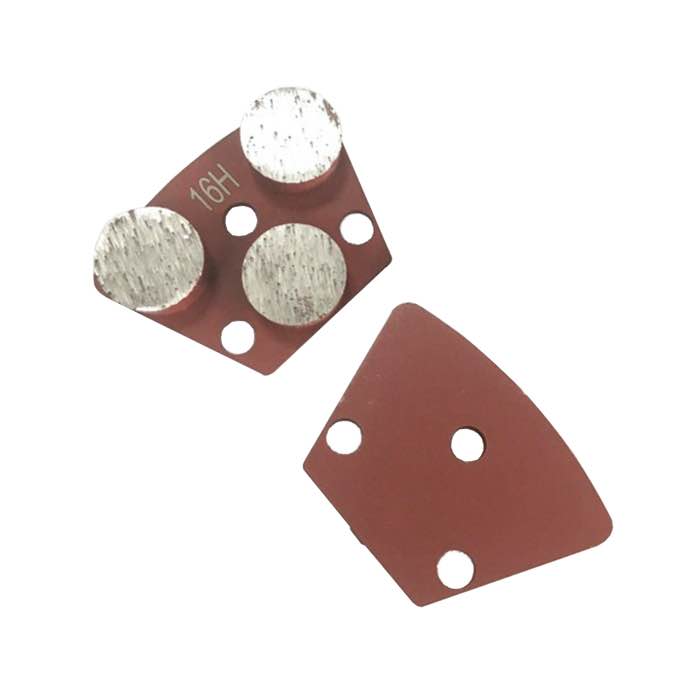
Use a JOY TP-S2 double-S segment trapezoid disc on a planetary grinder, or a 60/80 grit metal bond on a single-head machine. Pass over the slab once or twice, just enough to remove the cream. Do not over-grind; over-grinding on a soft machine can drop you into CSP 3 when you only needed CSP 2.
CSP 3 is the workhorse profile for most commercial flooring. It shows distinct aggregate texture, you can see the peaks, and you can feel a slight grit with a bare hand. This is the target for most 2-4 mm epoxy systems, self-leveling cement overlays, and UHPC toppings. Most coating manufacturers specify CSP 3 on their technical data sheets; if you have never checked, this is the level you should aim for unless told otherwise.
Achieve CSP 3 with a 30/40 grit metal-bond diamond on a 2-head or 3-head planetary grinder. One full pass is usually enough on a medium-hard slab; on a very hard mix, you may need a 16/20 grit first pass. After grinding, sweep and vacuum the slab, then check the profile against the comparison chips before coating.
CSP 4 is a heavy, open profile where you can see exposed coarse aggregate and the peaks are clearly visible. This is the profile for thick broadcast epoxy systems, 6 mm-plus cement overlays, and resin mortar floors. It is also the profile you need after removing a failed coating: the old epoxy or mastics must come off completely and leave an open slab.
To get to CSP 4, use a 16/20 or 20/30 grit aggressive metal bond, or use PCD (polycrystalline diamond) tooling to remove coatings first. The JOY WM-PCD PCD tooling strips thick coatings rapidly and leaves a CSP 4-5 profile; follow it with a 30/40 metal bond to bring the profile back to a consistent CSP 4 across the whole floor. Do not go past CSP 4 for thin coatings; the peaks will be too tall and the coating will not wet out.
Every good floor prep job ends with a profile check. Do these three things:
Document the CSP level on the job report. If a coating fails six months later, the first question the coating manufacturer will ask is what CSP you prepared. Without a record, you will not be able to defend the job. Browse the full grinding tooling lineup for metal-bond grits from 16 to 200 that let you dial in any CSP between 2 and 5.
Written and reviewed by JOY TECH — an SGS & BV audited, CE/RoHS certified diamond tools manufacturer founded in 2004, exporting to 50+ countries.
Our factory and QMS are audited by SGS and Bureau Veritas. Products meet CE/RoHS requirements and every piece is 100% inspected before packing.
Verified Certificates
