Average response time: under 24 hours
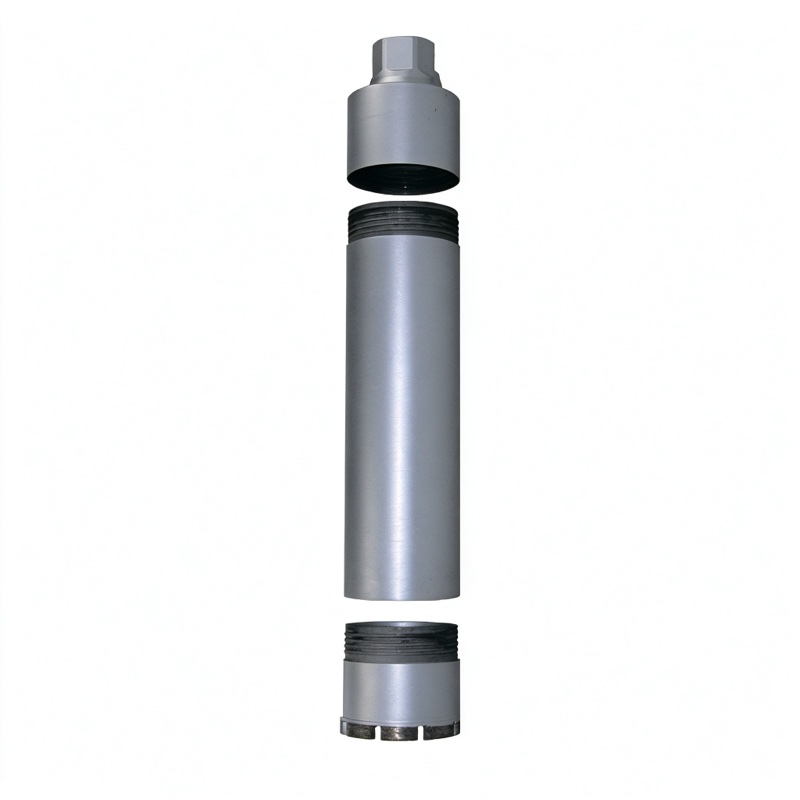
To drill a vent, chimney, or cable penetration through a concrete roof slab, use a rig-mounted wet diamond core drill anchored to the roof, with a slurry-catching bag around the bit. A segmented diamond core bit handles typical 100-200 mm roof openings at 400-800 RPM. Overhead coring is the most dangerous drilling orientation: the rig must be anchored or vac-mounted, the operator must wear a harness, and water must be routed so it does not run down into the building. Scan the slab for post-tensioning cables and embedded radiant heat before cutting.
Roof slabs are usually the densest concrete on a building. They carry live and dead loads, water-proofing membranes, and often contain post-tensioning cables running in two directions. A penetration through a roof must be located away from PT tendons, through the concrete itself, and sealed afterward so water does not track into the building. The work is also overhead: gravity works against you, both for holding the drill and for controlling slurry.
Common roof openings include plumbing vent stacks (100-110 mm), HVAC penetrations (150-300 mm), exhaust ducts, solar conduit sleeves, and chimney flashings. Each opening needs a curb or flashing installed after coring, and the annulus must be sealed with a waterproof boot.
Get the structural drawings. Locate PT tendons, rebar mesh, and any embedded conduits. Use a rebar detector on the roof surface, and if the building has a PT slab, bring in GPR scanning. Cutting a PT cable is a structural emergency that can cost days of repair and thousands of dollars. Mark the opening circle and cross-check that it sits between tendons.
Inspect the roof membrane. Most flat roofs have EPDM, TPO, or bitumen waterproofing that runs up the curb around penetrations. Score the membrane with a knife around the circle before coring, so the bit does not tear the membrane as it enters the concrete. Protect the rest of the roof with walk boards so equipment does not puncture the membrane.
A handheld overhead drill for a 100 mm roof hole is unsafe. The torque reaction when the bit catches rebar can pull the operator off balance. Use a core drill stand anchored to the roof with wedge bolts into the concrete, or a vacuum base on a smooth finished slab. The stand column points vertically down, the motor hangs under the roof, and the operator feeds from below.
| Roof opening | Bit diameter | RPM | Rig type |
|---|---|---|---|
| Vent stack 110 mm | 125 mm | 500-800 | Vac stand or anchor rig |
| HVAC duct 200 mm | 225-250 mm | 400-600 | Anchored rig |
| Exhaust 300 mm | 325-350 mm | 300-500 | Heavy rig, 3-speed |
| Conduit sleeve 50 mm | 65 mm | 800-1200 | Handheld with tripod |
Water fed through the spindle runs down the barrel and then, under gravity, drops out the bottom into the building below. Use a slurry-catching shroud or a plastic bag taped to the underside of the roof around the opening. Professional crews carry overhead collection bags with a drain tube that feeds into a bucket. Without collection, the finished ceiling below will be plastered with wet concrete.
For roof jobs where water is impossible, a dry dry diamond core bit with a vacuum shroud works on smaller penetrations, but expect shorter bit life and a heavy dust plume. Use water whenever the ceiling below can be protected.
Once the hole is cored, remove the slurry bag and inspect the cut. Install the roof curb or boot, set the pipe or duct through, and seal the annulus. On flat roofs, a metal curb with a pitch pan and flashing cement is standard; on sloped roofs, a rubber boot flashing clamped to the pipe. Never leave an open annulus; water tracking through a roof penetration causes ceiling stains that are expensive to repair.
Only for small 50-65 mm openings on low-slope roofs. For 100 mm and larger, use an anchored or vacuum-mounted rig; overhead torque is a serious injury risk.
Stop immediately. Do not continue cutting. PT cables are pre-stressed and can release violently. Contact the structural engineer before doing anything else.
Use an overhead slurry bag or a vacuum shroud attached to the underside. Route the drain tube to a bucket; never let free slurry fall.
A 125-130 mm core opening, leaving room for the roof curb and flashing. Always confirm with the roof curb manufacturer's spec.
Concrete roof coring is an overhead, slurry-controlled, PT-aware operation. Survey the slab, anchor the rig, catch the slurry, and seal the penetration properly. The vent will pass inspection and stay watertight for the life of the roof.
Written and reviewed by JOY TECH — an SGS & BV audited, CE/RoHS certified diamond tools manufacturer founded in 2004, exporting to 50+ countries.
Our factory and QMS are audited by SGS and Bureau Veritas. Products meet CE/RoHS requirements and every piece is 100% inspected before packing.
Verified Certificates
