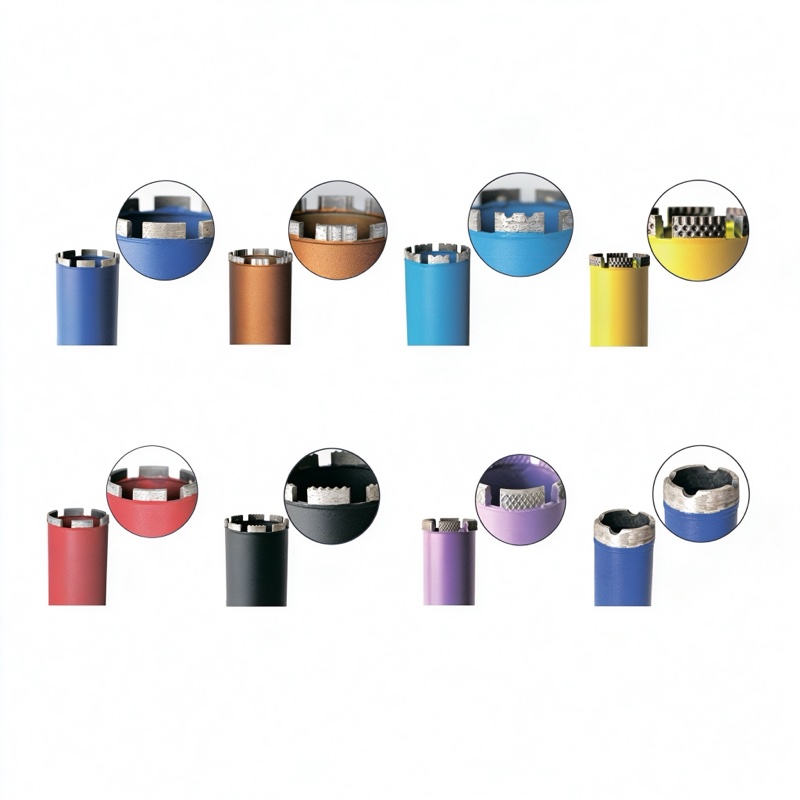
Core bits wander because the sharp diamond rim slides on smooth concrete before it bites. Fix it by drilling a small pilot indent first, starting at a shallow angle to carve a crescent guide groove, using a centering shoe or starter guide, and keeping RPM low until the first 5–10 mm of cut is established. Once the bit is seated, ramp up speed and feed normally.
A new diamond core bit has a perfectly circular rim with fresh, sharp diamonds. On smooth, troweled concrete, that rim acts like a hockey puck on ice — it slides instead of biting. The problem is worse on:
The most reliable fix is a small pilot hole before the core bit. Use a hammer drill with a 10–12 mm masonry bit to make a 15 mm deep indent exactly at the center. The core barrel's inner tongue or a center pin will drop into the indent and lock lateral movement. This is standard practice for any hole over 80 mm diameter.
Without a pilot bit, start the diamond core bit at a 30–45 degree angle to the surface. Let the leading edge of the rim grind a small crescent groove. Once the groove is deep enough to trap the rim (about 5 mm), slowly rotate the drill upright. The groove prevents the bit from skating sideways.
Repeated production holes — for example, conduit penetrations on a facade — justify a centering shoe. A core drill accessory guide clamps to the surface and keeps the barrel concentric for the first 20 mm. It also doubles as a splash collar. For smaller stone work, a stone hole saw with a built-in center pilot is self-centering by design.
Speed matters more at start than during the rest of the hole. Run the drill at half the normal RPM while seating the bit. High speed makes the rim skate; low speed lets the diamonds bite. Do not push hard — let the weight of the rig do the work. Once 10 mm of depth is achieved, the bit cannot wander and you can return to normal speed and feed.
Fresh segments have sharp, protruding diamonds that skate on smooth surfaces. Once you have cut 10 to 15 mm into the concrete, the segment wears to a flat face that grips. This break-in period is normal, but it is also when most wandering happens. Do not fight the bit by forcing it straight — let the crescent groove do the guiding. If you are drilling a production series of identical holes, use a fixed guide jig bolted to the wall: it pays for itself after the third hole. On smooth power-troweled floors, etch the start point with a few light hammer-drill taps before coring. A 10 mm deep rough indent gives the rim something to bite.
A: Usually not. Fresh segments need a wear-in cut. The starter groove method seats the diamonds faster and is the standard workaround.
A: A center punch barely marks concrete. A real 10 mm pilot indent with a hammer drill is far more effective.
A: Yes. A glazed bit slides rather than cuts. Dress the segment on an abrasive block if seating becomes impossible.
A: Start dry (or with very little water) to get bite, then add water once the bit is seated. Flooding at start makes wandering worse.
Wandering is a seating problem, not a bit problem. Spend 30 seconds on a pilot indent or a crescent groove, start slow, and the rest of the hole will go straight. Contact JOY TECH for core bits with sharp, easy-to-seg segments and matching guide accessories.
