Average response time: under 24 hours
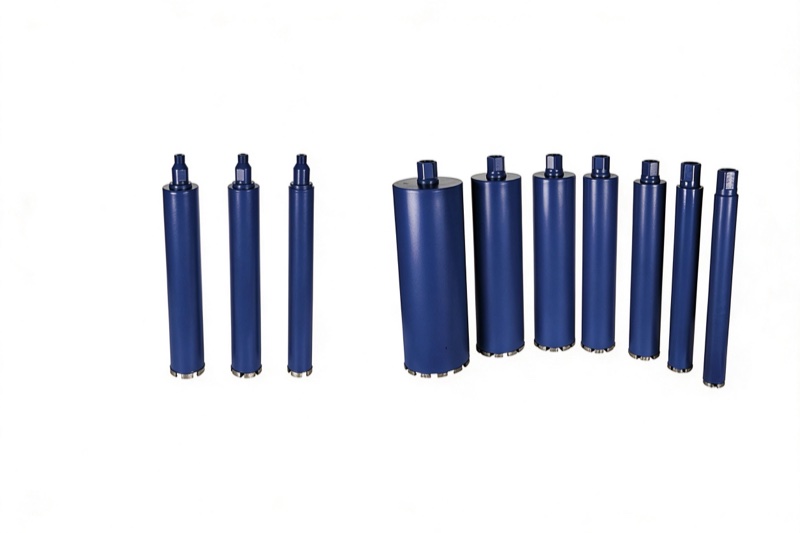
Segments come off a diamond core bit for one of four reasons: no water or not enough water, feed pressure too high, drilling into steel or rebar, or a bond that is too hard for the aggregate. A bit that loses whole segments in one hole is usually cooling failure; a bit that wears unevenly is bond mismatch. Check water flow first, then RPM and feed, then the concrete mix. Most segment loss is avoidable once you match speed, pressure, and bond to the material.
Diagnosis starts with the failure pattern. If you pull the bit out and one or more segments have cleanly sheared at the silver weld, the bit overheated: the brazed joint lost strength at about 600 degrees Celsius. If segments are worn thin on one side but intact, the bit was running off-center or the feed wanders. If segments are polished smooth with no diamond showing, the bond is too hard and the diamonds are not breaking out. Each pattern points to a different fix.
A bit that has lost a segment should not keep drilling. The missing segment leaves a flat spot on the bit's crown that hammers against the hole wall; the next segment on that flat spot takes the shock and fails within a few more holes. Worse, a loose segment spinning inside a 200 mm hole is a safety hazard. Replace the bit or rebuild the crown before continuing.
Wet core bits run on water that both cools the diamonds and flushes cuttings out of the hole. A 100 mm bit needs roughly 3 to 5 liters per minute of water; a 200 mm bit needs 6 to 10 liters per minute. If your rig is fed by a gravity bucket, check the hose: a blocked filter or a kinked line cuts flow by half, and the bit overheats in 30 seconds. You will see the water turn brown to black, which means the bit is already running hot.
Overheating tells on the bit before it tells on the hole. The steel body discolors to a blue or straw tint near the segments; the brazing turns black; the segment tips glaze. If you see this on withdrawal, stop drilling. Let the bit cool in clean water for two minutes before running it again. Always use a JOY DCB-W wet core bit on a rig with proper water feed; dry bits are not meant for continuous wet drilling.
Running a bit too fast overheats the diamonds; running it too slow grinds the bond flat. The industry range is roughly 1500 rpm for a 25 mm bit, 800 rpm for a 100 mm bit, 400 rpm for a 200 mm bit, and 250 rpm for a 300 mm bit. Most rigs have a two-speed gearbox; pick the gear that matches the diameter you are cutting, not the gear that was left from the last job.
Feed pressure should come from the rig weight, not from you leaning on the handle. A 100 mm bit on a rig drilled into a vacuum anchor should self-feed at about 15 to 25 kg of downward force. If you have to push hard, the bit is dull or the bond is wrong. If drilling sounds like screaming metal, back off; that sound is the diamonds overheating.
A bit made for soft concrete will glaze on hard aggregate like granite or flint. The bond does not wear, the diamonds stay buried, and the bit polishes itself smooth. Switch to a softer bond bit for hard mixes, or to a bit with a higher diamond concentration. Conversely, a soft bond on soft concrete wears out in half the holes. Tell your supplier the compressive strength of the slab if you have it; our core bit range covers soft, medium, and hard concrete.
Drilling into rebar is the fastest way to lose a segment. The steel wire grabs the segment and twists it off at the weld. If you hit rebar, slow the RPM by half, feed lighter, and let the bit grind through slowly. For structural drilling where rebar density is unknown, mark the slab with a rebar scanner before drilling. If you must regularly drill through reinforced slabs, use a bit with segmented design rather than a closed-tube bit.
For small holes where water is impractical, a dry bit works if it is designed for it. A JOY DDC dry core bit runs without water but needs short on-off cycles: drill 30 seconds, pull out and let it air-cool for 30 seconds. Never run a wet bit dry, and never run a dry bit wet. Half the segment-loss cases we see are contractors trying to use a wet bit on a site with no water supply.
Next time segments disappear, pull the bit and photograph the crown. Compare: clean sheared segments mean cooling, side wear means alignment, polished tips mean bond mismatch. Fix the water feed first, then the gearbox, then the bond. Bit life on a well-set rig should be 40 to 60 linear meters per wet bit on medium concrete; under 20 meters means something is wrong with your setup, not the bit.
Written and reviewed by JOY TECH — an SGS & BV audited, CE/RoHS certified diamond tools manufacturer founded in 2004, exporting to 50+ countries.
Our factory and QMS are audited by SGS and Bureau Veritas. Products meet CE/RoHS requirements and every piece is 100% inspected before packing.
Verified Certificates
