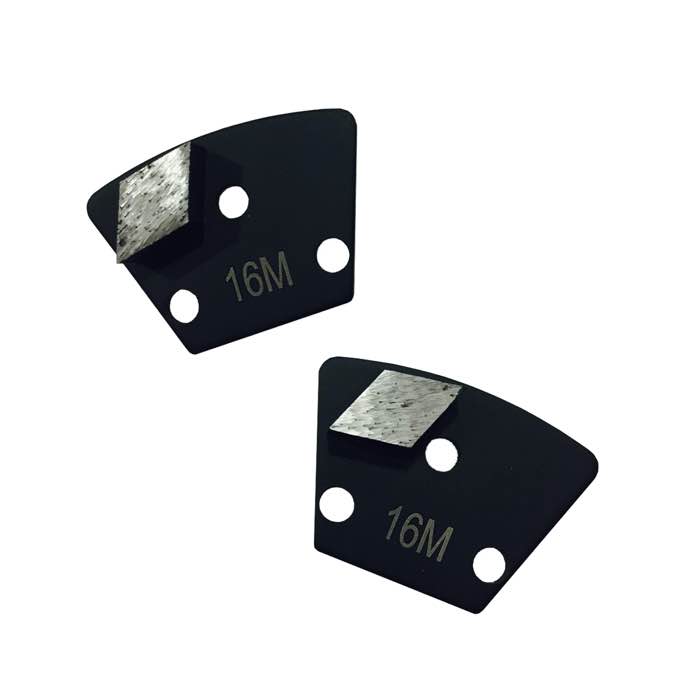
To custom-spec a diamond tool, give the factory five parameters: the exact material you cut (concrete PSI, stone type, abrasiveness), desired cut speed vs tool life trade-off, grit size (30/40 for fast grinding, 80/100 for finishing), bond hardness (soft for hard material, hard for abrasive material), and segment shape/size. With that, a factory can formulate a bond in 2–3 weeks and ship a test sample.
The bond is the metal powder matrix that holds diamond particles. Its job is to wear away just fast enough to expose fresh diamonds as old ones dull. Get the bond wrong and the tool either glazes (too hard) or self-destructs (too soft).
| Material | Recommended bond | Why |
|---|---|---|
| Hard, dense concrete (C40+) | Soft bond | Bond wears fast enough to expose new diamonds |
| Medium concrete (C25–C40) | Medium bond | Balanced life and speed |
| Abrasive concrete / asphalt | Hard bond | Resists fast wear, lasts longer |
| Hard granite | Medium-hard, fine grit | Clean finish, less chipping |
| Soft marble / limestone | Soft bond, fine grit | Polish without scratching |
Grit is the mesh size of the diamond particles. Larger grit (30/40, 40/50) cuts fast but leaves deep scratches. Smaller grit (80/100, 120) finishes smoother but cuts slower.
You do not choose one grit for the whole job — you step down through the sequence. At JOY TECH, our trapezoid grinding discs are available in the full 16–120 grit range for floor grinders.
Diamond concentration is the weight of diamond per segment. Higher concentration = longer life but slower cut and higher price. For custom orders, tell the factory whether you want a "fast-cut economy" bond or a "long-life premium" bond. They will adjust diamond content accordingly.
The factory will respond with a recommended bond code and a sample. Test the sample on your floor, then adjust.
For grinding discs, segment shape changes cutting behavior: arrow segments cut aggressively, double S segments disperse dust, PCD segments strip coatings. For saw blades, segment height and width set life vs speed. Specify the machine adapter (Husqvarna, WerkMaster, Scanmaskin) so the segment bolts on correctly. The same spec approach applies to our diamond saw blades, where segment height and bond set cutting life.
The single best thing you can do for a custom tool is mail a small sample of the material you cut. A 10 cm concrete cube or a thin stone offcut travels by express in a week. The factory can then test bond options on the exact same hardness and aggregate you face, rather than guessing from a description like "medium concrete." This eliminates the two or three trial iterations that usually happen by email. Include details: PSI if known, age of the slab, whether it has steel trowel finish, and what machine you will run the tool on. With that, the first sample the factory ships is usually the right one.
The first custom sample is rarely perfect. If it cuts too slowly, ask for a softer bond. If it wears too fast, ask for a harder bond. Each iteration takes about a week. Plan for two rounds of samples before production. Most buyers get frustrated after one sample and switch factories, but the real differentiator is the factory that listens and adjusts. A good engineer will call you to discuss the test result rather than just shipping another sample blind. That conversation is worth more than the sample itself.
A: 2–3 weeks for a sample, another 3–4 weeks for production after approval.
A: Standard shapes use existing molds. Truly new segment shapes may carry a one-off mold fee of USD 200–500.
A: Yes — ask the factory for two samples with different bonds and run them side by side on the same slab. This is the fastest way to pick.
A: Tell the factory. They will shift to a softer bond. That is normal iteration, not a failure.
Custom diamond tools are not magic — they are a conversation about material, machine, and goal. Give the factory the data, test the sample, and iterate once. Contact JOY TECH to discuss a custom bond for your specific floor or stone.
