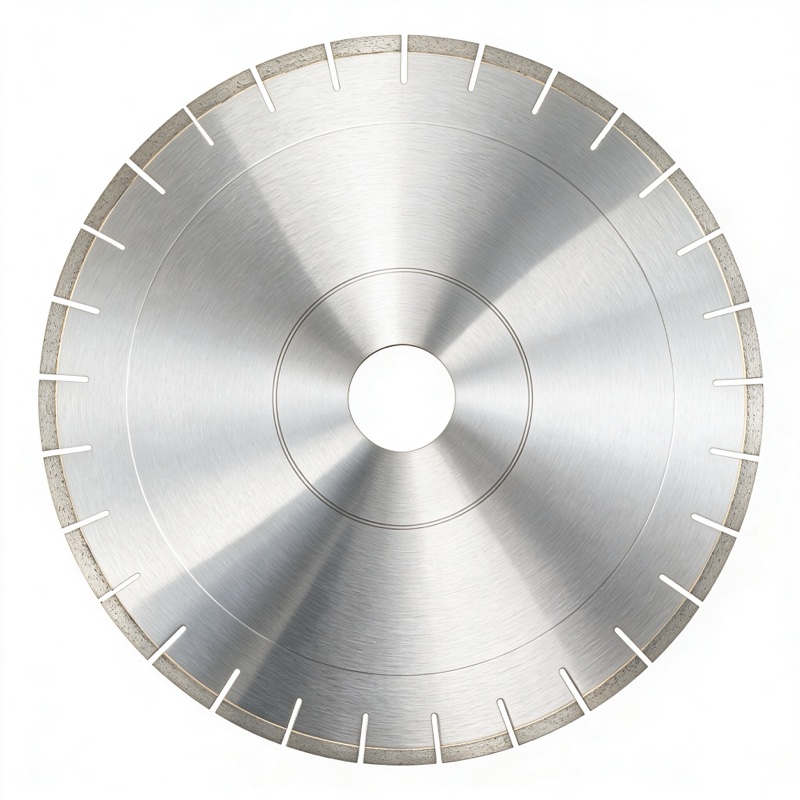
To cut Dekton or other sintered-stone slabs without cracking, use a thin-kerf diamond blade designed for sintered stone, always cut wet, support the slab fully, and feed steadily without stopping mid-cut. Sintered stone is extremely hard and brittle; a generic granite blade will chip, burn, and crack the slab. Our thickened-segment Dekton blade and silent-core Dekton blade are purpose-built for this material.
Dekton, Neolith, and Lapitec are made by ultra-compacting minerals at very high pressure. They are harder than granite but far more brittle. Heat from a dull or mismatched blade causes thermal shock; unsupported overhang causes flex cracks; and a stopped cut creates a stress notch that propagates. The blade must cut cool and fast.
Align the cut, lower the blade at the start edge, and maintain constant forward feed all the way through. For long cuts, support both sides so the slab does not sag. For cutouts (sinks, cooktops), drill a relief hole at each internal corner first to stop crack propagation. Finish visible edges with resin polishing pads after sawing.
Using a granite blade without water is the fastest way to ruin an expensive slab. Cutting too slowly burns the edge; cutting too fast chips it. Forcing the slab by hand on a small angle grinder causes chatter cracks.
Sintered stone slabs flex, and flexing cracks them mid-cut. Always support the slab on sturdy sawhorses across its full length, vacuum-clamp it to the saw bed, and never leave a large overhang hanging free. On long cuts, add a support stand under the offcut so it does not drop and chip the edge as the blade exits.
Cooktop and sink cutouts are the most common failure point. Drill round relief holes at every internal corner before sawing the opening, so stress cannot propagate from a sharp ninety-degree corner. Never stop the blade inside the slab; the restart notch becomes a future crack line.
Too slow burns the edge; too fast chips it. The correct feed produces a steady ribbon of slurry and a clean kerf. If you hear grinding without cutting, the blade is dull or the bond is wrong. Stop and reassess rather than forcing through an expensive slab.
Only a purpose-built thin blade, wet and clamped, handles Dekton without cracking. Do not improvise with a granite blade.
Never stop the blade mid-slab. A restart notch propagates cracks in sintered stone. If you must pause, lift the blade clear before stopping the motor.
Sawn edges on sintered stone need resin polishing pads to restore the finish. After the cut, progress through 50, 100, 200, 400, 800, 1500, and 3000 grit wet, and the edge matches the slab face.
Cut long straight edges first, then cutouts. Never cut a slab freehand on saw horses unsupported. For countertop fabrication, the bridge saw holds the slab rigid; on-site trimming is limited to small adjustments. If a job needs extensive cutting on site, reconsider whether the slab should go back to the shop.
Sintered stone cracks from thermal shock. Abundant water on both sides of the blade is non-negotiable. If water stops, lift the blade clear immediately. Do not restart a hot blade into a cold slab.
On cutouts, drill round relief holes at every internal corner before sawing. Sharp corners concentrate stress and crack sintered stone. Never stop the blade inside the slab; a restart notch propagates cracks.
On long Dekton cuts, have a helper or stand support the offcut so it does not drop and chip the edge as the blade exits. A dropping offcut is the most common cause of a ruined expensive slab at the final moment.
A: Only for small trims; slab fabrication belongs on a bridge saw with water and clamping.
A: Sharp internal corners concentrate stress. Always drill round relief holes at corners before cutting out.
A: On indoor fabrication, the silencing slots reduce noise and vibration that can crack large slabs.
Sintered stone rewards a purpose-built thin blade, wet cooling, rigid support, and uninterrupted feed. Do not improvise with a granite blade. Contact JOY TECH for Dekton and sintered-stone blades in normal, silent-core, and thickened-segment variants.
