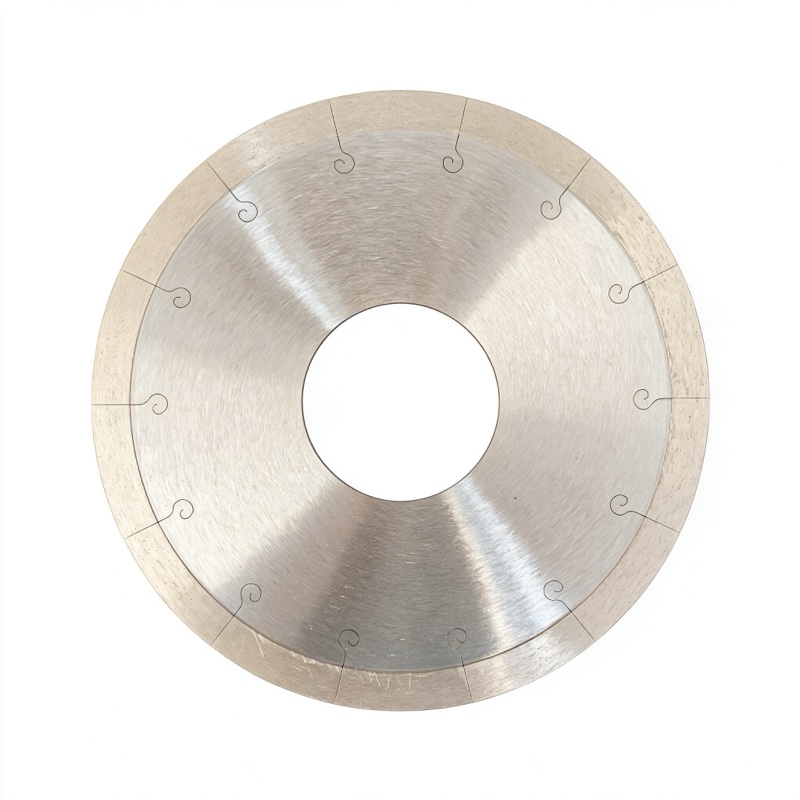
Yes, a thin continuous-rim diamond blade on a wet tile saw can cut glass tile, glass mosaic, and mirror, but a standard segmented or turbo blade will chip and shatter it. Glass must be cut wet, at low speed, with steady feed, and supported firmly. For thick or large mirror, a traditional glass cutter scored and snapped gives cleaner results than sawing.
Glass is brittle and has no tensile strength; any impact or uneven pressure causes cracks that run unpredictably. A coarse segmented blade catches edges and snaps chips out. A fine, continuous diamond rim grinds through rather than chops, and water carries away heat and fine glass slurry. Our nano glass saw blade is designed for ultra-friable glass-like engineered surfaces, and the hot-pressed tile blade works well on glass mosaic.
For mirror, the silver backing must be protected. Mask the cut line with tape, cut with the glass face up, and run the blade at minimum feed. Avoid dry cutting; heat builds in seconds and cracks the sheet.
Straight cuts on flat mirror are faster and cleaner with a hand glass cutter: score firmly, snap over a dowel, and flake the edge. Diamond sawing is reserved for curves, notches, and glass tile where a score-and-snap will not work.
Cutting glass produces micro-shards that embed in skin and eyes. Wear a full face shield, not just safety glasses, and heavy gloves. Wet cutting reduces flying chips but creates slippery slurry, so keep the floor clear. Never let a helper hold a large glass sheet by hand near the blade; support it on the saw table.
Sawn glass edges are sharp and slightly rough. After the cut, deburr the edge with a stone or fine polishing pad before installation. For glass mosaic and tile, this step also removes the crystalline haze that hides the finished surface.
Glass mosaic often has a mesh backing that can melt under friction. Keep cuts wet and short; let the blade breathe between passes. If the backing smokes, you are cutting dry or too fast.
Thin continuous rim, wet, slow. For straight mirror lines, score-and-snap still beats sawing.
A 1-1.2 mm continuous-rim diamond blade on a wet tile saw is the minimum. Do not use a standard stone blade; its coarse grit will chip glass. Feed at about half your normal stone rate, and never twist the sheet. Keep both hands supporting the glass so it does not flex as the blade exits.
Wear a face shield and gloves. Wet glass shards are slippery; lay down a rubber mat. After cutting, deburr edges with a sanding block so the finished mosaic is safe to handle.
Fresh glass edges are razor sharp. Deburr with a fine stone or diamond pad before installation. Wear cut-resistant gloves when handling cut sheets. If a chip appears, stop; it will run across the whole sheet under pressure.
Mirror backing can burn. Mask the cut line, cut face up, and keep the feed slow. For straight mirror cuts, score and snap is cleaner than sawing; reserve sawing for curves and glass tile.
For straight mirror cuts on flat glass, a hand glass cutter scored firmly and snapped over a dowel gives a cleaner edge than sawing. Reserve the diamond blade for curves, notches, and glass mosaic where score-and-snap will not work.
Use the thinnest continuous-rim blade available for glass, about 1 mm thick. A thicker kerf chips more. Run the wet saw at its normal tile speed, never faster, and keep the glass fully supported through the cut.
A: No. Dry grinding heats and shatters glass and throws shards; always wet and use eye/face protection.
A: The thinnest continuous rim available (1-1.2 mm) minimizes chip-out on glass.
A: Thermal stress from dry cutting, or binding pressure. Slow the feed and confirm water flow.
A diamond blade does work on glass and mirror, but only a thin continuous-rim wet blade used gently. For straight mirror cuts, score-and-snap is still king. Contact JOY TECH for thin-rim glass and nano-glass blades for your mosaic and mirror jobs.
