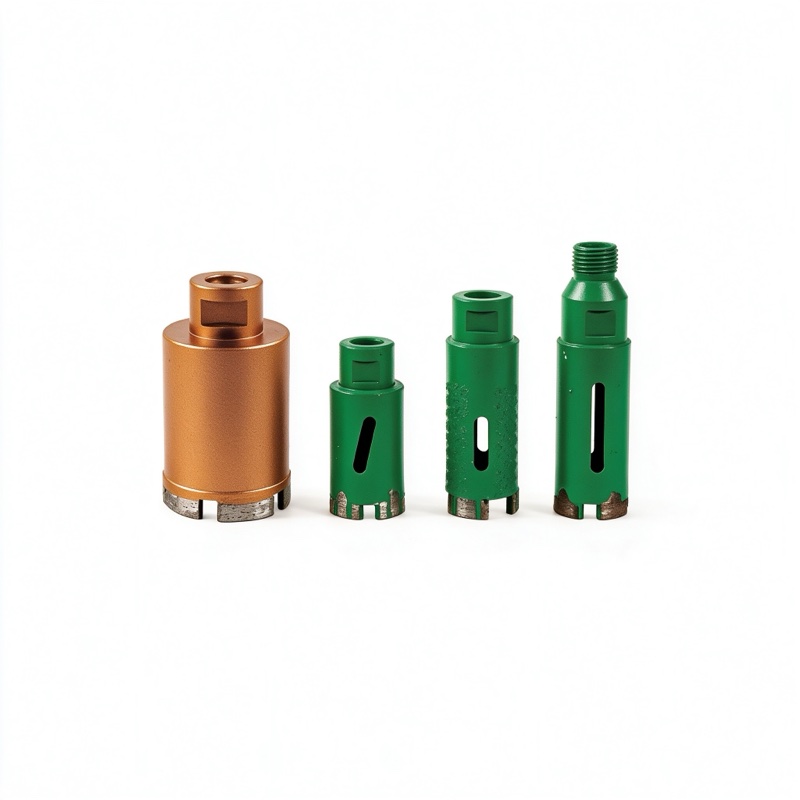
For holes wider than 25 mm in concrete, a diamond core bit outperforms a carbide-tipped hole saw in speed, hole quality, rebar performance, and bit life. Carbide hole saws are cheaper upfront and acceptable for a handful of holes in soft brick or block, but they bog down on reinforced concrete, tear out around the edge, and wear out in minutes. For any real concrete drilling, choose diamond.
A carbide hole saw uses welded tungsten-carbide teeth that chip and tear the surface. A diamond core bit grinds a clean annular cut with industrial diamonds embedded in a metal bond. The result is a round, smooth, crack-free hole with a removable core.
| Factor | Diamond core bit | Carbide hole saw |
|---|---|---|
| Hole quality | Clean cylindrical wall, no spalling | Chipped, ragged edge |
| Cut speed in concrete | Steady, fast after start | Slow, grabs and stalls |
| Rebar | Cuts through steadily | Teeth shatter instantly |
| Bit life | 20–100+ metres of hole | 1–5 holes in concrete |
| Upfront cost | Higher | Low |
| Best diameter | 25–500 mm | 14–65 mm |
Carbide earns its place when:
For stone or tile, a stone hole saw with brazed diamond rim is the middle ground — cheaper than a core bit but far more capable than carbide.
Choose a diamond core drill bit when:
A carbide hole saw might cost USD 15 and die after three concrete holes: USD 5 per hole. A dry diamond core bit at USD 60 may drill 100 holes: USD 0.60 per hole. For a contractor doing service openings every week, the diamond bit pays for itself on the second job.
Diamond core bits need torque, not impact. Use a two-speed drill or a coring rig at 300–1500 RPM depending on diameter. Carbide saws tolerate high speed and hammer mode, but that is exactly what ruins the cut on concrete.
The sticker price on a carbide hole saw looks attractive, but the real number is cost per finished hole. Suppose a carbide saw costs USD 12 and dies after three concrete holes: USD 4 per hole. A USD 45 diamond core bit that makes 100 holes costs USD 0.45 per hole. On a single job of twenty holes, the diamond bit wins by a factor of twenty. Also factor in labor: a carbide saw stalls and binds, slowing your crew. A diamond bit feeds steadily and finishes the hole in half the time. For a contractor doing service openings every week, the diamond bit pays for itself before lunch on the first Tuesday. Buy the cheapest carbide saw only for one-off DIY work.
Once you decide on diamond, pick the segment style. A segmented rim clears chips fast in concrete and block. A turbo rim gives a smoother hole in brick and tile. For reinforced concrete, choose a laser-welded wet bit with medium bond. For cleanout of old openings, a shorter barrel saves weight. Match the thread to your drill: 5/8-11 for angle-grinder-style machines, 1-1/4-7 for larger coring rigs. Adapters exist but add wobble, so buy the thread your machine uses. Keep one spare bit on the truck — running out mid-job costs more than the spare itself.
A: It will cut for a few seconds, then the carbide teeth will shatter on the rebar or coarse aggregate. Use diamond.
A: If you are drilling two or three holes, rent. If you are a tradesperson, buy — the speed and clean holes justify the price in a week.
A: Yes, as long as you switch off hammer mode and have enough torque. Under 80 mm diameter, most 1500 W drills are fine.
Wet diamond coring makes almost no airborne dust. Dry diamond with a shroud is next. Carbide sawing is the dustiest option of all.
Carbide hole saws have a niche in soft materials and one-off jobs, but for concrete — especially reinforced concrete — diamond core bits are the professional standard. Faster, cleaner, and cheaper per hole over a working month. Contact JOY TECH to choose a core bit sized to your drill and your material.
