Average response time: under 24 hours
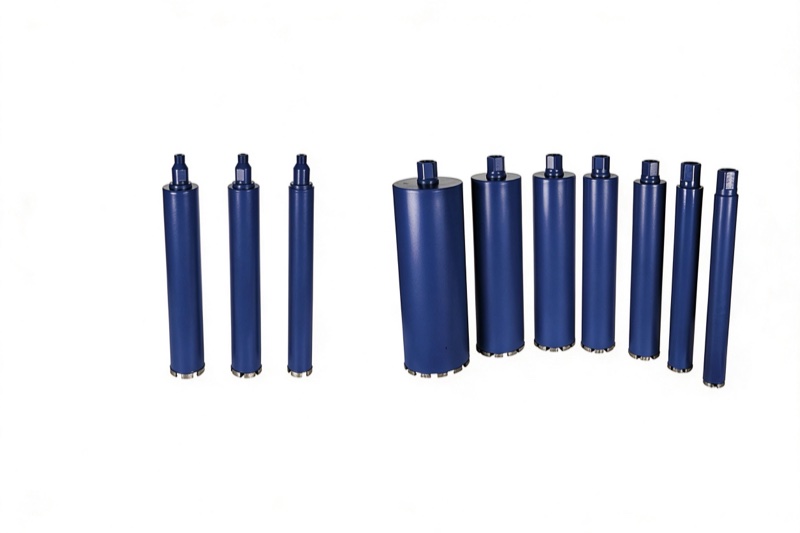
Use a handheld diamond core drill for holes up to about 4 inches (102 mm) in diameter and depths under 12 inches, where portability matters and the cut is shallow. Move to a rig-mounted core drill on a stand or vacuum base once the hole exceeds 4 inches in diameter, goes deeper than 12 inches, must be perfectly perpendicular, or cuts through reinforced concrete. A handheld drill with a wet diamond core bit is fast on small MEP openings, while a rig with a continuous threaded tube core drill holds tolerance on deep structural penetrations.
Handheld core drills weigh 6-10 kg and run on 110V or 220V motors in the 1500-2500 W range. They are the standard tool for electricians and plumbers cutting 25-76 mm holes in block walls for conduits, cables, and small waste pipes. The operator can walk the site, drill at any height, and finish five to ten openings in an hour. The trade-off is control: a handheld bit can walk on smooth surfaces, and the operator absorbs the full torque reaction when the bit breaks through or catches rebar.
Handheld drilling is also limited by diameter. Above 110 mm, the torque required to start the cut becomes dangerous for the wrists and shoulders. Most manufacturers rate handheld rigs for bits up to 102 mm, and even then the operator should wear a torque-reaction clutch and avoid locking the drill against their body. For light work, a general-purpose diamond core bit on a wet handheld rig handles block, brick, and light concrete cleanly.
A core drill stand bolts to the wall or floor with anchor bolts, or sticks to smooth concrete with a vacuum base. The stand locks the drill in a fixed axis, so the hole starts exactly where marked, stays perpendicular, and feeds at a steady rate. That precision matters for structural openings where a pipe or sleeve must pass straight through two walls, or where the opening must match a manufactured flange.
Rigs also change the size envelope. A 3-speed core motor on a stand will drive a 150-350 mm bit through reinforced concrete that would stall a handheld drill. The stand absorbs torque, so the operator only manages feed pressure and water flow. For deep holes, a threaded extension tube lets the drill reach 600 mm, 900 mm, or beyond without remounting the rig.
| Parameter | Handheld | Rig mounted |
|---|---|---|
| Max bit diameter | 102 mm | 350 mm+ |
| Typical depth | 200-300 mm | 500-1000 mm |
| Perpendicularity | Operator dependent | Fixed to ~0.5 deg |
| Rebar cuts | Limited | Full segment core bits |
| Setup time | Minutes | 30-60 min |
Handheld bits are usually shorter barrel lengths (150-300 mm) with a 1-1/4 inch UNC or M14 connection, because the operator carries the weight. Rig-mounted bits run longer barrels, often 450 mm or 600 mm, and use 1-1/4 inch UNC or 1/2 BSP connections rated for higher torque. Segment height also differs: handheld bits favor fast-cutting 10 mm segments for block, while rig bits for reinforced concrete use 12-15 mm segmented crowns that survive rebar hits.
Adapters matter. If you already own a handheld drill and want to mount it on a stand, confirm the spindle thread matches, or use an exchange adapter to marry the motor to the rig column. A mismatched adapter causes wobble, which quickly rounds the hole edge and wears the segments unevenly.
Wet drilling is the default on rigs because the stand holds a water feed hose to the bit spindle. The water lubricates and cools the diamond segments and flushes slurry out of the barrel. On handheld work, a manual water bottle or a water valve adapter on the side handle gives the operator a trigger-controlled flow without needing a hose reel. For indoor finishes where slurry is unacceptable, a dry bit on a vacuum-connected shroud is the alternative, but expect slower penetration and shorter segment life on concrete.
Yes, most 110-220 V core motors have a bolt-on collar that fits a universal stand. Use an exchange adapter if the spindle thread does not match, and check that the stand's feed handle clears the motor housing before drilling.
Practically 102 mm in block or light concrete. Above that, torque reaction becomes a wrist injury risk, and the hole wanders. Move to a stand for anything 125 mm and larger.
Vacuum bases work on smooth, clean concrete floors for small holes. Anchor bolts are required for wall drilling, ceiling drilling, and any hole through reinforced concrete where the rig could twist loose under load.
A premium segmented wet core bit with 12 mm segments typically lasts 30-60 holes in reinforced concrete on a rig, because steady feed and consistent water cooling reduce thermal shock. Handheld bits wear faster because feed pressure varies by operator.
Choose handheld for small, shallow, repeated holes where speed and portability matter; choose a rig once diameter, depth, precision, or rebar load exceeds what an operator can safely hold. Matching the bit length, connection, and segment spec to the rig is what separates a clean core hole from a stalled job.
Written and reviewed by JOY TECH — an SGS & BV audited, CE/RoHS certified diamond tools manufacturer founded in 2004, exporting to 50+ countries.
Our factory and QMS are audited by SGS and Bureau Veritas. Products meet CE/RoHS requirements and every piece is 100% inspected before packing.
Verified Certificates
