Average response time: under 24 hours
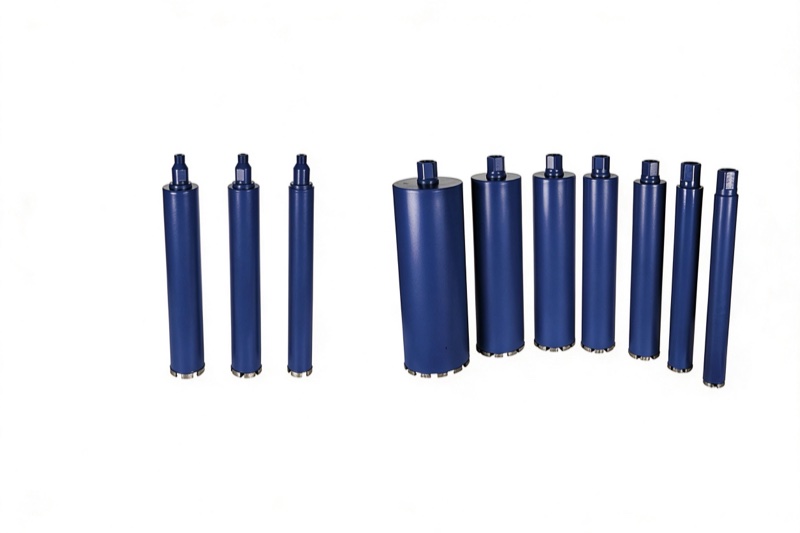
To take an intact concrete test core for compressive or tensile strength testing, use a thin-walled diamond core bit on a rig-mounted wet core drill, running at 500-1000 RPM with steady feed. A thin-walled diamond core bit cuts clean cylinders that labs can saw, cap, and test without micro-cracks from rough drilling. Standard test cores are 100 mm (4 inch) or 150 mm (6 inch) diameter, with a length-to-diameter ratio of 2:1. The bit must not overheat the sample, must not vibrate the core loose, and must leave the cylinder intact for transport.
Concrete test cores are taken from finished structures to verify in-place strength, detect hollow spots, check layer thickness, or investigate deterioration. Lab-cured cylinders give design strength, but field cores tell you what actually poured. Standards like ASTM C42 and BS EN 12504 specify how cores are drilled, extracted, capped, and tested. A core drilled with the wrong bit or wrong technique fails the test, and the project has to re-core, costing days.
Key properties of a good sample: the cylinder must be intact (no cracks from drilling), the end faces must be flat (the lab saws them), and the diameter must be consistent so the test machine can grip it. A bit that wanders, overheats, or chips the edge produces a rejected sample.
The most common test core diameters are 100 mm and 150 mm. The core length is typically twice the diameter (200-300 mm) to meet the L/D ratio required by the testing standard. For thin slabs, smaller diameter cores (50-75 mm) are accepted, but the test result has more scatter.
| Standard | Diameter | Length | Use |
|---|---|---|---|
| ASTM C42 standard | 100 mm | 200 mm | Compressive strength |
| ASTM C42 large | 150 mm | 300 mm | High-strength concrete |
| Thin slab | 50-75 mm | Slab thickness | Topping / overlay |
| Split tension | 100 mm | 200 mm | Indirect tensile strength |
Test-core bits use a thin wall (3-4 mm) to minimize concrete disturbance and to leave the maximum intact cylinder. The segments are medium-bond, so they cut fast without heating the sample. Thick-walled bits used for construction penetrations leave more heat-damaged concrete around the core and produce a rougher cylinder. For sampling, invest in a purpose-built thin-wall test core bit; it pays for itself in fewer rejected samples.
For reinforced concrete, a segmented crown with RC segments handles rebar intersections. A core that cuts through a rebar is still valid for testing, as long as the rebar is noted on the sample log and the lab saws around it. Do not try to drill around rebar; the core will wander.
Mark the core location with spray paint. Anchor the rig to the slab or wall with wedge bolts, and align the spindle perpendicular to the surface. Start at low RPM with light feed until the crown bites. Once the annulus is fully engaged, bring RPM to 600-900 and feed steadily. Keep water flowing; water cools both the bit and the sample, preventing thermal micro-cracks.
When the bit reaches the target depth, stop feeding and let the barrel spin a few seconds to clean the bottom of the core. Withdraw the barrel while still running. The core stays in the barrel; tilt the rig and tap the side with a rubber mallet to slide the cylinder out onto a foam pad. Never pry the core out with a screwdriver; that chips the end and ruins the test.
After coring, the hole in the slab or wall must be patched. Fill the opening with a non-shrink grout or a structural repair mortar matching the concrete strength. On floor slabs, grind the patch flush. Record the core location on the structural drawings so future crews know what is in the slab.
For repeated sampling campaigns, a threaded extension tube lets the rig reach through deeper sections without remounting. A core drill accessory kit with a foam cradle, labeling tags, and a mallet keeps samples organized from slab to lab.
100 mm (4 inch) for most jobs, 150 mm for high-strength or coarse-aggregate concrete. Length is twice the diameter per ASTM C42.
It will cut, but a thin-wall test bit leaves a cleaner cylinder and less heat damage. Labs reject cores with rough edges or micro-cracks from overheating.
Keep drilling. Note the rebar on the sample log; the lab will saw around it. A core with rebar is still valid if the rebar is not in the test zone.
Slide it onto a foam pad, label it, and carry it upright in a rack. Never stack cores or let them bounce in a truck bed.
Test core sampling is a precision wet coring job. Use a thin-wall diamond test bit, anchor the rig, feed steadily, and handle the cylinder gently. The lab gets an intact sample that produces trustworthy strength data.
Written and reviewed by JOY TECH — an SGS & BV audited, CE/RoHS certified diamond tools manufacturer founded in 2004, exporting to 50+ countries.
Our factory and QMS are audited by SGS and Bureau Veritas. Products meet CE/RoHS requirements and every piece is 100% inspected before packing.
Verified Certificates
