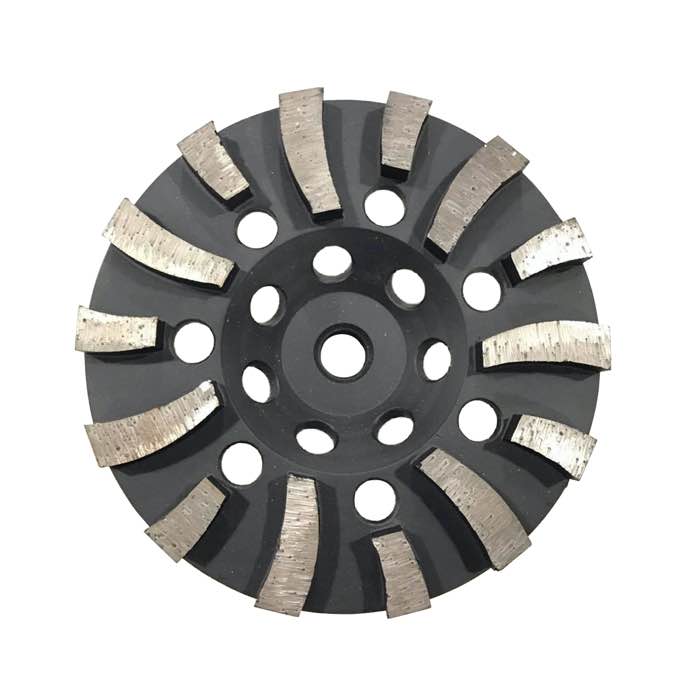
For edge, corner and joint work with an angle grinder, a 4 inch (100 mm) cup wheel is usually the better choice: it is lighter, follows vertical walls and inside corners without catching, and pairs with common 100/115 mm angle grinders running 10,000 to 12,000 RPM. Reserve the 7 inch (180 mm) cup wheel for broad horizontal faces such as slab level-downs, high spots on driveways and thick coating removal where the wider contact ring clears material fast. If most of your work is along walls, around columns or in tight corners, the 4 inch wheel will pay for itself in control and reduced fatigue. For floor-grade stock removal where you need a flat, repeatable scratch pattern, step up to a planetary floor grinder using Diamond Trapezoid Grinding Disc (JOY-TP-R3) rather than a hand cup wheel.
Cup wheel diameter changes three things at once: contact area, surface speed and the reach of the wheel under the guard.
The 100 mm cup wheel is the default for hand grinding crews. It shines on:
Pair it with a 100/115 mm angle grinder rated at or above the wheel's MAX RPM marking, and use a dust shroud if you are working dry. For soft to medium concrete, a standard turbo or segmented cup wheel (similar in bond to Double S Segment Trapezoid Disc (JOY-TP-S2)) stays free-cutting; on hard concrete or exposed aggregate, ask your supplier for a softer bond.
The 180 mm cup wheel is a production tool. It earns its keep when:
Because the 7 inch wheel generates more torque and heat, use a 7/9 inch angle grinder with a side handle, two-handed grip, and a guard set for grinding. Expect faster segment wear on hard concrete; a medium-hard bond is the safe starting point.
| Feature | 4 Inch (100 mm) | 7 Inch (180 mm) |
|---|---|---|
| Typical grinder | 100/115 mm angle grinder | 180/230 mm angle grinder |
| Spindle speed | 10,000–12,000 RPM | 6,500–8,500 RPM |
| Best surface | Edges, corners, verticals | Open horizontal slabs |
| Stock removal rate | Low to medium | High |
| Operator fatigue | Low | High |
| Corner access | Excellent | Poor |
Buyers often size up thinking bigger means faster. On edges and corners, a 7 inch wheel will chatter, gouge and wear unevenly because only a small arc of the ring is cutting. Conversely, using a 4 inch wheel to level an entire garage floor by hand is slow and leaves swirl marks. When the area is open and flat, switch to a planetary grinder with trapezoid tooling such as Double Zigzag Trapezoid Disc (JOY-TP-ZG2) for a flat finish; reserve hand cup wheels for detail work.
A: Only if the grinder's flange, guard and rated RPM are compatible. Most 125 mm grinders are not built for 180 mm wheels, and the guard will not cover the wheel. Do not remove the guard to force a larger wheel on.
A: A PCD (polycrystalline diamond) cup wheel on a 4 or 7 inch angle grinder removes soft coatings far faster than a metal-bond diamond cup wheel. Reserve standard diamond cup wheels for concrete laitance and light coating prep.
A: Hard concrete needs a softer bond so the bond matrix wears and exposes fresh diamonds. If the bond is too hard, the diamonds polish flat and the wheel stops cutting. Ask your supplier to match the bond to the concrete hardness test (Mohs or hammer tap).
A: On medium concrete, expect 20–40 hours of edge work. On hard concrete or thick coatings, drop to 8–15 hours. A wheel that wears in hours is either the wrong bond, running too fast, or being pressed flat on the surface.
Choose the 4 inch cup wheel for hand grinding edges, corners and vertical work where control matters; choose the 7 inch cup wheel for open horizontal stock removal where speed wins. In practice most crews carry both. For any area larger than a doorway, a planetary floor grinder with trapezoid segments like Diamond Trapezoid Grinding Disc (JOY-TP-R3) and Double S Segment Trapezoid Disc (JOY-TP-S2) will outproduce a hand cup wheel and leave a flatter, more consistent scratch pattern ready for coating or polishing.
