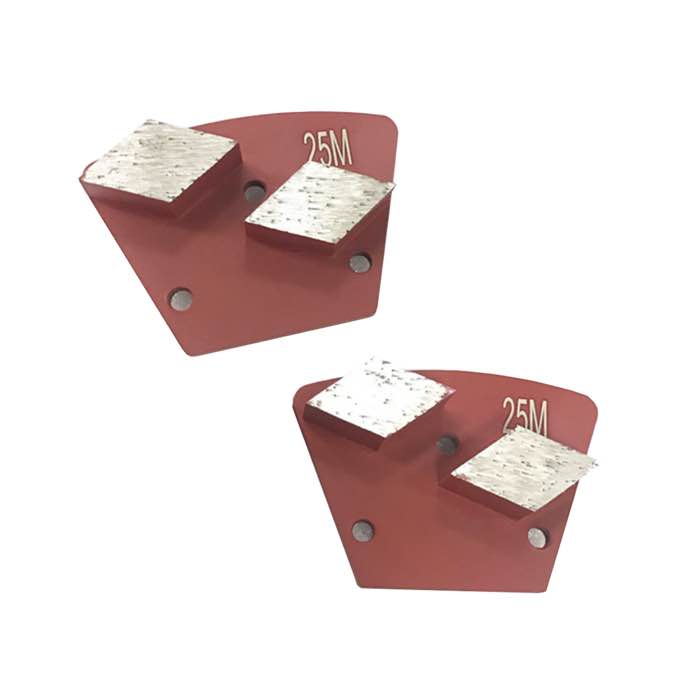
Segment shape changes cut behavior but not the bond or grit. Round segments cut smoothly and leave an even scratch; square (bar) segments bite aggressively for stock removal; arrow or shark-shaped segments evacuate swarf fast and resist loading on soft coatings. For bare concrete prep, round segments are the safest default. For high-spot grinding and coating removal, choose square bar or arrow. The difference in scratch depth between shapes is small at the same grit; the real difference is swarf clearance and edge chipping. Most contractors keep two shoe styles on the truck: round for finishing, arrow/bar for aggressive work.
Round buttons have a circular contact patch. They wear evenly because every edge of the button sees the same load, and they produce a predictable, symmetrical scratch. Round segments are the standard for polishing prep and for crews who want a flat floor with minimal wave. The Diamond Trapezoid Grinding Disc (JOY-TP-R3) three-round-disc shoe is a classic example.
Bar segments are rectangular bars laid across the shoe. Their straight leading edge bites hard into the slab, which makes them the choice for high-spot grinding and first-pass stock removal. The downside is edge chipping: the corners of the bar dig in, which can leave small gouges on soft concrete. The WerkMaster Double Bar Segment (JOY-WMS-B2) double-bar segment is a popular WerkMaster-style choice.
Arrow and shark segments are tapered wedges that push swarf out the side as they cut. This geometry resists loading on mastic, glue, and soft epoxy, and it creates a shearing action that cuts faster than a flat bar. The Double Rhombus Segment Diamond Trapezoid Grinding Disc (JOY-TP-RH2) rhombus shoe is a typical arrow-style design used for mixed coating-and-concrete work.
| Shape | Cut Rate | Finish | Loading Resistance |
|---|---|---|---|
| Round | Medium | Even, smooth | Medium |
| Square bar | High | Coarser, may chip | Lower on soft coatings |
| Arrow / shark | High | Medium | High, good on mastic |
At the same grit, shape has a minor effect on scratch depth; the grit and bond dominate. But shape affects scratch uniformity: round segments produce consistent parallel scratches, while bar segments can leave a slight wave if the machine is operated too fast. For polishing jobs, always finish with round or S-shaped segments.
A: Arrow or bar segments, by roughly 15-20%. But the gap closes once you reach 60 grit and finer, where round segments win on finish.
A: No. Different contact patterns create imbalance and a visibly streaky floor. Use matching shoes all around.
Round segments usually last longest because they wear evenly. Bar segments wear faster at the corners. Arrow segments sit between the two.
S and zigzag shapes are a hybrid: they clear swarf like an arrow but wear like a round button. The Double S Segment Diamond Trapezoid Grinding Disc (JOY-TP-S2) is a common choice for transitional grits between metal and resin bonds.
When switching shapes between passes, always wipe the holder clean; concrete dust trapped under a shoe changes its contact height and creates a scratch ring. Run the machine at the manufacturer's recommended RPM; too fast and round segments glaze, too slow and bar segments overheat. For polished concrete jobs, many crews finish the metal-bond sequence with round segments then move to resin-bond polishing pads, which are always round. Buying shoes in matched sets from one supplier also ensures the bond hardness across shapes stays consistent.
One nuance that shape guides rarely mention is chip load. Arrow segments push swarf sideways, which means they cut best on machines that travel in straight lines. On planetary machines that rotate randomly, the directional advantage fades and round segments often win.
Finally, remember that segment shape is a secondary tuning parameter. Grit, bond, and machine weight matter far more. Do not overthink shape until those three are dialed in for your local concrete.
Choose round for a flat, predictable finish; bar or arrow for aggressive stock removal and coating loading. Match shape to the pass, keep all shoes on a plate identical, and finish every floor with a round or S-segment pass for the cleanest scratch.
