Average response time: under 24 hours
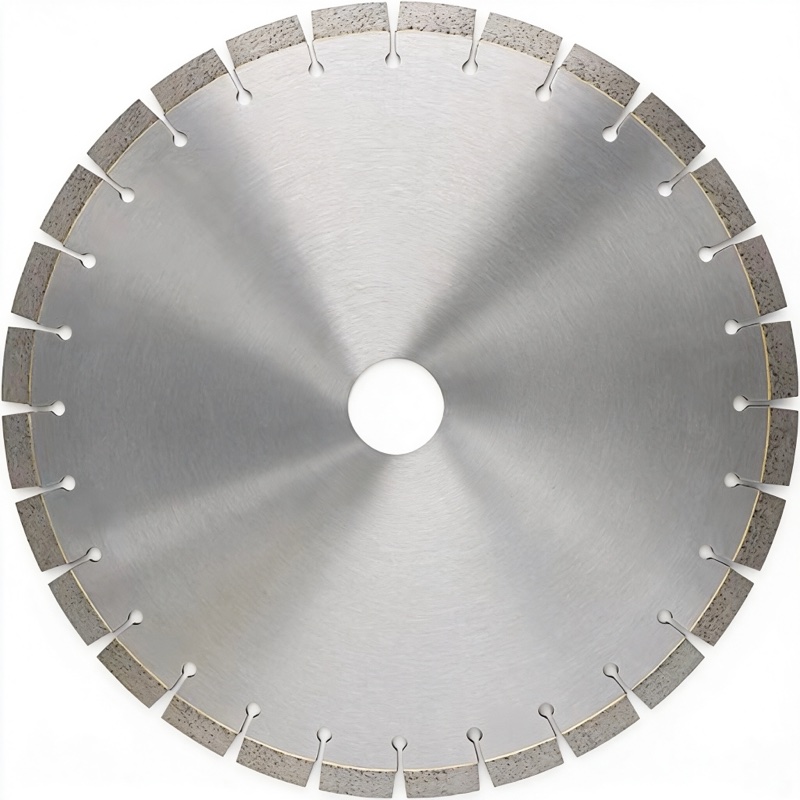
Three numbers decide whether a diamond tool cuts fast or glazes: bond (the metal or resin holding the diamonds — soft for hard material, hard for soft material), grit (the mesh size of the diamond — 16/18 for heavy grinding up to 3000 for polishing), and concentration (how much diamond by volume sits in the bond — typically 25, 35, 50, or 100 in industry-standard designations). A tool with the wrong bond will glaze in 20 m; the wrong grit leaves scratches you cannot remove; the wrong concentration either cuts slowly or wears too fast. If you can read these three numbers on a spec sheet, 80% of tool problems disappear. For our longer version, see bond, grit, and segment glossary.
The bond is the powder-metal mix (cobalt, iron, bronze, tungsten, plus additives) that is sintered around the diamond. The rule of thumb is counter-intuitive:
If you run a hard-bond blade on hard concrete, the bond cannot wear and expose new diamonds — the existing diamonds get blunt, and the tool glazes over with a smooth polished surface. If you run a soft-bond blade on soft abrasive material, the bond wears away before the diamonds are spent and the segment drops off early. Match the bond to the substrate — see soft vs hard concrete bond selection. Blades like the long-segment granite blade are built with a hard bond for dense granite, while asphalt blades use a much softer bond.
Grit is the US mesh size of the diamond grains. Larger number = smaller grain = smoother finish. Typical ranges:
| Grit | Use | Surface |
|---|---|---|
| 16/18 - 30/40 | Heavy grinding, coating removal, lippage | Aggressive, scratches visible |
| 46/50 - 60/80 | Initial concrete grinding, thin-set removal | Medium grind |
| 100/120 - 150 | Refining, preparing for polishing | Fine grind |
| 200 - 400 | Transitional polishing | Beginning gloss |
| 800 - 1500 | Polishing | Distinct gloss |
| 2000 - 3000+ | High-gloss / wet polish | Mirror finish |
You cannot skip grit steps safely: jumping from 30 to 100 leaves deep scratches that the 100 cannot remove. The standard sequence is 30/46/70/120/200/400/800/1500/3000 — see the full grit sequence. Resin pads are labeled with the same numbers; our terrazzo resin pads ship in the standard 50-3000 set.
Concentration is a standardized scale where 100 = 4.4 carats of diamond per cm³ of segment volume. Common values:
Higher concentration is not always better. On soft abrasive material, a high-concentration segment packs diamonds too close together and they cannot fracture cleanly — the tool burns. Match concentration to the job: 50 for general concrete, 75-100 for hard/reinforced, 25-35 for polishing transitions.
When a supplier sends a sheet, look for:
For blade selection in particular, see choosing a blade by segment, bond, and size.
A: No. Higher grit means smaller diamonds — it finishes, it does not remove. You need the full sequence from coarse to fine; a 3000-grit pad on a rough slab does nothing useful. Choose grit by the step, not by quality.
A: A soft-bond tool bites aggressively, produces visible steel fines alongside concrete dust, and wears down segment height noticeably over a job. A hard-bond tool feels smooth, does not bite until it warms up, and can glaze if you push too hard.
A: Because bond selection depends on it. Mohs 3-4 soft concrete needs a hard bond; Mohs 5-6 hard concrete needs a soft bond. Without that answer they can only ship a medium-bond compromise, which works acceptably on average but optimally on nothing.
A: You can, but the scratch pattern carries over. If Brand A's 100-grit leaves a deeper scratch than Brand B's 100, the next step has to do more work. Keep the same brand and the same machine across a job for predictable results.
Bond, grit, and concentration are the three variables behind 90% of diamond tool performance. Once you can read them on a spec sheet, you stop buying "a blade for concrete" and start buying "a soft-bond, concentration-50, 12 mm-segment blade for 40 MPa concrete." That shift is the difference between a tool that lasts 80 m and one that lasts 200 m. Explore our blade range and send us your substrate — we will match the bond, segment, and concentration for your job.
Written and reviewed by JOY TECH — an SGS & BV audited, CE/RoHS certified diamond tools manufacturer founded in 2004, exporting to 50+ countries.
Our factory and QMS are audited by SGS and Bureau Veritas. Products meet CE/RoHS requirements and every piece is 100% inspected before packing.
Verified Certificates
