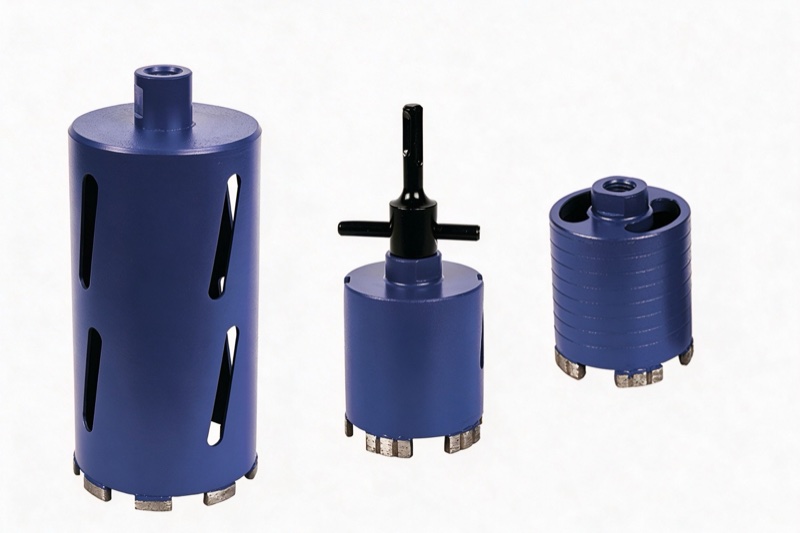
Yes, you can drill concrete without a hammer drill, but the tool choice depends on hole size. For holes up to 12 mm, an SDS-plus rotary hammer is faster and cheaper. For holes 25 mm and larger, a diamond core bit on a regular (non-percussion) drill is actually the better choice: it makes a cleaner round hole, does not crack the slab, and produces far less vibration. Diamond coring is a grinding process, not a percussive one, so it needs no hammer action at all.
An SDS hammer drill breaks concrete by repeatedly punching a tungsten-carbide tipped bit into the surface. It is fast for small anchors but it cracks, chips, and shreds aggregate around the hole. A diamond core bit grinds a continuous ring of concrete with embedded diamond particles, leaving a smooth, cylindrical, crack-free opening.
| Factor | SDS / Percussion bit | Diamond core bit |
|---|---|---|
| Best hole size | < 16 mm | 25–500 mm |
| Action needed | Hammer + rotation | Rotation only, no hammer |
| Wall finish | Rough, spalled | Smooth, cylindrical |
| Rebar | Quickly dulls the tip | Cuts through rebar steadily |
| Dust | Very dusty | Wet drilling = almost dust-free |
If your drill has no hammer mode, do not worry: most wet diamond core bits are designed for rotation-only drills. They work best when:
For shallow work in brick and block, our diamond dry core bit lets you drill without water and without a hammer drill, as long as you use a vacuum extraction shroud.
Do not reach for a diamond core bit for every job. SDS drills remain the right tool when:
Diamond core bits under 25 mm diameter are slow and fragile; for those small holes, a masonry bit on a hammer drill is more economical.
More accessories are listed under core drill accessories, including water valves and extraction adapters that make no-hammer coring practical on a standard drill.
Once you have chosen the right bit, the drill itself matters. A regular drill used for coring must have a torque clutch that slips if the bit grabs, otherwise your wrist will take the twist. Set the gearbox to the low-speed range: high-speed drilling burns diamonds and overheats the segment. Keep the drill aligned with the hole axis — side loading is the number one cause of premature segment loss. If you are drilling above 65 mm diameter, mount the drill on a stand rather than holding it by hand. The stand also lets you feed the bit evenly, which is the single biggest factor in bit life. Finally, always run water for concrete: a dry bit in a reinforced wall will glaze in minutes and the rebar will heat the segment to blue.
A: Under 80 mm diameter, a 1500–2000 W dry or wet drill is fine. Above 100 mm, use a two-speed coring rig with a clutch to avoid kickback.
A: Never. Hammer action will destroy the segment weld and can crack the barrel. Run rotation only.
A: Yes, that is their main advantage. They cut through rebar instead of shattering like carbide bits. Slow down when you feel the feed bite change.
A: For concrete, yes. For brick and block, dry coring with the right bit and vacuum is acceptable.
You do not need a hammer drill to make holes in concrete — for any hole wider than 25 mm, a rotation-only diamond core bit is the more accurate, quieter, and cleaner option. Reserve your SDS drill for small anchor holes. Contact JOY TECH to size a core bit and adapter to your existing drill.
