Average response time: under 24 hours
Wait 28 full days for adhesive or chemical anchors, and at least 7 days for wedge, sleeve, or mechanical anchors, before drilling into new concrete. A 150 mm slab at 20 degrees Celsius reaches about 70 percent of its design strength in 7 days, which is enough for a friction anchor but not for a bonded anchor that needs full concrete strength. Below 10 degrees Celsius, double the wait time. Drilling too early gives you a hole that looks perfect but holds a fraction of the rated load.
Concrete reaches about 16 percent strength in 1 day, 40 percent in 3 days, 65 percent in 7 days, 90 percent in 14 days, and 99 percent at 28 days, all at standard 20 degree Celsius curing. An anchor installed at day 3 has only 40 percent of the concrete's pull-out strength, even if the hole looks clean. Structural engineers size anchors against 28-day strength, so drilling at day 3 is gambling on a 60 percent strength deficit. For anything load-bearing, wait.
Concrete younger than 7 days is still soft at the paste level. A diamond bit or hammer drill cuts the wall but smears cement paste into a smooth layer rather than shearing rough aggregate. That smooth layer has no mechanical grip, so a wedge anchor spins in place when torqued, and an adhesive anchor bonds to weak surface paste that delaminates later.
Adhesive anchors rely on chemical bond between resin, steel, and concrete. They require full 28-day cure before drilling, and the hole must be clean and dry. Installing into a slab that is still curing is the number one cause of adhesive anchor pull-out in field failures. If the project cannot wait, use a mechanical wedge anchor rated for the actual 7-day strength, or set post-installed plates later.
Friction-type anchors only need enough strength to grip without crushing. A wedge anchor in a 7-day-old slab at 20 degrees is usually acceptable for non-structural loads like racking, ductwork, and pipe supports. For structural hold-downs and seismic connections, still wait the full 28 days. Always follow the anchor manufacturer's datasheet; some specify 14 days regardless of anchor type.
Concrete below 10 degrees Celsius cures slowly. A slab poured at 5 degrees may take 60 days to reach 28-day strength. If you must anchor in cold weather, protect the slab with blankets for the first 72 hours, then add days to the anchor wait. As a rule: double the wait time for every 10 degrees below 20. A 7-day wedge anchor wait in 5 degree weather becomes 14 days. Adhesive installers also worry about adhesive cartridge temperature; most epoxies must be above 10 degrees to cure properly.
Hot weather is kinder to strength but harsher to the surface. Slabs below 7 days old can plastic-shrink-crack, and the top paste is dusty even when the body is strong. Brush the hole clean and blow it out; otherwise the adhesive bonds to dust rather than concrete.
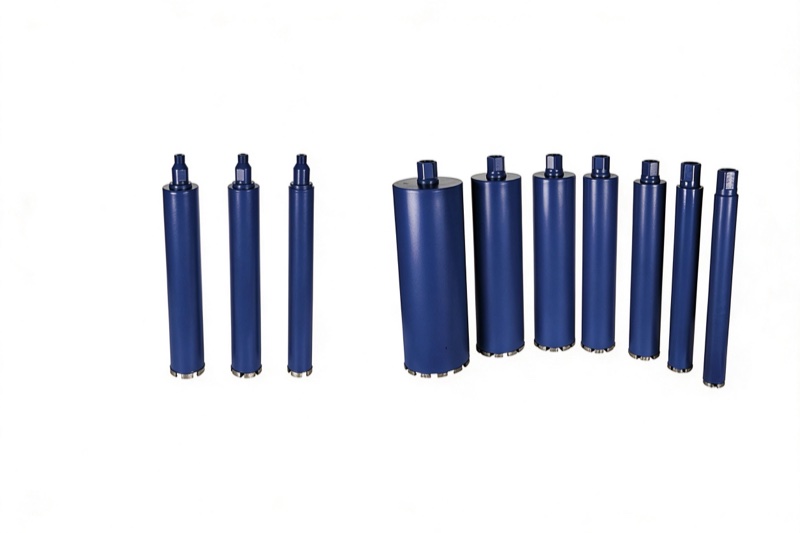
For anchor holes in cured concrete, use a hammer drill with a carbide bit for holes under 20 mm, or a diamond core bit for holes above 20 mm. A diamond-cut hole is rounder and has a rougher wall, which helps both wedge and adhesive anchors. Run a JOY DCB-W wet core bit for holes 25 mm and up; water cooling keeps the bit round and the edge clean. If you cut dry, use a vacuum-equipped hammer drill to control silica dust.
Drill the hole 1.5 times the anchor diameter deeper than the embedment, so dust has somewhere to go. Then clean it in the standard sequence: blow with compressed air, brush with a nylon tube brush, blow again, brush again, blow again. Six cleaning cycles is the industry standard for adhesive anchors; skip two of them and bond strength drops by 30 percent or more. For wedge anchors, three cycles are enough.
Sometimes the construction schedule forces an early anchor. In that case, choose the right tool and the right anchor. Use JOY CDS segmented core bits for clean holes in slabs you cannot wait to cure; the rim cuts rather than smears, leaving a rougher wall that grips better than a hammer-drilled hole in young paste. Pick a wedge or sleeve anchor rather than adhesive, and derate the load to the slab's actual strength at the day you drill. Log the pour date and the drill date on the anchor record.
Every anchor install should carry a record: pour date, drill date, concrete strength at drill day, hole diameter, embedment depth, and cleaning cycles. If an inspector asks why an anchor was drilled at day 9 instead of day 28, the record shows the call was deliberate. For production anchor drilling on a multi-story slab where cure dates differ floor by floor, talk to our team about bit sets and rigs matched to your schedule.
Written and reviewed by JOY TECH — an SGS & BV audited, CE/RoHS certified diamond tools manufacturer founded in 2004, exporting to 50+ countries.
Our factory and QMS are audited by SGS and Bureau Veritas. Products meet CE/RoHS requirements and every piece is 100% inspected before packing.
Verified Certificates
