Average response time: under 24 hours
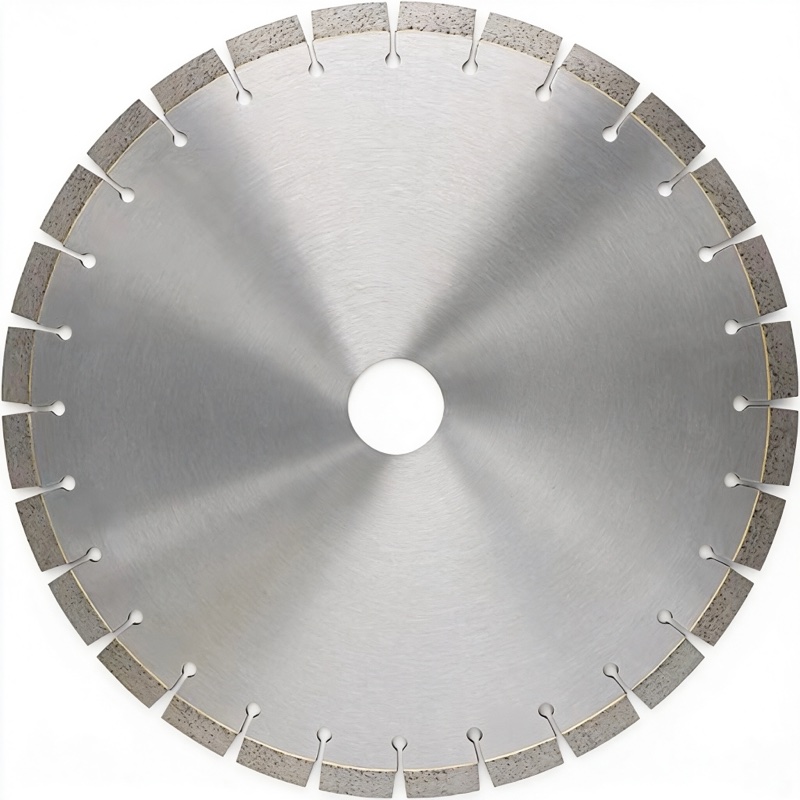
Wet cutting keeps the blade cool, reduces dust by 90 %, and extends segment life 2–3×; use it whenever a water source is available. Dry cutting wins on portability and speed when no water is on site — roads, interior floors, winter jobs, and rooftop work. A blade sold as "dry" can usually cut wet too, but a blade designed only for wet cutting should never be run dry for more than a few minutes, or the segment overheats and loses diamond retention.
Water serves three jobs: it carries heat away from the segment, flushes swarf from the kerf, and traps silica dust before it becomes airborne. On a 350 mm blade running at 5,000 RPM, the segment tip can reach 600 °C dry; water drops that below 200 °C. At those temperatures the metal bond stays hard, diamonds stay locked in, and the cut is clean. The same logic applies to wet core drilling, where flushing also keeps the barrel cool.
Dry blades run hotter, so the bond is formulated to wear faster and expose fresh diamonds as the old ones burn out. Slots, gullets, and segmented rims are wider to let air circulate. Dry-cut blades are also designed with deeper undercut protection so segment loss does not spiral. For tile and stone work, our Arix stone saw blade is sold both wet and dry because the Arix diamond columns handle thermal shock well.
| Situation | Best choice | Why |
|---|---|---|
| Road saw with water tank | Wet | Dust control, 2–3× blade life |
| Interior floor cut, interior demolition | Wet with vacuum | Silica dust regulation |
| Rooftop, no water supply | Dry | Portability first |
| Winter job, freezing temperatures | Dry | Water will freeze in line |
| Cutting marble or soft limestone | Wet | Prevents burning and staining |
| Tile installers on a job site | Dry or wet-adaptable | Small saws, portability |
In the US, EU, and most Gulf states, silica dust exposure is now tightly regulated. Dry cutting without a HEPA vacuum is often prohibited inside occupied buildings. Even when regulation is not the driver, a wet cut produces a slurry that a shop vac picks up in minutes, versus a dust cloud that settles for an hour. For contractors who have to pass OSHA or EU equivalent audits, wet cutting is the default.
Most modern diamond saw blades are marketed as "dry/wet" precisely so buyers do not have to carry two sets. If you run a dry-design blade wet, segment life improves slightly; if you run a wet-only blade dry, watch the smoke. A wet-only blade run dry overheats in 30–60 seconds of continuous cut and the segment blueing is visible. If you see dark edges on the segment, stop, cool the blade, and switch to water-fed operation.
A: Only if the grinder is rated for wet use and you use a residual-current device. Standard angle grinders are not.
A: Slightly, on aggregate — you manage water flow and slurry. But blade life more than compensates.
A: On the same concrete, wet segments typically last 2–3× as long as dry segments.
A: Some laminates and green concrete call for dry cutting to avoid delamination. Otherwise wet is preferred.
Wet cutting is the default when water is available; dry cutting is the practical answer when it is not. Buy dry/wet-rated blades so your crews are not locked into one mode on site, and always match the blade bond to the material. Contact JOY TECH for a blade spec matched to your typical job sites.
Written and reviewed by JOY TECH — an SGS & BV audited, CE/RoHS certified diamond tools manufacturer founded in 2004, exporting to 50+ countries.
Our factory and QMS are audited by SGS and Bureau Veritas. Products meet CE/RoHS requirements and every piece is 100% inspected before packing.
Verified Certificates
