Average response time: under 24 hours
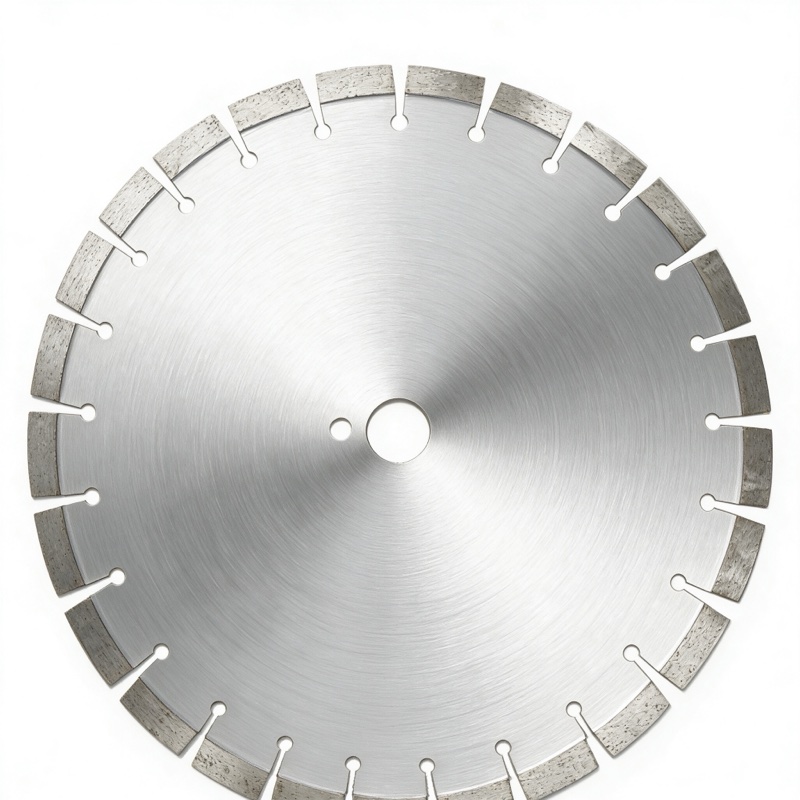
For cutting clean expansion or control joints in a fresh or cured concrete slab, use a laser-welded diamond saw blade such as the concrete-asphalt laser-welded blade on a walk-behind flat saw, or a high-frequency welded blade like the concrete-asphalt HF-welded blade for smaller handheld saws. The joint should be cut to one-quarter of the slab thickness, within 6-18 hours of finishing (fresh-cut) to prevent random cracking. Match the bond to the aggregate — soft-bond blades for hard flint aggregate, hard-bond blades for soft limestone — and run the saw with proper water flow to suppress dust and cool the segments.
Contractors often use the terms interchangeably, but they are different. Control joints are sawed or tooled grooves that force the slab to crack in a straight line rather than randomly; they are cut soon after finishing. Expansion (or isolation) joints are full-depth gaps filled with compressible foamboard that separate slabs from walls, columns or existing pavement; they are usually formed before the pour, not sawed. This article focuses on saw-cut control joints, which is what most B2B customers mean by "expansion joint cutting".
The two blade families you will specify on a BOM are laser-welded and high-frequency welded. Laser-welded blades (segments fused by a laser beam to the steel core) tolerate the highest spindle power and are the default for 350-500 mm walk-behind flat saws on commercial slabs. High-frequency induction-welded blades are a cost-effective choice for 300-350 mm handheld saws and light walk-behind saws on residential or light commercial work. Our full range of diamond saw blades covers both methods.
| Blade family | Typical diameter | Best for | Weld type |
|---|---|---|---|
| Laser-welded general concrete | 350-800 mm | Commercial slabs, fast cut, high HP saws | Laser |
| High-frequency welded | 300-450 mm | Handheld & light walk-behind, budget jobs | Induction HF |
| Arix / ordered-segment | 300-500 mm | Reinforced or abrasive concrete, smooth cut | Laser |
| Asphzalt / green concrete | 350-600 mm | Green sawing, asphalt overlay | Laser |
Concrete is only as consistent as its aggregate. Hard, siliceous aggregates (flint, river gravel, granite) wear the bond fast and need a hard bond that holds the diamond longer. Soft aggregates (limestone, shell, crushed coral) wear the bond slowly and need a soft bond that exposes fresh diamond. Using the wrong bond means either the blade glazes over and stops cutting (soft bond on hard aggregate) or the segments wear out in an hour (hard bond on soft aggregate). Tell your supplier the compressive strength and the aggregate source when you order.
A clean joint starts with a straight line. Snap a chalk line across the slab, lay a straightedge or a cutting guide rail, and set the blade depth to one-quarter of the slab thickness plus 5 mm. Start the saw, lower the blade gently, and walk at a steady pace — do not push the saw into the cut. Water flow should be 4-8 L/min per blade; enough to keep the segment cool and suppress dust, not so much that slurry floods the site. On long runs, rotate the blade direction every other joint to even out wear. If you hit rebar, slow the feed and keep water flowing; do not force through or you will lose a segment.
Cutting too late is the most expensive mistake: if random cracks have already appeared, the joint is decorative, not functional. Cutting too shallow is the second: a joint that is less than ¼ of the slab thickness does not induce the crack and you get a random crack beside the saw line. Spacing joints too wide on a large slab produces curling and reflective cracking. And using a worn-out blade that chatters leaves a ragged joint that will not accept sealant and will deteriorate in one winter.
In warm, dry weather (20-25 °C), cut within 6-12 hours. In cool weather (5-15 °C) you have up to 24-48 hours. If you wait longer than that the concrete will have already cracked on its own; the saw line becomes cosmetic only.
You only cut 50 mm deep (¼ of slab), so a 350 mm blade on a 450 mm flat saw is enough. Reserve 500 mm+ blades for full-depth cuts, demolitions, and pipe trenches.
Yes. Wet cutting controls silica dust and extends blade life dramatically. Dry cutting is permitted only outdoors with a HEPA vacuum attachment on the saw, and is slower and noisier.
Usually the bond is too hard for your aggregate, or the blade is not being fed fast enough. Try cutting a soft abrasive block (a cinder block) for 30 seconds to expose fresh diamond, and confirm the bond spec with your supplier for your aggregate source.
The right saw blade for expansion or control joints is a laser-welded diamond blade sized to your walk-behind saw, bonded to your aggregate, run with water, and cut to one-quarter slab thickness within the right time window. Specify the laser-welded concrete blade for commercial work and the HF-welded blade for smaller handheld saws. A clean, straight, correctly timed joint will keep the slab crack-free for twenty years.
Written and reviewed by JOY TECH — an SGS & BV audited, CE/RoHS certified diamond tools manufacturer founded in 2004, exporting to 50+ countries.
Our factory and QMS are audited by SGS and Bureau Veritas. Products meet CE/RoHS requirements and every piece is 100% inspected before packing.
Verified Certificates
