Average response time: under 24 hours
Grind and seal grinds the concrete once or twice to open the surface, then seals it with a penetrating or topical sealer. Polished concrete grinds through a full metal-bond and resin-bond grit sequence (roughly 30 to 3000 grit) to a dense, reflective floor. Grind and seal is cheaper and faster; polished concrete is more durable, higher-gloss and genuinely maintenance-light. Choose grind and seal for budget garage, warehouse and utility floors; choose polished concrete for showrooms, retail and high-traffic commercial spaces.
A grind-and-seal floor goes through one or two coarse grinding passes — typically 30 to 150 grit metal bond — to open the slab, remove laitance and level trowel marks, and then applies an acrylic, epoxy or polyurethane sealer. The finish is satin to low-gloss. It is sold as resurfaced concrete rather than polished concrete, because the surface is still protected by a film rather than being densified and ground through to a closed surface.
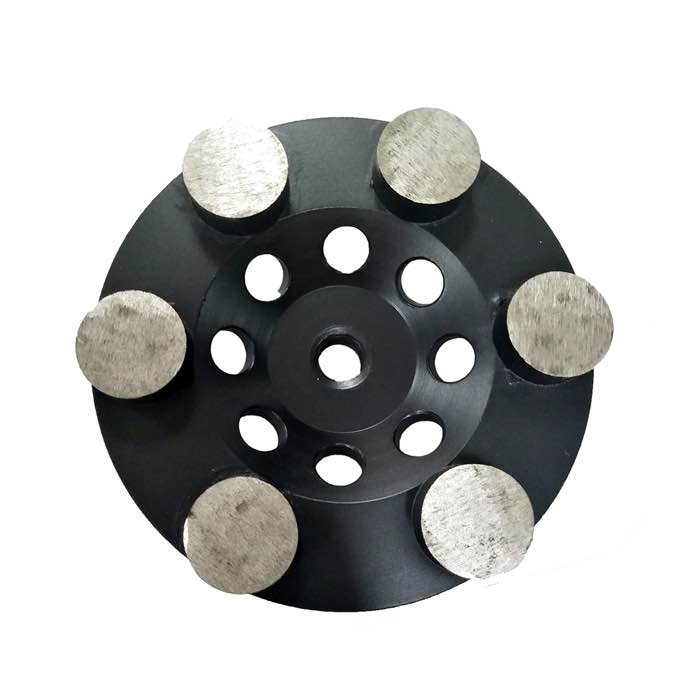
Polished concrete is a true mechanical process: after grinding with metal-bond diamonds through several grits, a chemical densifier is applied to harden the cement paste, and the floor is then ground finer and finer with resin-bond diamonds — often 200, 400, 800, 1500 and 3000 grit. The final surface is the concrete itself, densified and burnished, and carries the gloss of a waxed floor with no film to wear off. Diamond Grinding Cup Wheels with 6 Round Segments (JOY-CW-R6) are typical of the coarse metal-bond tooling used in the opening phase of either process.
| Factor | Grind and Seal | Polished Concrete |
|---|---|---|
| Process | 1–2 grind passes + sealer | Full metal + resin grit sequence + densifier |
| Gloss level | Satin / low gloss | Low to mirror gloss |
| Cost per m² | $15–$35 | $40–$120+ |
| Lifespan | 5–10 years; re-coat the sealer | 20+ years; occasional buffing |
| Maintenance | Re-seal every 2–5 years | Dust mop and burnish |
| Best for | Garages, warehouses, utility floors | Retail, showrooms, offices, food plants |
Specify grind and seal when budget is tight, the floor is functional rather than visible, or the slab has minor trowel marks and laitance to open up. It is also the practical answer for older, uneven slabs where a full polish would expose too much variation. Specify polished concrete when the client wants a decorative, light-reflective floor that competes with epoxy or tile, when trucked traffic and forklifts mean no film can wear off, or when low-maintenance operation is the selling point. Both start with the same coarse diamond grinding — Diamond Trapezoid Grinding Disc (JOY-TP-R3) handles the opening pass on walk-behind grinders — they simply diverge after the sealer step.
A: Yes. Strip the old sealer first with PCD tooling, then run the densifier and resin-grit sequence. Budget for an extra PCD stripping step, which is why many contractors polish from day one on visible floors.
A: The sealer locks surface dust down, but the slab under the film is not densified. Once the film wears or chips, dusting can return. Polished concrete densifies the slab itself, so it stays dust-free for life.
A: Grind and seal can be walked on the next day. Polished concrete takes 3–5 passes and a densifier cure, usually 2–3 days for a medium space, but it never needs re-coating.
Grind and seal and polished concrete are two different products that share the same first step. Choose grind and seal for cost-sensitive utility floors; choose polished concrete for floors that must look good, last for decades and need almost no upkeep. Either way the job lives or dies on the coarse metal-bond tooling that opens the slab cleanly. See our metal-bond grinding discs to tool up for the opening phase.
Written and reviewed by JOY TECH — an SGS & BV audited, CE/RoHS certified diamond tools manufacturer founded in 2004, exporting to 50+ countries.
Our factory and QMS are audited by SGS and Bureau Veritas. Products meet CE/RoHS requirements and every piece is 100% inspected before packing.
Verified Certificates
