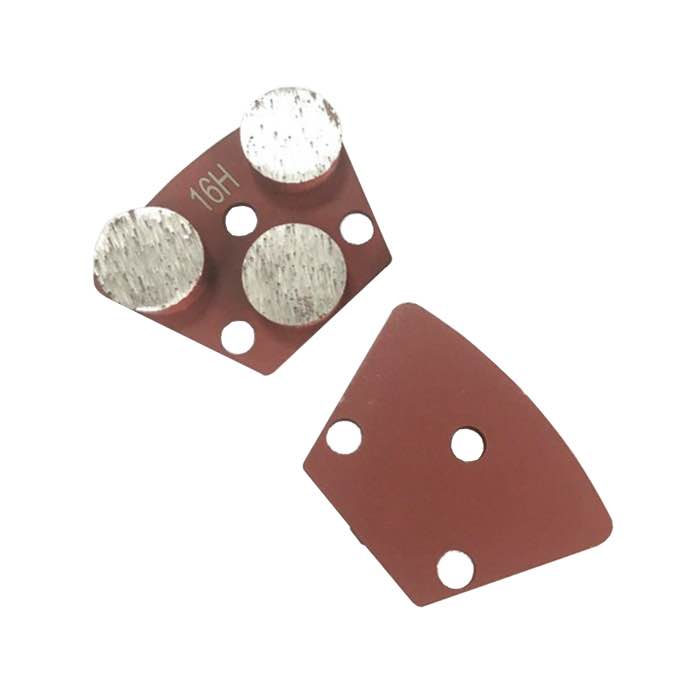
For most interior slabs, wait at least 7 days before light grinding and 28 days before any heavy grinding, polishing or coating prep. The 28-day mark is when concrete reaches roughly 99% of its design compressive strength; grinding before then risks pulling out aggregate, laitance delamination and a weak surface profile. For thin overlays, toppings and repair mortars, follow the manufacturer's cure schedule—often 3–7 days for light grinding but 14+ days before densifier. If you must grind early to open traffic, use a fine-grit, soft-bond metal disc and take very light passes; aggressive tooling such as Double Zigzag Trapezoid Disc (JOY-TP-ZG2) on young concrete will tear the paste rather than cut it.
Fresh concrete is a mix of cement paste, sand and aggregate. In the first week, the cement hydration reaction is still producing calcium silicate hydrate (the glue that holds the slab together). Grinding too early:
| Age | Strength Reached | What You Can Do |
|---|---|---|
| 0–24 h | <5 MPa | Finish, broom, cure cover—no grinding |
| 3 days | ~40% | Light edge cleanup only |
| 7 days | ~70% | Light grinding, slab flattening with fine grit |
| 14 days | ~85% | Standard grinding for coating prep |
| 28 days | ~99% | Full polishing, densifier, heavy stock removal |
These numbers assume normal temperature (20–25°C) and moist curing. In cold weather (<10°C), double the waiting time; in hot, dry, windy conditions, curing membranes or wet burlap are essential before any grinding.
Sometimes the schedule will not wait. Light grinding at day 3–7 is acceptable when:
Use a 120–200 grit soft-bond metal disc or a resin pad on a low-speed planetary grinder. Avoid aggressive PCD or coarse 16/20 grit tooling. A disc like Diamond Trapezoid Grinding Disc (JOY-TP-R3) in a soft bond and fine grit will skim laitance without tearing the paste.
Do not rush these jobs:
Young concrete is soft; mature concrete is hard. Bond selection flips accordingly.
A: Technically yes with a fine soft-bond pad, but you risk pulling laitance and weakening the surface. Better to wait 7 days for light grinding and 28 days for anything that takes off more than 0.2 mm.
A: Press a coin hard across the surface. If it leaves no mark and no powder, the surface is hard enough. Alternatively test with a rebound hammer or consult the concrete supplier's strength data sheet.
A: Yes, rapid-set and repair mortars reach handling strength in hours and full strength in days. Always follow the bag's cure schedule; many are ready for grinding at 24 h and for coating at 3 days.
A: No. Exposed aggregate requires mature paste to hold stones in place. Grind at 7 days at the earliest for a light expose; wait 28 days for a uniform, lasting finish.
Curing time is the cheapest tool you own. Rushing grinding on fresh concrete produces dust, delamination and wasted tooling. Plan for 7 days light and 28 days heavy, match the bond to the concrete age, and use gentle tooling like Diamond Trapezoid Grinding Disc (JOY-TP-R3) and Double Rhombus Trapezoid Disc (JOY-TP-RH2) when the schedule forces early work. The slab will reward you with a flatter, denser and more durable finished floor.
