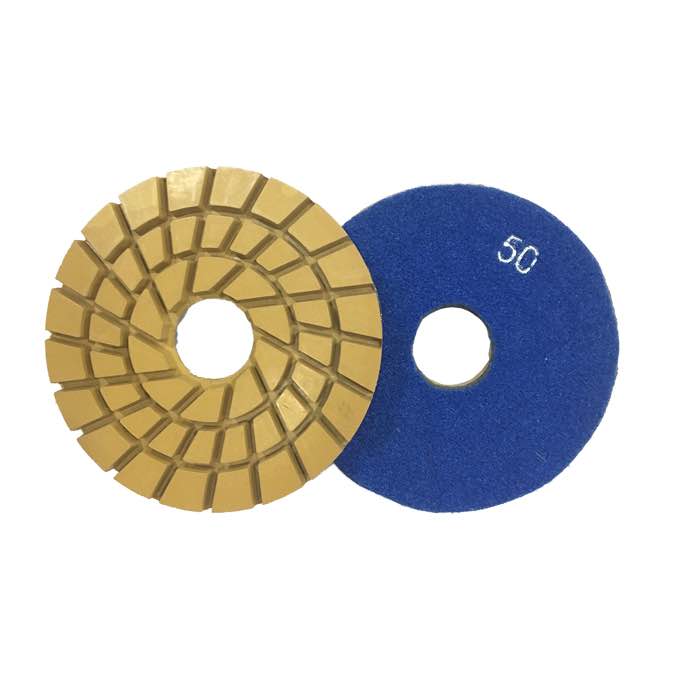
Dry grinding is generally fine outdoors on patios, driveways, and walkways, provided you connect an industrial HEPA dust extractor and accept the larger cleanup. Wet grinding is the better choice when the concrete is hard and abrasive, when you want to extend diamond tool life, or when dust cannot drift onto neighboring properties. There is no universal rule—match the method to the floor and the site: dry for speed and dust collection on open, distant yards; wet for heat control on hard slabs and for jobs in populated areas. Most patio contractors use dry grinding with a vacuum for a quick turn, then wet-polish the final passes if a shine is required. Tools like Diamond Trapezoid Grinding Disc (JOY-TP-R3) and Double S Segment Trapezoid Disc (JOY-TP-S2) work in either mode.
| Factor | Dry grinding | Wet grinding |
|---|---|---|
| Speed | Fast, no slurry | Slower, but cuts cooler |
| Dust | High—needs HEPA vacuum | Near-zero airborne dust |
| Tool life | Shorter on hard concrete (heat) | Longer—water cools segments |
| Cleanup | Bagged dust | Slurry must be contained |
| Best site | Open yards, driveways | Neighborhoods, hard aggregate |
Dry grinding shines when the work area is open, distant from houses, and you have a strong dust extractor. A trapezoid grinding disc with a HEPA vacuum keeps silica dust under control and lets you move fast. This is the default method for residential patios in rural or large-lot settings.
Switch to wet when:
Use a water feed on the grinder, and contain slurry with trenches or absorbent booms. Never let cement slurry wash into storm drains.
For medium slabs where contractors want both dust control and tool life, many run the first passes dry with a vacuum, then switch to wet for the polishing sequence. WerkMaster Single Teardrop Segment (JOY-WMS-D1) teardrop segments are a popular choice for wet outdoor finishing.
Outdoor jobs have variables indoor floors never see. On a sloped patio, dry-grind downhill so dust blows away from the finished area; on a windy day, reposition the vacuum hose and consider wetting the pile area to settle dust. Wet grinding on a slope means slurry runs downhill—dig a small sump at the low end to catch it before it reaches the lawn. Never let wet slurry flow across a neighbor’s driveway; it stains. Check the forecast twice: a surprise shower mid wet job means a mud cleanup, and a gust mid dry job means dust everywhere.
On patios that abut a house, tape plastic over doorways so dry dust does not drift inside. For wet work, set up a small sump pump to route slurry to a waste barrel rather than letting it puddle on the lawn. Both methods leave you with a cleaner site and fewer callbacks from neighbors.
A: No. Crystalline silica dust is a serious health hazard and drifts on wind. Always use a HEPA extractor outdoors, even on open sites.
Not directly, but it keeps diamonds cool and sharp on hard concrete, so the effective cut rate stays consistent longer.
No. Wet concrete is slippery, electric grinders are unsafe, and rain washes slurry everywhere. Wait for dry weather.
Pump it into a settling tank or let it dry, then dispose as construction waste. Never hose it into the street or storm drain.
Outdoor grinding can be dry or wet: choose dry for fast, open-yard work with a HEPA vacuum, and wet for hard slabs, dust-sensitive neighborhoods, or high-gloss finishes. Either way, control dust or slurry, watch the weather, and use ground-fault protection when water meets electricity.
