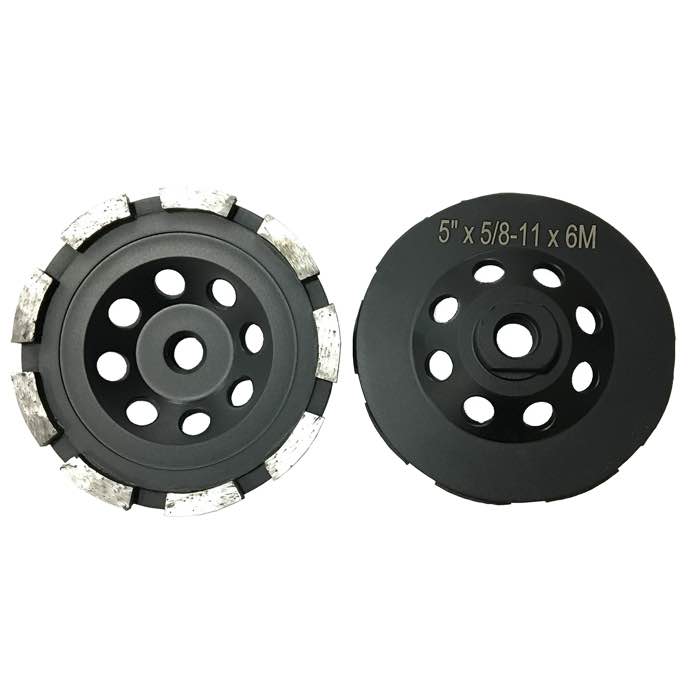
Yes, you can grind quartz or granite floors with diamond tools, but not with the same soft-bond discs used on concrete. Stone is hard and non-abrasive, so you need a harder metal bond that holds diamonds longer. Start at 30/60 grit metal, then resin pads through 500-3000 grit. Use wet grinding for granite and engineered quartz to cool the tooling and control dust.
Concrete is abrasive: it wears the bond and exposes new diamonds. Granite and quartz are hard and relatively non-abrasive, so a soft concrete bond wears away before new diamonds emerge — the disc glazes. A hard bond holds diamonds longer and is matched to the stone. If you use a concrete disc on granite, it will stop cutting within minutes.
| Step | Bond / grit | Note |
|---|---|---|
| Initial leveling | Hard metal 30/60 | Wet recommended |
| Refining | Metal/resin 120-200 | Remove deep scratches |
| Polishing | Resin 300-1500-3000 | Wet pads for gloss |
For countertop or edge work, use a cup wheel tuned for stone, such as a rhombus-segment cup wheel on an angle grinder. For floors, a hard-bond trapezoid disc matched to your plate system gives predictable life.
Wet grinding is standard for granite and engineered quartz. Water cools the diamonds, prevents glazing, suppresses dust, and brings out the polish. Dry polishing is possible on quartzite but risks heat cracks on sensitive materials. Always check the slab — some engineered stones can thermally shock.
Concrete discs are soft-bonded to wear fast on abrasive cement. On hard, non-abrasive granite, that soft bond erodes before the diamond dulls, or worse, the diamonds wear smooth without new ones exposing — the disc glazes. Stone tooling uses a hard bond that holds diamonds longer. If you try a concrete disc on granite, expect minutes of cutting followed by a shiny wheel.
Wet stone polishing uses 3-4 inch resin pads on a backing holder, worked 50 → 3000 grit under a constant water trickle. Keep the surface wet throughout; dry stone polishing burns the resin. After 1500 grit, dry the surface and inspect for scratches before moving to 3000. Rinse slurry away promptly — dried stone slurry is hard to remove.
Engineered quartz contains resin and can heat-crack or discolor. Use moderate pressure, keep water flowing, and avoid prolonged dwell. Marble and terrazzo are softer — switch to a softer bond and finer grits, and never use aggressive metal discs designed for granite on marble.
For stone floors, run 50, 100, 200 metal or hybrid, then 400, 800, 1500, 3000 resin wet. Do not skip. Between grits, rinse the slurry. Stone shows scratches dramatically — raking light inspection is essential.
Granite needs a penetrating sealer to resist stains. Marble is acidic-sensitive — avoid vinegar cleaners. Terrazzo with epoxy matrix can heat-crack; keep water flowing during polishing.
Older terrazzo or granite floors can be restored the same way: grind off scratches, densify or seal, polish to gloss. The process is nearly identical to concrete, with harder tooling. Test a hidden corner first — old stone may be filled and stain unexpectedly.
Before committing tooling to a stone floor, grind a hidden patch. Note how fast the disc cuts and whether it glazes. If it stops cutting in ten minutes, switch to a harder bond. Stone tooling is bond-specific; what works on granite may not work on engineered quartz. Buy a small sample set first.
Wet stone grinding needs a steady but not flooding water feed. Too much water washes away the cutting action; too little heats the diamond. Aim for a wet slurry, not a pool. Have a wet/dry vac ready.
A: Yes, but swap to hard-bond stone discs. Concrete discs glaze instantly.
A: Resin pads work for both, but stone pads are often formulated for wet use and higher gloss.
A: Yes, with wet diamond pads on a backing holder, worked from 50 to 3000 grit.
A: The bond is too soft — it is wearing before diamonds break out. Switch to a hard bond for stone.
Stone grinding is a bond-selection game: hard bonds for hard stone, wet cooling, and a full resin polish. Contact JOY TECH for hard-bond discs and stone polishing pads matched to granite or quartz.
