Average response time: under 24 hours
Before you pour self-leveler or a tile bed, grind down any high spots on the slab so the peak is within 3 mm of the target elevation. Use a walk-behind grinder with a 30/40 grit diamond disc, take 0.3 mm to 0.5 mm per pass, and feather the edges of each high spot so the transition blends into the surrounding slab. Mark the high spots with a 3 m straightedge and a felt marker, then grind in overlapping passes until the straightedge rocks no more. Do not try to grind down more than 1 mm in one pass; you will glaze the tooling and overheat the motor.
Self-leveling compound will flow over low spots, but it cannot fill a high spot on its own. If you pour leveler over a peak, the compound builds up on the sides and leaves a thin, weak spot right over the high point. That thin spot cracks under traffic, shows through tile, and telegraphs through finish coatings. The fix is to grind the peak down first so the leveler has a uniform depth across the whole floor.
Use a 2 m or 3 m straightedge on the dry slab and slide it around in a grid pattern. Mark any spot where the straightedge rocks or wobbles with a felt marker. A laser level gives you a more complete picture, showing elevation across the whole room in a single sweep. Typical high spots on a garage or warehouse slab run from 2 mm to 8 mm above the surrounding floor; on a badly finished slab you may see 10 mm or more.
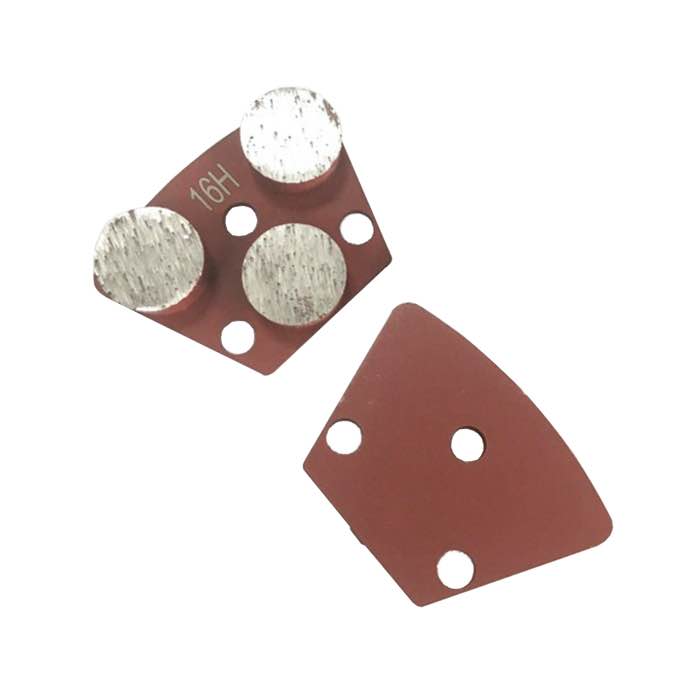
Use a coarse metal-bond diamond disc, usually 30/40 grit, for the bulk of the removal. The JOY TP-R3 triple-round-segment trapezoid disc is built for aggressive stock removal on hard concrete and will chew through a 5 mm peak in a few passes without loading up. Finer tooling will glaze on a high spot and take forever; start coarse, then step down.
For high spots that sit next to a wall, under a pipe, or in a corner that the walk-behind cannot reach, switch to a handheld angle grinder with a double-row diamond cup wheel. The JOY CW-DR double-row cup wheel removes material fast on edges and around openings, but be careful not to dig in: a cup wheel will leave a swirl mark if you hold it in one spot.
Aim to bring the high spot down to within 1 mm of the target; self-leveler will handle the last small gap. If the high spot is more than 5 mm, plan on two or three grinding sessions rather than one long pass. Overloading the grinder loads the diamonds, burns the bond, and leaves a glazed surface that leveler will not stick to. Step grit stages from coarse to fine as the surface comes down, and do not jump more than one grit number at a time.
Grinding high spots throws a lot of fine dust, even before you reach the finishing stages. Run the walk-behind grinder connected to a HEPA vacuum rated at 300 CFM or more, and keep the vacuum hood skirt in good condition. A torn skirt lets the dust plume escape at the back of the grinder and turns the whole room into a silica exposure zone. On handheld work, use a dust shroud on the angle grinder and connect it to a 150 CFM extractor. Do not blow the dust off the slab with compressed air; that re-suspends it and undoes all the vacuum work.
High spots on a slab usually show up after you roll out a self-leveling plan, a tile layout, or a coating schedule. Run a 3 m straightedge across the floor in a grid pattern and mark every wobble with a felt pen. Plan on grinding the marked spots down before any coating goes down, because leveler and tile will follow the contour rather than flatten it. The time spent on a grinder now saves days of patching and grinding later once the finish is in place.
If you are working on a large slab or a hard mix that glazes standard tooling, talk to the supplier before you mobilize. The team at JOY TECH support can recommend the right grit and bond for your concrete hardness and the expected depth of cut.
Written and reviewed by JOY TECH — an SGS & BV audited, CE/RoHS certified diamond tools manufacturer founded in 2004, exporting to 50+ countries.
Our factory and QMS are audited by SGS and Bureau Veritas. Products meet CE/RoHS requirements and every piece is 100% inspected before packing.
Verified Certificates
