Average response time: under 24 hours
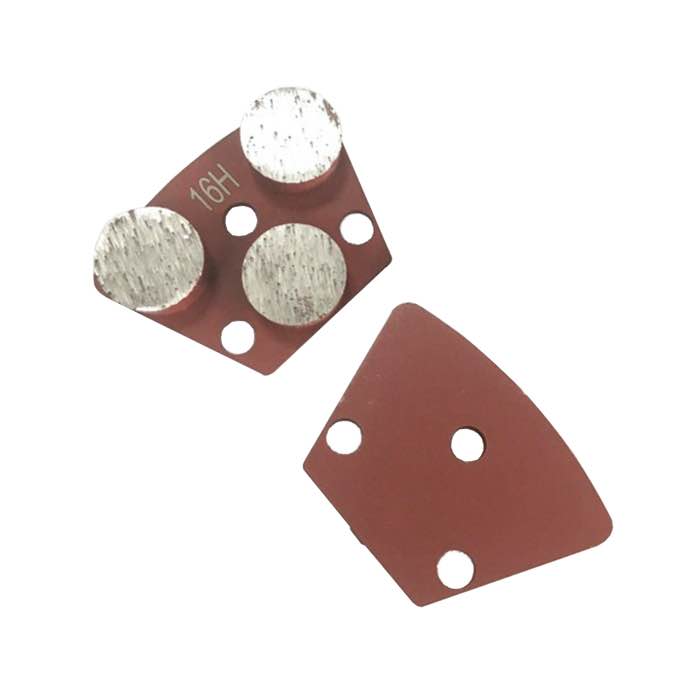
Use a soft-bond grinding shoe on hard concrete and a hard-bond shoe on soft concrete. This is the "opposites attract" rule: a soft bond wears faster and keeps exposing fresh diamonds to cut dense, high-PSI slabs, while a hard bond resists the abrasive pull of soft concrete so the shoe does not disappear in minutes. Match the bond first, then the grit, and your shoes will cut fast and last a full job.
Every diamond grinding shoe holds diamonds in a metal matrix called the bond. The bond's hardness controls how quickly the matrix erodes and releases dulled diamonds:
Choosing by grit alone is the most common mistake. A 30-grit shoe in the wrong bond either glazes over (bond too hard) or burns out in one pass (bond too soft).
| Test | What to look for | Likely bond |
|---|---|---|
| PSI rating (from mix design or MoH test) | Above ~4,500 PSI | Soft bond |
| Scratch test with a nail or coin | Hard, no visible scratch | Soft bond |
| Chalky, dusty, crumbly surface | Low density, weak surface | Hard bond |
| Fresh pour (under 28 days) | Still releasing water | Hard bond |
When in doubt, run one shoe in soft and one in hard bond on a small test area and compare cut speed and wear. The shoe that cuts steadily without glazing is the right one.
Bond is the matrix; segment shape is the cutting profile. Triple-round trapezoid shoes (JOY-TP-R3) suit general prep on medium concrete, while single-rhombus shoes (JOY-TP-RH1) cut aggressively on hard slabs. Double-round and double-S profiles (JOY-TP-S2) give a flatter finish for the transition passes. Buy the bond that matches your concrete and the shape that matches your machine head.
Stay within the same bond family for the metal steps, then move to resin pads for the finish. Mixed-bond sequences cause uneven cut and visible color differences in the final floor.
A: If the shoe glazes — smooth, shiny, stops cutting — the bond is too hard. If it wears down rapidly with little cut, the bond is too soft for that concrete.
A: Not for long. On soft concrete a soft bond erodes fast and the shoe rounds off within a few hundred square meters. Switch to a hard-bond shoe for that slab.
A: Medium bond in 30/60 grit covers the widest range of rental jobs; add soft-bond coarse shoes for contractors who report hard, high-PSI floors.
A: Only slightly. Higher RPM generates more heat and wear, so lean one step softer on hard concrete with a high-speed planetary machine.
Bond first, grit second: soft bond for hard concrete, hard bond for soft concrete, and medium as your everyday default. Test a small area when the slab is unfamiliar, keep the metal sequence in one bond family, and finish with resin pads. Browse the JOY-TP trapezoid shoe range and order the bond your concrete needs.
Escrito y revisado por JOY TECH — fabricante de herramientas de diamante auditado por SGS y BV, certificado CE/RoHS, fundado en 2004 y con exportaciones a más de 50 países.
Nuestra fábrica y sistema de gestión de calidad son auditados por SGS y Bureau Veritas. Los productos cumplen CE/RoHS y cada pieza se inspecciona al 100 % antes del embalaje.
Certificados verificados
