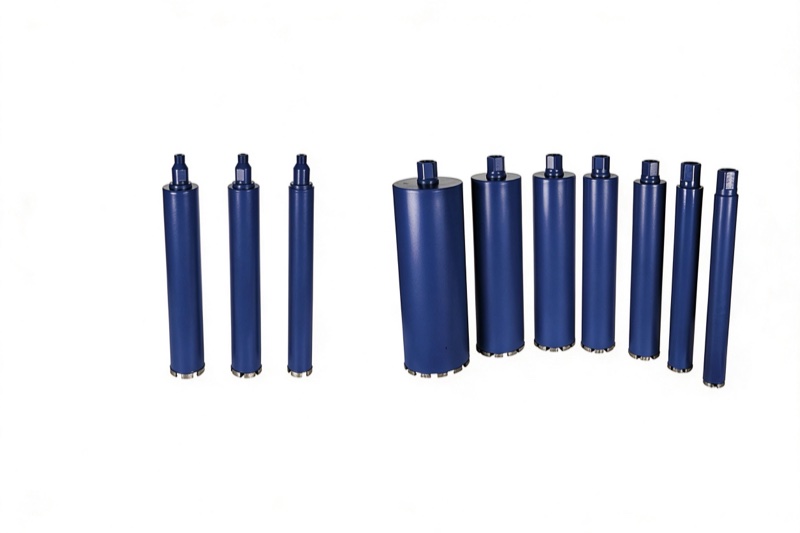
A standard diamond core drill bit with a 14"/350 mm barrel drills up to about 16 in (400 mm) of concrete in one pass. Deeper holes are made by screving extension rods onto the barrel, and rig-mounted coring sets routinely drill 1–3 m deep holes. The limiting factor is not the diamond segment life but bit wander, wobble, and the ability to flush cuttings out of the hole.
Diamond core barrels are made in a few fixed lengths to match common wall, floor, and slab thicknesses. Choosing the right barrel the first time avoids buying extensions you do not need.
| Barrel length | Typical use | Max practical depth |
|---|---|---|
| 6 in / 150 mm | Hollow block, tile, thin wall | 150 mm |
| 10 in / 250 mm | Interior partition walls | 250 mm |
| 14 in / 350–450 mm | Standard cast-in-place walls | 400 mm |
| 18–24 in / 450–600 mm | Thick walls, raft slabs | 600 mm |
Most contractors stock the 14 in barrel because it covers the majority of HVAC, plumbing, and electrical openings in residential and light commercial concrete. Browse our full range of diamond core drill bits to compare barrel lengths and diameters.
Once the required depth exceeds the barrel length, you screw extension rods between the bit and the drill. Continuous threaded tube drills and extension couplings let you stack 300 mm, 450 mm, or 1 m sections until you reach the target depth. Typical deep-hole combinations are:
Each extension adds a coupling joint. Long assemblies wobble, so reduce feed pressure and keep RPM low as depth grows.
The diamond segment itself will usually outlast a single deep hole. The real limits are:
Contractors often buy a barrel that is too short and end up wishing they had gone one size up. As a rule, add 50 mm to the wall thickness you expect to drill: that extra length gives you room to start the hole, punch through the far face, and still pull the barrel out cleanly. For a 200 mm concrete wall, a 300 mm barrel is comfortable; for a 250 mm wall, go to a 450 mm barrel. If you regularly drill both 200 mm and 400 mm walls, buy the longer barrel and a 200 mm extension rather than two dedicated barrels. The extension costs less than a second long barrel and stores flatter in the truck. On very deep holes, also confirm that your drill motor has enough torque at the reduced RPM needed for large diameters. A 250 mm hole at 500 mm depth will stall a light 1500 W drill; step up to a 3000 W rig for anything that big.
A: Technically yes, but most hand-held rigs top out around 600 mm barrels because of weight. Beyond that, extension rods are cheaper and more manageable.
A: Not directly, but poor flushing and overheating at depth will glaze the segment. Good water flow protects your investment.
A: Holes above 150 mm diameter deeper than 1 m should be rig-mounted. Hand-held drilling above 110 mm diameter is both unsafe and inaccurate.
A: No. Dry bits are for shallow masonry and blockwork only. Deep concrete holes must be wet drilled to cool the segment.
A single diamond core bit handles roughly 400 mm of concrete; beyond that, extension rods multiply the depth while a drill stand and steady water supply keep the hole straight and cool. Match your barrel length to the wall thickness you usually cut, and keep one extension rod on the truck for the unexpected deep job. Contact JOY TECH for a quote on core bits, extension rods, and wet drilling accessories sized to your rig.
