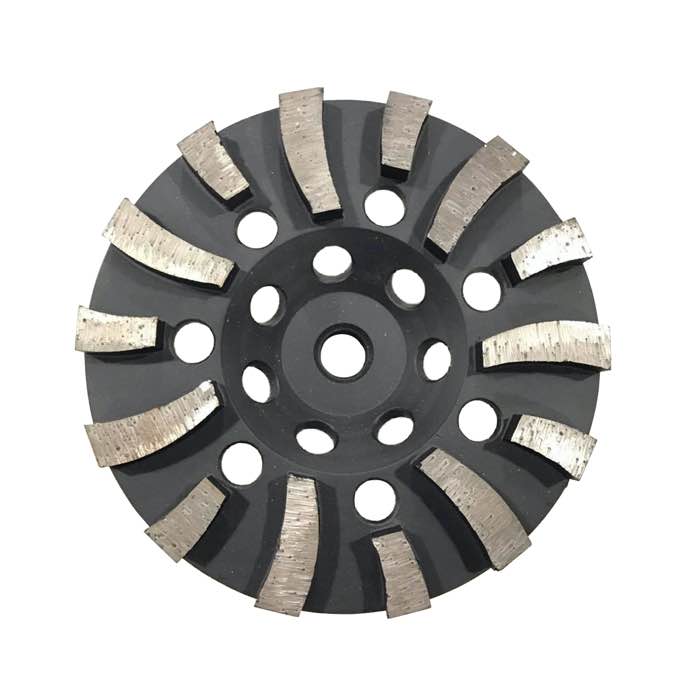
A 600-800 mm walk-behind grinder grinds a bare, flat concrete floor at roughly 15-35 m² per hour for one coarse pass, depending on machine weight and disc. A full grind-and-polish job (multiple grit steps) averages 5-15 m² per hour all-in for a single operator. To estimate 100 m², budget about 8-16 working hours including edges, not counting coating removal or repairs.
| Machine / step | Approx. rate (m²/hr) |
|---|---|
| Single-disc grinder, coarse metal pass | 15-30 |
| Planetary grinder, coarse pass | 40-70 |
| Planetary, intermediate resin passes | 50-100 |
| Edging by hand (perimeter) | 3-8 linear m/hr |
| PCD coating removal | 10-25 |
For a bare slab to a satin polish (metal 30/60/120, densifier, resin 150/300/500):
Use a disc matched to the machine, such as an EDCO grinding disc or Lavina segment disc, to keep throughput predictable.
Always do a 1 m² test patch first to gauge cut speed and disc wear. If the disc glazes, you have the wrong bond and the job will take twice as long. Quote by square meter with allowances for coatings, cracks and densifier.
Run a timed 10 m² trial on the actual slab. Count the minutes, the grit steps needed, and the disc wear. Multiply by the total area, add 20% for edges and interruptions, and you have a defensible estimate. Never estimate from a table alone — slab hardness and coating status vary too much.
Track how many square meters each set of discs covers. Metal discs may cover 200-500 m²; resin pads 50-200 m² per set. Divide cost by coverage to get per-square-meter tool expense. This number goes into your quote — do not forget it when competing on price.
Aggressive floors need two coarse passes; flat floors need one. Never skip the second pass just to save time — the first pass rarely covers 100% of the floor. Plan time for both. On a well-finished slab, one 60-grit pass may be enough to open the surface.
Two operators go faster: one runs the main grinder, one does edges and moves cords. By dividing labor, the edge work is not left as a bottleneck. Track time per crew to refine future estimates.
Indoor jobs are predictable. Outdoor grinding stops in rain. Hot days shorten disc life; cold days slow the operator. Build buffer time for site access, parking, and material delivery delays.
Write the quote as a line item for main floor and a separate line for edges and stairs. Customers understand that edges take hand work. This protects you from losing money on a job where the main floor goes fast but edges drag on.
Rented grinders break. Build a 10% buffer for downtime. If the vacuum clogs or a belt snaps, you are covered. Have the rental number on site.
Suppose a client asks for 200 m² ground to 300 grit. Your timed trial shows 25 m²/hr on the main slab. That is 8 hours of grinding. Add edges (40 m wall at 4 m/hr = 10 hours, split across a second worker), plus vacuum and cleanup (2 hours), plus patching and crack filling (3 hours). Total crew time is roughly 18-20 hours. Price labor, machine rental, pads and densifier, and add a 10% contingency. This is how a defensible quote is built — never guess from a square-meter rate alone, because every slab is different.
A: Roughly yes, but finer grits go faster than coarse opening. Coarse grinding dominates the schedule.
About 5-10 m² per hour at best — which is why large floors need a walk-behind machine.
A: Yes. A 700-900 mm planetary with twin heads often doubles throughput versus a single-disc 250 mm machine.
Lithium densifier is walk-on in 1-2 hours and ready to polish in 2-4 hours; sodium/potassium can take overnight.
Realistic time estimates come from machine throughput, number of grit steps, and hidden work like coatings and edges. Test first, then quote. Contact JOY TECH for free-cutting discs that keep your estimated schedule on track.
