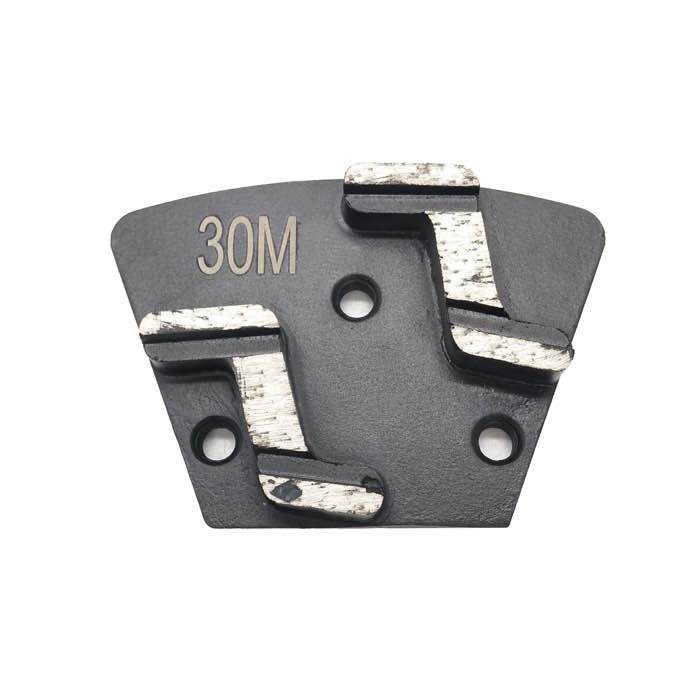
More segments do not automatically mean faster grinding. Each segment on a shoe carries a fixed load from the machine, so splitting that load across more segments lowers the pressure per diamond and actually slows the cut. A two-segment shoe is the sweet spot for most concrete grinding: it balances cut rate, swarf clearance, and tool life. Single-segment shoes are aggressive but wear fast and leave wave; three-segment shoes cut gently and last long, which is ideal for polishing prep and light material removal. Match segment count to the job: one segment for thick coating removal, two for general grinding, three for fine prep and flatness work.
A walk-behind grinder puts roughly 20-40 kg of downward force on each shoe. With one segment, all that force concentrates on one cutter, pressing diamonds deep into the concrete. With three segments, the same force spreads across three cutters, so each diamond bites more lightly. That is why a single-segment shoe sounds loud and cuts fast, while a three-segment shoe hums along and lasts twice as long.
| Count | Cut Rate | Tool Life | Best Use |
|---|---|---|---|
| 1 segment | High | Short | Coating removal, high spots |
| 2 segments | Medium | Medium | General grinding, daily use |
| 3 segments | Lower | Long | Fine grinding, polishing prep |
The Diamond Trapezoid Grinding Disc (JOY-TP-R3) three-round-segment shoe is a favorite for polishing prep, while crews doing heavy stock removal often prefer WerkMaster Single Bar Segment (JOY-WMS-B1) single-bar or WerkMaster Double Bar Segment (JOY-WMS-B2) double-bar configurations.
Spacing between segments is as important as the count. Gaps let concrete swarf escape and prevent the matrix from clogging. Clustered segments (all in a line) load faster; staggered segments (S-shape, zigzag) clear swarf better and produce a flatter scratch. That is why S-segment shoes like the Double S Segment Diamond Trapezoid Grinding Disc (JOY-TP-S2) are popular for transitional grits.
A: Only at fine grits. At coarse grits, more segments reduce cut rate and can leave the floor under-ground. Match count to grit, not to vanity.
A: No. Unequal segment count creates imbalance, vibration, and a wavy floor. Replace all shoes on a plate together.
A: Roughly 1.5x longer on normal concrete, because each segment wears slower. The total diamond volume also increases, which helps.
A: Use more segments (2-3) with a hard bond. The extra spread lowers heat and the hard bond resists wear.
Total diamond volume is what really controls cost per square meter. A three-segment shoe costs more up front but spreads wear across more diamonds, which often wins on large jobs. Track both cut rate and tool life on your local concrete; the optimal count is empirical, not theoretical. Crews that grind the same slab type every day usually settle on one default count and buy in bulk, while crews that switch between garages, warehouses, and overlays keep both two-segment and three-segment sets in the truck.
Remember that segment count interacts with machine weight. A heavy 700 mm grinder presses so hard per shoe that even a single segment will cut aggressively; a light 250 mm edger needs two segments just to bite. Match count to machine weight as well as application.
When in doubt, err on the side of fewer segments. A slightly aggressive cut that finishes fast can be refined with a finer grit, while an under-cut floor that needed more bite cannot be fixed after the crew leaves.
Segment count is a tuning dial: fewer segments cut harder but wear faster, more segments cut gently and last longer. Two segments is the default for daily grinding, three for polishing prep, and one for aggressive stock removal. Never mix counts on a single plate.
