Average response time: under 24 hours
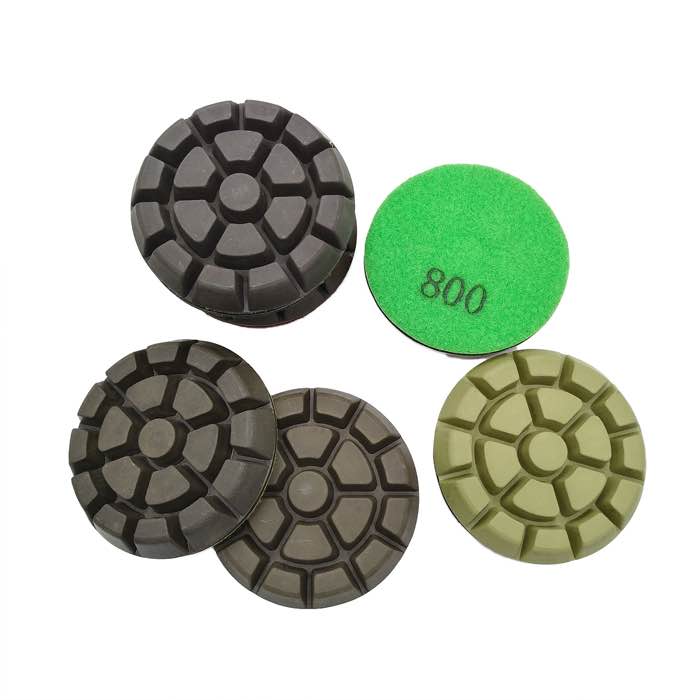
To achieve a mirror-high gloss on polished concrete, you must: (1) fully remove all scratches at every grit — under-polishing at 400 grit cannot be rescued at 1500; (2) apply the densifier after the 150/180 metal grind and let it cure fully; (3) polish through 50/100, 200, 400, 800, 1500 and 3000 grit using quality resin pads such as the resin floor polishing pad at each step; (4) finish with a high-speed burnish at 1500-2000 RPM using a burnishing pad. The single biggest cause of dull-looking "high gloss" floors is skipping the densifier or rushing the 800-grit step.
Gloss is measured at a 60° angle with a gloss meter. A typical polished concrete floor after 400 grit reads 20-30 GU (satin). After 800 grit, 40-50 GU (low gloss). After 1500 grit, 60-70 GU (high gloss). After 3000 grit plus burnish, 80-95 GU (mirror). Specify the gloss level in the contract — "high gloss" without a number is a dispute waiting to happen. Most retail and showroom jobs target 70+ GU; warehouses target 30-50 GU for slip resistance.
| Finish level | Grit | Typical GU | Look |
|---|---|---|---|
| Matte / salt-and-pepper | 200-400 | 20-30 | Refined but not reflective |
| Satin | 800 | 40-50 | Soft sheen, warehouse standard |
| High gloss | 1500 | 60-70 | Clear reflection, retail standard |
| Mirror | 3000 + burnish | 80-95 | Sharper than a stone floor |
Gloss is a sum of every prior step. If the 400-grit pad has not fully removed 200-grit scratches, the 800 step will not fix them, and the 1500 step will lock them in. Run the floor at each grit until you can no longer see the previous scratch pattern in raking light. On a planetary grinder this is usually 2-3 passes; on a single-disc grinder it is 4-6 passes. Use a fresh set of pads at each step — worn pads load up and stop cutting.
Densifier is not a surface coating — it is a chemical hardener that reacts with free lime in the concrete. Apply it after the 150/180 metal grind, when the surface is open and clean. Let it soak 20-30 minutes, wipe off excess, and cure overnight. If you apply densifier after 400 grit, the surface is too closed and the densifier cannot penetrate — the floor will look hazy and will never reach a true mirror. Lithium densifier is the easiest to work with; it does not leave white residue.
For the 50/100 and 200 steps, use hard-bond transition pads that quickly remove metal scratches. For 400-800, a medium-bond resin floor polishing pad gives the best balance of cut and finish. For 1500-3000, use a soft-bond spiral resin polishing pad that polishes rather than cuts. Run the grinder at slow walk pace; do not force weight. After 3000, switch to a 1500-2000 RPM high-speed burnisher with a burnishing pad — this step alone can add 15-20 GU.
The most common culprits: (1) skipped the 800 grit, (2) used worn pads, (3) applied densifier too late, (4) floor not flat — low spots catch dust and look matte, (5) no burnish step, (6) applied a topical acrylic sealer that yellows. Walk the finished floor in raking light (a lamp at 30°) before handover. You should see your lamp reflected as a sharp, bright line across the floor.
Yes, as long as the slab is structurally sound and not severely pitted. Start with aggressive metal grinding (30/40 or 16/20) to open the surface, densify, and run the full resin sequence. Old slabs often polish better than new ones because the cement has already cured.
On a 3-head planetary grinder: 2-3 passes per grit. On a single-disc grinder: 4-6 passes. The rule is — keep going until the previous scratch pattern disappears, not until a set time is up.
No. Traditional floor wax yellows, scuffs, and requires re-buffing monthly. Modern polished concrete uses an impregnating silane/siloxane guard that is invisible and lasts 2-5 years. Burnish with a pad, not wax.
Usually the densifier was not worked in evenly, or the floor has inconsistent moisture. Test with a gloss meter in 4 spots per 50 m²; patches are a sign of uneven pad pressure or an uneven densifier application.
A true high gloss is the result of disciplined grinding: full scratch removal at every grit, correctly timed densifier, fresh resin pads through 3000, and a final high-speed burnish. Specify the gloss number in the contract, walk the floor in raking light before handover, and your client will see their own reflection for years.
Written and reviewed by JOY TECH — an SGS & BV audited, CE/RoHS certified diamond tools manufacturer founded in 2004, exporting to 50+ countries.
Our factory and QMS are audited by SGS and Bureau Veritas. Products meet CE/RoHS requirements and every piece is 100% inspected before packing.
Verified Certificates
