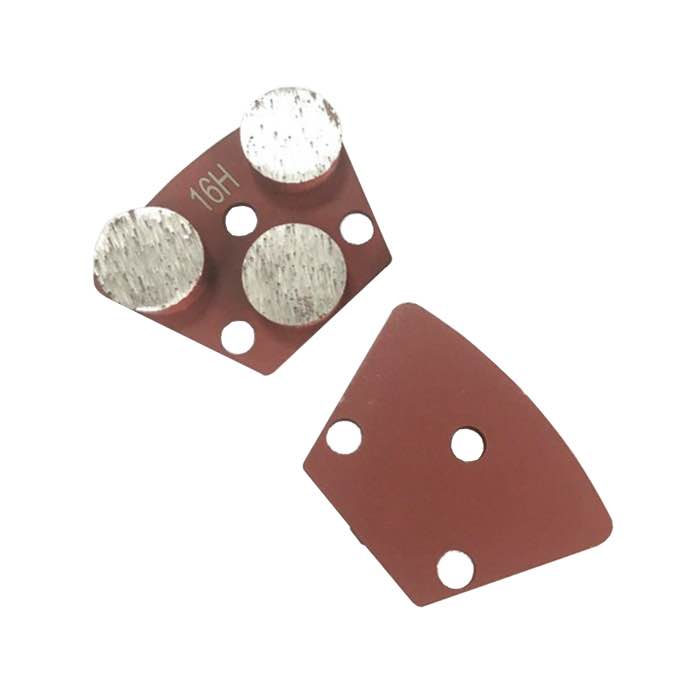
To buy the right concrete grinding disc, answer two questions first: which floor grinder (or connection) the disc must fit, and what material you are grinding or which coating you are removing. The disc shape must match your machine — trapezoid types and most brands like HTC, Lavina, Klindex, Husqvarna, Scanmaskin, Werkmaster, Edco and Blastrac are generally not interchangeable — and the bond hardness plus diamond grit must match the concrete hardness and the finish you want.
A concrete grinding disc — also called a diamond grinding disc, concrete grinding shoe, diamond grinding segment, or diamond grinding wheel — is a diamond tool designed to grind concrete and terrazzo floors efficiently. It is also excellent for coating removal when welded with PCD segments or low-grit arrow-type diamond segments. Different floor grinders use different disc shapes, so matching the disc to your machine is the first step toward a clean, even grind.
Except for some trapezoid shapes, most concrete grinding discs are not compatible across machines. A disc made for an HTC grinder will not fit a Lavina, Klindex, Scanmaskin or Werkmaster without the right connection or adapter. That is why reputable suppliers classify grinding discs by floor grinder brand or connection type.
The simplest way to confirm the right type: send a photo of the disc you currently use (or the back of the plate with its mounting holes) and the supplier will recommend the correct disc for your machine. If you use an angle grinder, look for cup wheels or trapezoid discs with the correct arbor hole instead of planetary-plate tooling.
Different concrete hardness needs a different metal bond. The rule is simple: hard concrete needs a soft bond, and soft concrete needs a hard bond. A soft bond exposes fresh diamonds faster for abrasive, hard floors, while a hard bond lasts longer on soft, sandy floors.
| Concrete Hardness | PSI | MPa (Grade) | Recommended Bond | Code |
|---|---|---|---|---|
| Extremely Hard | 6500-9000 | C50-C65 | Extremely Soft | XHF |
| Very Hard | 5000-7000 | C40-C55 | Very Soft | VHF |
| Hard | 4000-5000 | C30-C50 | Soft | HF |
| Medium Hard | 3000-4000 | C20-C40 | Medium Soft | MHF |
| Soft | 1500-3500 | C15-C25 | Hard | SF |
| Very Soft | 1000-2000 | C10-C20 | Very Hard | VSF |
If you do not know the concrete hardness, do a quick scratch test or check the original pour specification. When in doubt, start with a medium bond and adjust after the first pass.
Grinding work is divided into coarse, medium and fine grinding, and the diamond grit size controls the result. Coarse grits cut fast and level surfaces; fine grits refine scratches and prepare for polishing or sealing.
| Application | Recommended Diamond Grit | Segment Shape |
|---|---|---|
| Coarse Grinding | 6# , 16# | Arrow, Stair, Segment Bar |
| Medium Grinding | 36#, 60#, 80# | Segment Bar |
| Fine Grinding | 120#, 180#, 220# | Round |
For a polished-concrete project, work through the sequence from coarse to fine. For a single-pass prep job before coating, a medium grit such as 30/40 or 60/80 is usually enough.
PCD grinding discs and arrow-type segments have only one correct rotation direction. The direction depends on the rotation of your floor grinder: if the grinder spins clockwise, you need clockwise PCD tooling; if it spins counter-clockwise, you need counter-clockwise tooling. For arrow segments, the rotation should run along the tip of the arrow. Many buyers order both directions so one set covers machines that rotate either way.
For a ready-to-run start, look at JOY trapezoid metal-bond grinding discs for concrete leveling, Werkmaster PCD tooling for coating removal, and PCD cup wheels for angle-grinder prep work.
A: No. Most concrete grinding discs are machine-specific. Except for some trapezoid shapes, HTC, Lavina, Klindex, Husqvarna, Scanmaskin, Werkmaster, Edco and Blastrac tooling is not interchangeable. Check the plate shape and mounting before ordering.
A: Very hard concrete (5000-7000 PSI, C40-C55) needs a very soft bond. The bond and the concrete hardness are opposite: hard floor, soft bond. This lets the diamonds expose faster and keep cutting on abrasive floors.
A: For paint, epoxy and glue, use PCD tooling or low-grit arrow/segment-bar discs such as 6# or 16#. For light coatings like thin sealers, a medium grit around 36#-60# often works in fewer passes.
A: Yes. PCD discs and arrow segments only work properly in one rotation direction, matching the spin of your floor grinder. Buy clockwise and counter-clockwise sets if you run machines that rotate in both directions.
A: Send a photo of your current disc, including the mounting side, to the supplier. Suppliers that classify tooling by grinder brand or connection can recommend the right disc quickly.
Buying concrete grinding discs comes down to four checks: machine fit, bond hardness, diamond grit, and rotation direction. Confirm the concrete hardness and the finish you need, match the tooling to your grinder brand, and you will avoid wasted passes and premature wear. If you are unsure about any of the four, send us a photo of your current disc and the floor details — we will recommend the right PCD or metal-bond grinding disc for your job.
