Use a soft bond on hard concrete and a hard bond on soft concrete. This counterintuitive rule exists because diamond grinding depends on self-sharpening: in hard concrete, the matrix wears slowly, so a soft bond lets spent diamonds fall away and exposes fresh ones. In soft, abrasive concrete, the matrix wears fast, so a hard bond holds diamonds longer. For a 4,000 PSI slab, start with a medium bond; if the shoe glazes (stops cutting), move softer; if it wears out in under 300 m2, move harder. Most manufacturers color-code bonds: soft = red/green, medium = yellow/blue, hard = grey/black.
The bond is the metal powder matrix (usually bronze-tin, cobalt, or tungsten-based) that sinters around the diamond crystals. Its hardness controls how quickly the matrix erodes under grinding heat. A soft bond erodes in minutes; a hard bond can last ten times longer on the same floor.
| Concrete Type | PSI | Recommended Bond |
|---|---|---|
| Soft, sandy mix | < 3,000 | Hard bond |
| Normal commercial slab | 3,000-4,000 | Medium bond |
| Dense, hard mix | 4,000-5,000 | Soft bond |
| Very hard / silica fume | > 5,000 | Extra-soft bond |
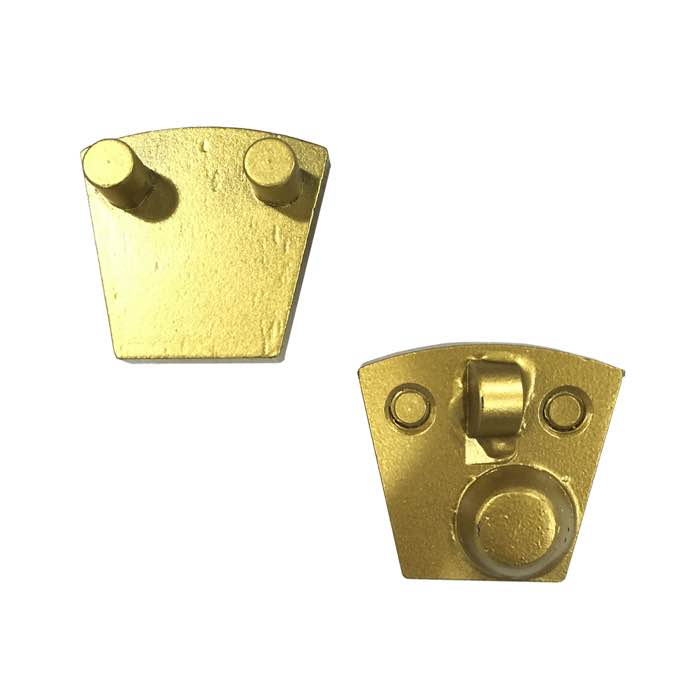
The Diamond Trapezoid Grinding Disc (JOY-TP-R3) and Double Rhombus Segment Diamond Trapezoid Grinding Disc (JOY-TP-RH2) trapezoid shoes are commonly stocked in medium and soft bonds; crews working dense industrial slabs often switch to WerkMaster Double Rhombus Shark Segment (JOY-WMS-R2) shark-segment tooling for faster chip clearance.
A: No. Different wear rates create imbalance and a wavy floor. Replace all shoes on a plate with the same bond grade.
Ask the concrete contractor, pull a core sample, or use a rebound hammer. If unknown, start medium and adjust after the first 50 m2.
A: A coarse abrasive block used to open a glazed bond. Run the machine over it for 30 seconds to expose fresh diamonds.
A: Indirectly. A glazed bond rubs rather than cuts, which leaves swirl marks. A correctly matched bond produces a consistent scratch across every pass.
Keep a one-page bond chart taped inside your grinder lid: soft bond for hard slab, medium for normal, hard for soft. When a new crew member asks which shoe to grab, the chart removes guesswork. After finishing a job, jot down the concrete PSI, bond used, and square meters per set in a notebook. Over six months this becomes a proprietary cheat sheet that lets you quote tooling costs accurately on the next bid, instead of guessing and losing money on the first few jobs.
If you are buying shoes in bulk, order one set softer than you think you need. It is always cheaper to dress a slightly soft shoe on a dressing brick than to push a glazed hard shoe across the floor and waste a shift.
Bond hardness is also a function of segment design. A thin segment runs hotter and behaves like a softer bond, even if the matrix is nominally hard. When switching suppliers, re-test on a scrap slab before committing to a bulk order.
When in doubt, start medium and adjust after the first fifty square meters; this single discipline prevents more tooling waste than any other rule of thumb.
When in doubt, start medium. Watch the first 50 m2: if the shoes glaze, go softer; if they wear out, go harder. Matching bond to concrete is the single biggest lever on both finish quality and tool cost.
