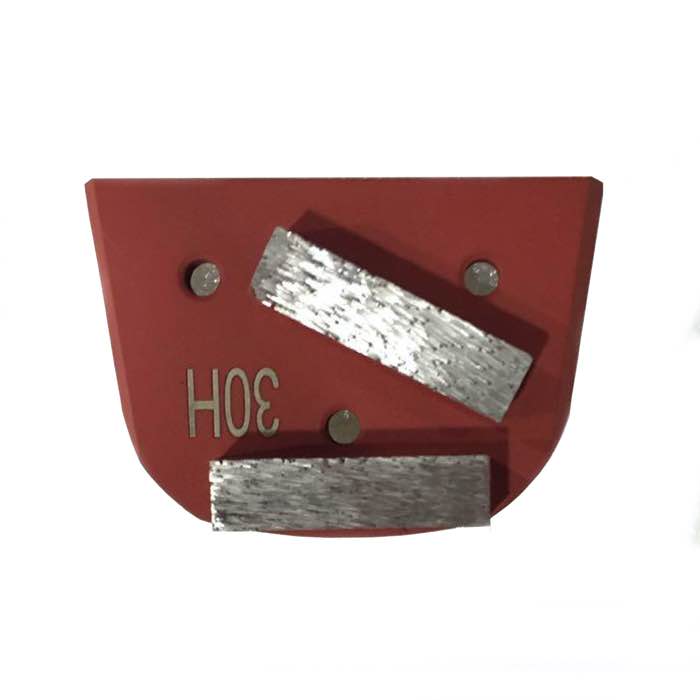
Choose the largest cup wheel your grinder is rated for. Most 100-125 mm (4-5 inch) angle grinders take a 115/125 mm (4.5-5 inch) cup wheel like the 5-inch L-segment wheel. Larger 150-180 mm (6-7 inch) grinders take a 180 mm (7 inch) wheel such as the 7-inch 12-arrow wheel. Never fit a wheel rated below your grinder's maximum RPM, and match the arbor hole (usually 22.23 mm).
| Diameter | Typical grinder | Best for |
|---|---|---|
| 100 mm (4 in) | Small 100 mm grinders | Tight corners, vertical edges |
| 115/125 mm (4.5-5 in) | Most midsize angle grinders | Edges, patches, general work |
| 180 mm (7 in) | Large 180/230 mm grinders | Faster floor prep, big edges |
Every diamond wheel has a maximum safe RPM printed on the label. Your grinder's no-load speed must be at or below that rating. A 7-inch wheel on a 12,000 RPM small grinder will disintegrate. As a rule, bigger wheels spin at lower RPM; check the label.
Most cup wheels use a 22.23 mm (7/8 inch) bore. Some include reducers for 16 mm or 20 mm. Always use the inner/outer flanges supplied with the wheel — loose mounting causes wobble and vibration. Do not stack washers to force a fit.
The 22.23 mm bore is standard on most cup wheels. Reducer rings exist for 16 mm or 20 mm, but always use the correct inner/outer flange — never stack washers or force the wheel on. A wobbling wheel destroys bearings and can shatter. Check the centering ring is seated before every use.
Always run the wheel with the factory guard in place and set so the open side faces away from you. Cup wheels spin at high RPM; a shattering wheel is lethal. Tighten the flange nut with the spanner, not an impact gun, and re-torque after break-in.
A concrete cup wheel glazed on stone means the bond is too soft. For granite or block, choose a harder-bond wheel. General-purpose wheels work for most residential concrete. Tell the supplier what you are cutting so they match the bond.
Unplug the grinder before changing wheels. Press the spindle lock, loosen the flange nut with the spanner, and swap the wheel. Re-tighten finger-plus a quarter turn. Do not over-tighten — it makes the next change hard.
A new wheel should run smooth. If it vibrates, check for a missing flange, a bent shaft, or a casting flaw. Balanced wheels extend bearing life and reduce operator fatigue.
The wheel label lists diameter, bore, maximum RPM and material rating. If your grinder's no-load RPM exceeds the wheel's max, do not use it. This is the single most important safety check. Most small angle grinders run 10,000-12,000 RPM; large 180 mm grinders run 8,000. Match them.
Cup wheels wear. Buy two of the size you use most. A mid-job wheel change is cheap insurance against downtime.
A larger wheel covers more area per rotation but runs at lower RPM. On an angle grinder, the guard and power limit size. A 125 mm wheel on a 1200 W grinder cuts faster than a 100 mm wheel on the same tool, but it is heavier and harder to hold on edges. For overhead or vertical work, smaller is better. For flat floor prep, go as big as your grinder and guard allow.
Keep one general-purpose wheel for everyday concrete and one PCD wheel for coatings. Buying three cheap wheels instead of one good one usually costs more. Wear rate on quality segments is predictable; cheap ones glaze early.
A: Only if the guard fits, RPM rating matches, and the motor has the power. Often the guard fouls — check before buying.
A: It covers more area per pass, but heavier wheels are tiring and harder to hold flat on small jobs.
22.23 mm is standard; adapters are available but never force a mismatched bore.
Compare the wheel's max RPM to the grinder's no-load RPM printed on the tool nameplate.
Size the cup wheel to your grinder's diameter, guard and RPM rating, and pick the segment style for the job. Contact JOY TECH for cup wheels in 100, 125 and 180 mm with the right bore and segment for your grinder.
