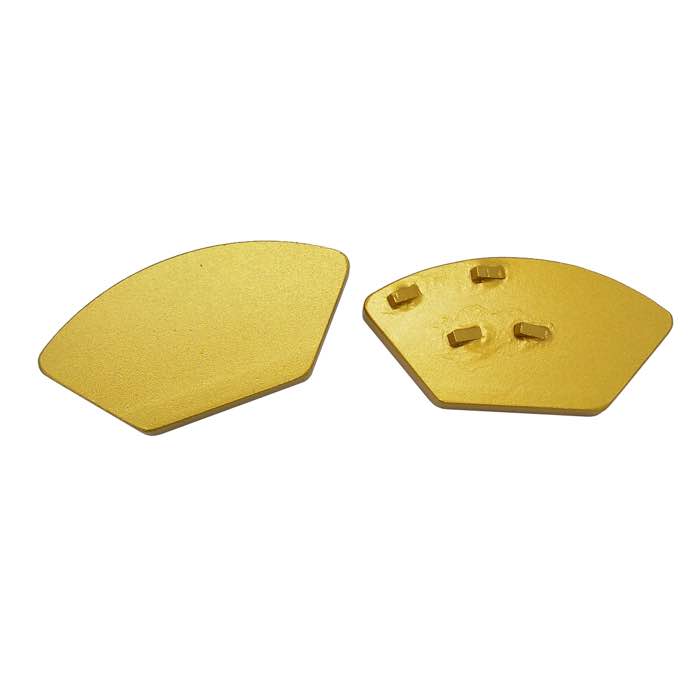
To strip mastic, epoxy, and thin film coatings without dulling too fast, choose a medium-hard metal bond in 30/40 or 60/80 grit—not the softest bond and not the hardest. A soft bond sheds diamonds too quickly when grinding a non-abrasive coating film, while an ultra-hard bond glazes because there is no concrete grit to refresh the diamonds. The sweet spot is a medium bond that exposes new diamonds as it cuts, paired with PCD tooling for the bulk removal. For the first pass on thick coatings, use PCD; for cleaning the residual film, a 30/40 medium-bond shoe like Double Rhombus Segment Trapezoid Disc (JOY-TP-RH2) or WerkMaster PCD Coating Removal Tool (JOY-WM-PCD1R1) gives the best balance of speed and life.
On bare concrete, the abrasive aggregate itself wears the bond and exposes fresh diamonds. On a coating, that abrasive action is missing. So:
| Coating | First tool | Cleanup grit / bond |
|---|---|---|
| Thick epoxy, self-leveler | PCD block | 30/40 medium |
| Mastic / glue film | PCD half-moon | 60/80 medium |
| Thin acrylic sealer | 30/40 medium bond | 60/80 |
| Bitumen / tar | PCD | 30/40 medium |
The fastest coating-remove workflow is two-stage. First, a PCD epoxy-removal tool strips 80–90% of the film. Then a medium-bond 30/40 metal shoe cleans the ghost layer, opens the slab, and prepares it for new coating. Trying to do the whole job with metal bond on thick epoxy wastes tools; trying to finish with PCD leaves scuff marks.
On WerkMaster machines, WerkMaster Double Rhombus Shark Segment (JOY-WMS-R2) rhombus-shark segments are tuned for coating cleanup and clear swarf well during the transition from PCD to metal bond.
Bond descriptions vary between factories, so never run a whole floor on a brand-new tool. Test three minutes on a hidden corner or under a parked car, then inspect the segment face. A healthy cutting face shows fresh diamond particles and a thin slurry stream; a glazed face is shiny and black; an over-soft face has pulled-out diamond holes and rounded edges. If the test looks wrong, swap before you commit the whole bay. This 5-minute check prevents a 2,000 m² mistake and is the fastest way to calibrate a new supplier’s bond to your local concrete.
Track tooling cost per square meter on every coating-removal job. Once you have three or four data points, you will know exactly which bond pays off on mastic, which on epoxy, and which on bitumen, and can quote jobs with confidence instead of guessing.
A: Start with PCD for the mastic bulk, then use 60/80 medium-bond metal shoes for the residue. This avoids both glazing and rapid wear.
A: No. A hard bond on a non-abrasive coating glazes and stops cutting, which wastes more time than it saves in tool life.
Run the tool on an abrasive dressing brick or a rough patch of exposed concrete for 30 seconds to open the segment face.
Dry with a HEPA vacuum is standard. Wet grinding cools PCD and reduces dust, but slurry handling adds cleanup time.
For coating removal without premature dulling, pair PCD for the bulk strip with a medium-bond 30/40 or 60/80 metal shoe for cleanup. Avoid soft bonds that shed diamonds and hard bonds that glaze, and watch the segment face—it tells you immediately whether the bond is right for the coating.
