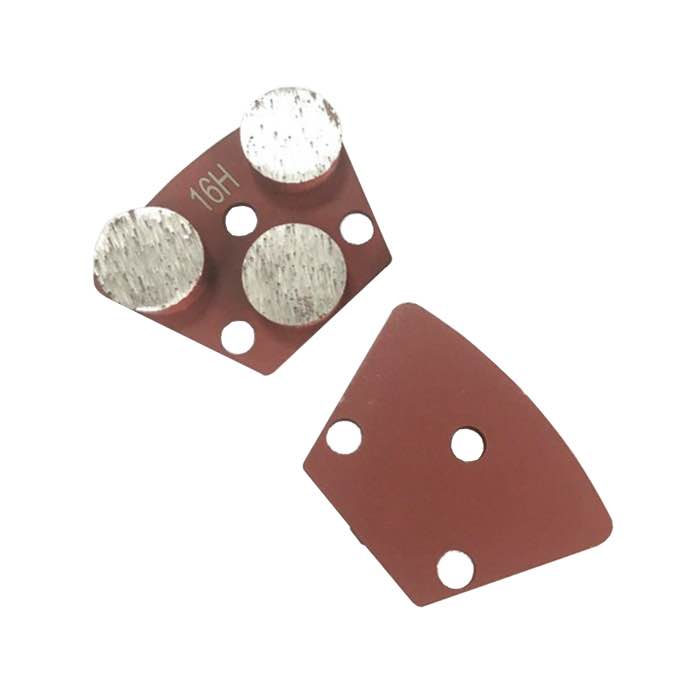
Choose trapezoid grinding shoes by matching three things: the mounting pattern on your grinder, the bond hardness to your concrete, and the segment shape to your production goal. Most planetary grinders accept universal 3-hole or 5-hole trapezoid shoes. For normal 3,000-4,000 PSI concrete, a medium bond with round or double-segment shoes like the Diamond Trapezoid Grinding Disc (JOY-TP-R3) delivers a balanced cut rate and long life. For hard concrete over 4,500 PSI, step down to a soft bond; for soft, abrasive concrete, choose a hard bond. Segment shape affects scratch pattern and swarf evacuation rather than raw speed, so pick round or S-shoe for a flatter finish and rhombus for aggressive stock removal.
Trapezoid (trapezium) shoes are the most common tooling format on walk-behind concrete grinders because they sit in quick-change pockets on the rotating plate. The wedge shape lets the shoe self-lock as the plate spins, which means less bolt torque loss during a long shift. When you shop, verify the pocket dimensions of your machine: older Husqvarna-style plates use a narrow trapezoid, while Lavina and superabrasive machines use a wider footprint. Mismatched shoes rattle, chip their holders, and leave uneven scratch lines.
| Shape | Best For | Finish |
|---|---|---|
| Round (3-seg) | General grinding, flatness | Even, predictable scratch |
| Rhombus / Shark | Aggressive stock removal | Deeper cut, coarser pattern |
| S / Zigzag | Polishing prep, swarf flow | Smoother, less wave |
The Double Rhombus Segment Diamond Trapezoid Grinding Disc (JOY-TP-RH2) and Double S Segment Diamond Trapezoid Grinding Disc (JOY-TP-S2) are popular starting points for crews that switch between coating removal and fine prep on the same machine.
A: Most will if the hole pattern matches, but always compare pocket dimensions. Some older machines need an adapter plate. Check the holder on your existing shoe and send a photo to your supplier before ordering.
A: Most planetary plates run three shoes per head (nine total), while single-disc machines run three to six. Always replace all shoes on a plate together so the cut stays balanced.
A: No. A soft bond on soft abrasive concrete wears out in hours. Use a hard bond on soft concrete and a soft bond on hard concrete.
A: The bond matrix is the same; the difference is heat control. Wet grinding reduces dust and extends shoe life on hard slabs, but requires slurry cleanup.
Trapezoid shoes are sold in sets of three (one per planetary head) or nine (a full plate). Buying by the box of nine usually lowers the per-shoe cost by 15-25%. Keep a spare set of each grit on the truck; running a worn set one day too long often ruins an otherwise good floor. On large jobs, track square meters per set and watch for the first sign of glazing, which is the cue to rotate to the next bond grade. Buying direct from a factory like JOY TECH removes distributor markup and lets you request custom bond hardness matched to your local aggregate.
Start by confirming the pocket and hole pattern on your grinder, then select the bond hardness that matches your concrete PSI, and finally choose a segment shape that balances cut rate with the scratch pattern your next coating requires. Testing a small set before bulk purchase is the cheapest insurance against a mismatched order.
