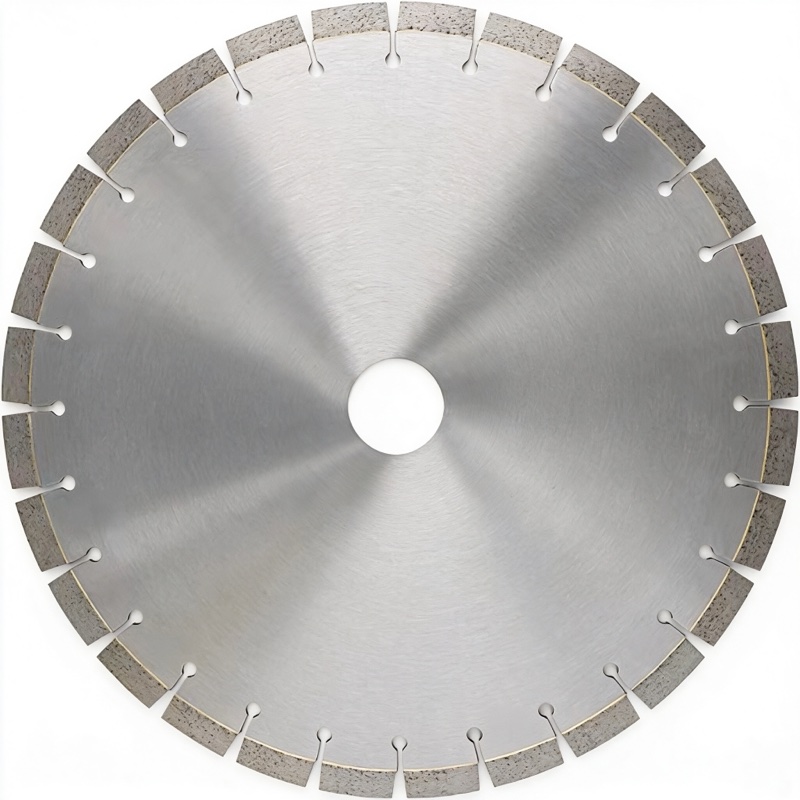
To cut granite, use a diamond blade with a soft bond designed for hard stone, preferably a segmented or turbo rim on a saw with water cooling. Granite is extremely abrasive and hard, so a hard-bond concrete blade will glaze and stop cutting. Wet cutting is strongly recommended because it cools the rim, prevents burning and produces clean edges. Feed steadily, keep the blade supported, and cut from the polished face side to avoid chipping.
Granite is an igneous rock full of hard quartz and feldspar crystals. It wears tooling aggressively. Two rules apply: the diamond must be high quality, and the metal bond must be soft enough to wear as the diamonds dull, exposing fresh grit. A hard bond (made for soft concrete) does not wear on granite, the diamonds polish flat, and the blade glazes. This is why granite-specific blades exist.
For granite quarry and slab work, choose long-segment or short-segment granite blades matched to your saw. We recommend the long-segment granite blade for fast general cutting and the short-segment granite blade for more controlled cuts. For precision fabrication cuts on granite slabs, our precision granite blade gives a truer, cleaner edge.
| Method | Pros | Cons |
|---|---|---|
| Wet cut | Cools rim, clean edge, long life | Slurry cleanup, plumbing |
| Dry cut | Portable, no water | Dust, faster glazing, short bursts only |
Fabrication shops almost always cut granite wet. Field crews cut dry only in short 30-second bursts, letting the blade air-cool between cuts, and use dust extraction. Long dry cuts on granite overheat and glaze the blade.
Granite cutting generates a lot of heat and dust, so a proper wet setup is essential. Feed water directly to the rim through the saw cooling line, and keep the flow adjusted so it reaches the cut without flooding the workshop. Collect the slurry - granite dust is silica and cannot be washed down the drain. A simple settling bucket keeps your site compliant.
Support the slab fully on the saw table. Granite is rigid but can chip along unsupported edges, and a slab that shifts as the blade exits causes wandering. Clamp long slabs so they cannot vibrate, and support the waste side so it does not drop and tear the segment. With good water, support and a matched soft-bond blade, granite cuts clean and predictable.
Because granite is abrasive, expect softer-bond blades to wear faster than on concrete. Budget replacement accordingly and keep spares. The right soft bond cuts cleanly; an overly hard bond just glazes and wastes the afternoon.
Use ample water when cutting granite - the dust is both a silica hazard and a sign the rim needs more cooling. A wet cut is also cleaner to finish.
On very hard granite, expect to change to a softer bond blade rather than forcing a general-purpose blade. The right bond pays for itself in cut speed.
For repeated granite work, investing in the right blade per material pays back quickly in cleaner cuts and far less dressing. Do not stretch one blade across every stone.
When evaluating a granite blade, ask about segment bond hardness for your specific granite; the same rim shape in the wrong bond will still underperform. Matching bond to rock is the real secret, and it is what separates a clean cut from a frustrating one.
A: It will cut poorly and glaze quickly. Granite needs a softer-bond stone blade.
Let the blade cut its rated depth; for thick slabs, cut from both faces or use the blade's full depth in controlled passes.
Usually a dull blade, too-fast feed, or no support at the exit. Use a sharp granite blade and slow the finish.
Granite cutting is about the right soft-bond blade, water cooling and steady feed. Do not waste time with a generic masonry blade. The takeaway is that granite needs a soft-bond blade and wet cooling to cut clean. Match the tooling to the rock, support the slab, and granite stops being a frustrating material. Contact JOY TECH for a quote on long, short and precision granite blades for bridge saws and angle grinders.
