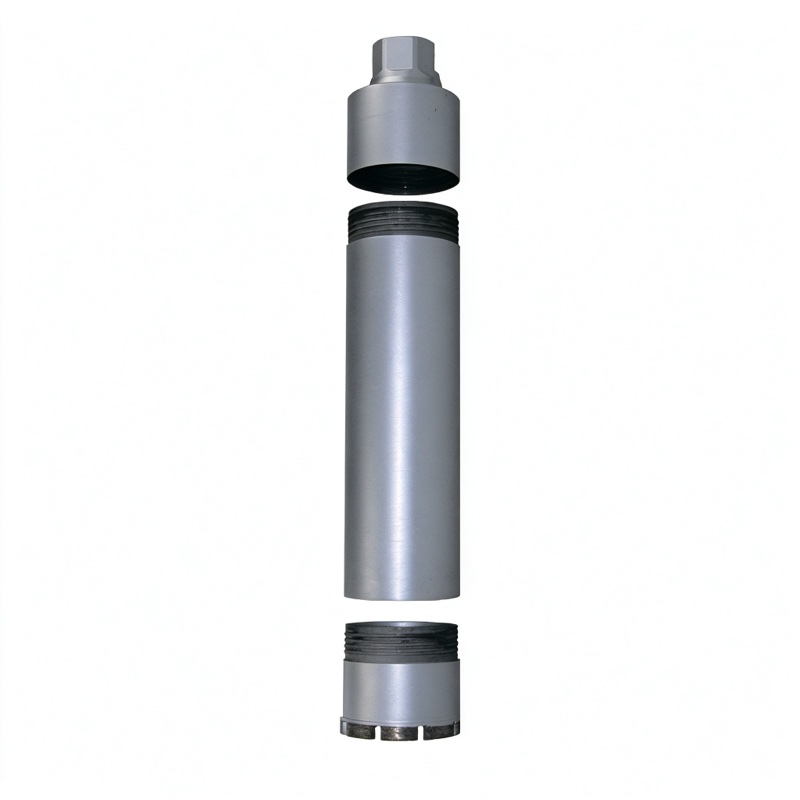
Drilling angled or horizontal holes in concrete is possible with the same diamond core bits used for vertical work, but you must mount the drill on an adjustable stand, use a pilot hole or suction guide, and manage water flow so slurry does not run back over the motor. Most angled penetrations for pipe sleeves, cable trays, and formwork ties are drilled at 15–45 degrees; beyond 60 degrees, treat it as vertical drilling and support the rig.
Vertical floor drilling lets gravity help: water flushes cuttings down and out. On a wall or ceiling, water runs backward over the bit and onto the drill body, and the bit tends to skate on the smooth surface. You also lose the natural weight feed, so the rig has to push the bit through the concrete.
For longer horizontal runs, continuous threaded tube extensions keep the barrel aligned because the stiff tube resists flex better than coupled segments.
On wall and ceiling holes, water wants to run back toward you. Mitigate it with:
On horizontal wall holes, water wants to run straight back at you. Fit a splash collar around the bit opening and feed water through the spindle rather than spraying from outside. Keep flow low — 2 to 3 liters per minute is enough for bits under 150 mm; more water just makes a mess and never improves cooling. Have a wet vacuum handy at the opening to suck slurry as it emerges. On overhead work, where water drips onto the motor, use a shroud with a weep hole and tip the drill slightly so water runs away from the body. If you can, wait for a dry day and use a dry diamond bit in brick, but always switch back to wet for concrete. Never trust an electric drill on overhead wet work without an RCD — the shock risk is real.
A: Hand-held angled coring is acceptable only up to about 30 degrees and under 80 mm diameter. Beyond that, mount the rig.
A: Yes, which is why a pilot indent or centering shoe is mandatory. Skip it and you will waste segments chasing the hole.
A: Yes, but anchor the rig to the ceiling and use a vacuum skirt. The drill weight is now working against you, so torque reaction is dangerous.
A: It can. Uneven feed on angled holes causes one side of the segment to wear faster. Keep the rig square to the surface and feed evenly.
Angled and horizontal core holes are routine work for the right diamond bits, but they demand a locked stand, a pilot start, and careful water control. Do not try to free-hand large wall openings — the kickback risk is real. Contact JOY TECH for wet core bits and stand adapters configured for your angle and wall thickness.
