Average response time: under 24 hours
You can drill small holes (up to 10 mm diameter, 50-80 mm deep) in concrete with a standard hand drill if it has a hammer-drill mode and you use a carbide-tipped masonry bit. For larger or deeper holes, rebar, or solid structural concrete, a corded or SDS rotary hammer is required. The technique is: mark the hole, start slow at 90 degrees, engage hammer mode, apply firm forward pressure, pull the bit out every 10 mm to clear dust, and never force a bit that has stopped cutting.
Not every hand drill has a hammer function. Check the mode selector: if it only has drill and screw modes, the tool is not suitable for concrete. A hammer-drill mode (often marked with a small hammer icon) is the minimum. Cordless drills at 18V can handle small anchor holes; 12V tools are too weak for repeated concrete work. Corded drills at 600W or more give more consistent torque.
Use a carbide-tipped masonry bit with a tungsten carbide tip brazed to a steel shaft. Standard twist drill bits will not work; their HSS edge dulls instantly on aggregate. For occasional use, a standard 3-flute carbide bit is fine. For repeated jobs, a reinforced masonry bit with a wider tip lasts longer. Bit sizes most often needed for wall anchors are 6 mm, 8 mm, and 10 mm.
If you are drilling more than a few holes, an SDS-plus bit with a round-shank adapter in your keyless chuck cuts noticeably cleaner than a standard carbide bit. The SDS flute geometry evacuates dust faster and the reinforced tip survives occasional rebar hits. Do not run the drill in hammer mode with an SDS adapter in a keyless chuck under heavy load; the adapter can slip. Use the adapter only for light to medium holes.
Do not use an SDS-only bit in a keyless chuck unless you have an SDS-to-round adapter, and avoid using impact-driver rated bits in a hammer drill; they are designed for screw driving, not percussion.
Mark the hole center with a marker or a center punch. A small indentation with a nail or center punch prevents the bit from skating on the smooth surface. If you are near a tile or finished edge, apply masking tape over the mark. Start the drill at slow speed, no hammer, to cut a shallow guide notch, then level to 90 degrees and engage hammer mode.
Apply firm, steady forward pressure. The drill itself does the work through percussive impact; pushing too hard binds the bit and dulls the tip faster. Typical pressure is enough to hold the bit in contact, not bodyweight. Pull the bit out every 10-15 mm to evacuate dust. This "pecking" clears the flute and keeps the bit cool. Stop if the drill suddenly slows, which usually means you hit aggregate, a rock, or a piece of rebar.
Wrap a piece of masking tape around the bit at the desired depth. When the tape reaches the surface, you are at the target depth. This is essential for anchor holes, where drilling too deep wastes the bit and drilling too shallow leaves the anchor short.
If you hit steel, the drill will make a higher-pitched sound and the bit will stop advancing. Pull back, move the hole 10-20 mm to one side, and restart. Do not try to drill through rebar with a small carbide bit; it will burn the tip and possibly snap. If the rebar is in the way of a structural hole, you need a diamond core bit on a rig, not a hand drill.
Concrete dust is crystalline silica and is hazardous. Wear a N95 or P2 mask, safety glasses, and hearing protection. Attach a shop vacuum to the bit if you have a dust-extraction shroud, or hold a vacuum hose next to the hole. For indoor work, wet the surface slightly before drilling to suppress dust, but clean up the slurry immediately.
Stop and switch tools if:
An SDS-plus rotary hammer rental costs less than a burned-out drill and a bag of dull bits.
Blow the hole out with a squeeze bulb or compressed air (wear eye protection). Brush out loose dust with a wire brush if you are setting chemical anchors; loose dust weakens the bond. For wedge or sleeve anchors, a clean hole is enough. If the hole is in an exterior wall, seal around the anchor with exterior caulk to prevent water tracking back through the concrete.
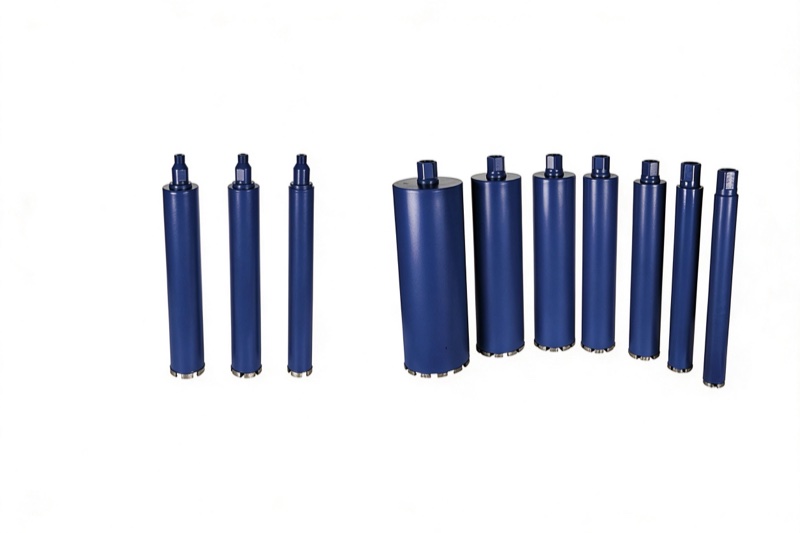
For larger concrete holes, switch to a diamond core bit on a rotary hammer or rig.
Written and reviewed by JOY TECH — an SGS & BV audited, CE/RoHS certified diamond tools manufacturer founded in 2004, exporting to 50+ countries.
Our factory and QMS are audited by SGS and Bureau Veritas. Products meet CE/RoHS requirements and every piece is 100% inspected before packing.
Verified Certificates
