Average response time: under 24 hours
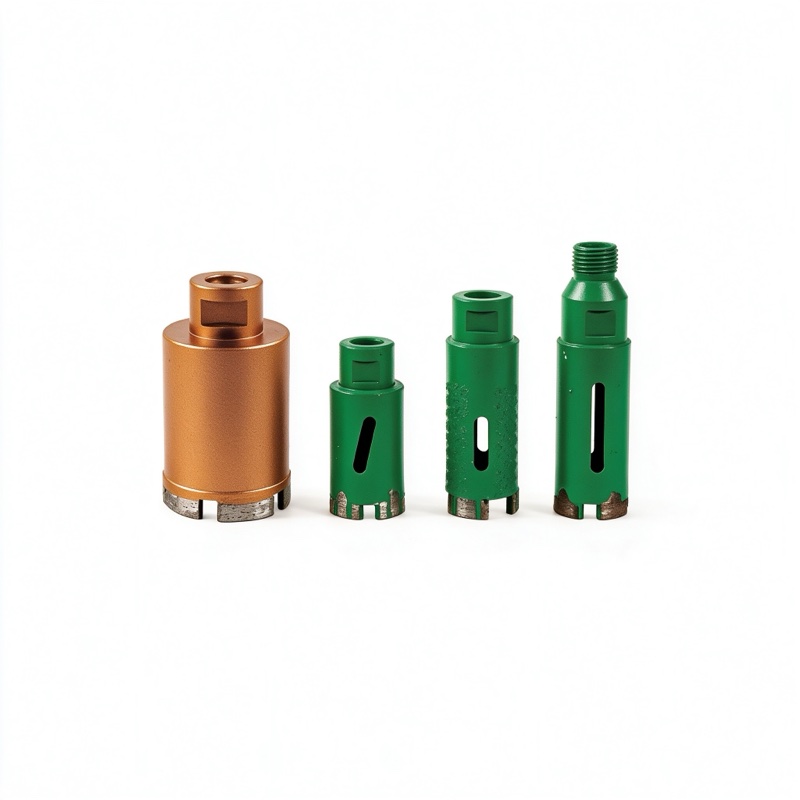
To drill a 35-50 mm faucet or spray-hole in a granite countertop, mark the center, apply masking tape to prevent walking, and use a diamond hole saw running at 800-1500 RPM with constant water cooling. Start at a 45-degree angle to nick the edge, then straighten the drill once the rim engages. A stone hole saw for granite produces clean, chip-free edges; a carbide masonry bit will wander and crack the slab. Drill halfway from the top, then flip or support the slab and finish from the underside to avoid spalling the polished face.
Granite is an igneous rock with quartz and feldspar grains locked in a crystalline matrix. A standard carbide-tipped bit grinds against the grains, heats up, and dulls within minutes. Diamond tooling cuts the grains rather than abrading them, which keeps the edge true and prevents the micro-cracks that propagate into visible chips. For installed countertops where the sink cutout is already done, the remaining holes are usually for the faucet (35 mm), sprayer (12-15 mm), soap dispenser (25 mm), or air gap (28 mm).
Hardness varies across granite types. Absolute black, Kashmir white, and blue granite are the toughest and need a continuous-rim diamond hole saw at lower RPM. Softer granites and gneiss cut faster but can chip if feed pressure spikes. Always test a corner offcut first to set your water flow and speed.
A low-speed (800-1500 RPM) drill, preferably a variable-speed corded drill or a dedicated wet stone drill, gives the best control. Cordless drills at high speed glaze the diamond rim and overheat the stone. Add a water feed: a drip bottle, a sponge held against the cut, or a water valve adapter connected to a gravity-fed bottle. Water keeps the diamond cool, washes slurry away, and suppresses silica dust.
| Hole purpose | Diameter | Bit type | RPM |
|---|---|---|---|
| Faucet | 35 mm (1-3/8 in) | Continuous rim diamond | 800-1200 |
| Sprayer / soap | 12-25 mm | Small diamond hole saw | 1000-1500 |
| Air gap | 28 mm | Diamond hole saw | 900-1300 |
| Sink overflow / ro | 8-12 mm | Diamond core drill | 1500-2000 |
Mark the center and draw a circle with a pencil. Lay tape over the mark and poke through the center with a nail. Tilt the drill to 45 degrees and nick the edge of the circle with the rim of the hole saw; this creates a starter groove. Slowly bring the drill upright, keeping the bit on the mark. Do not push down hard. Let the diamond rim cut, and feed only enough to keep a steady stream of wet slurry emerging.
When the bit reaches half depth, withdraw it and inspect the hole. If the countertop is installed, place a wet shop towel under the hole to catch the breakthrough and reduce chipping on the underside. Continue drilling until the pilot pin or rim breaks through. If you are working on a loose slab, flip it and finish from the back to protect the polished face.
Running the drill dry is the fastest way to glaze a diamond bit and burn the granite edge, which looks like a white hazy ring that cannot be polished out. Pressing too hard cracks the slab, especially near the sink cutout where stress is already concentrated. Drilling too fast at high RPM overheats the bond and wears the segments in minutes. If the bit stops cutting, stop, add water, and let it cool before continuing.
For larger holes such as an under-mount drain opening, use a long-shank hole saw to reach the full countertop thickness without bottoming out the barrel. On stacked stone, quartz, or engineered surfaces, the same technique applies, but keep RPM lower on porcelain-like quartz to prevent thermal shock.
Not for a clean result. A carbide bit will wander, overheat, and likely chip or crack the slab. Use a diamond hole saw with water cooling.
On installed countertops, drill from the top until the pilot breaks through, then support the underside with wet towels and finish slowly. On loose slabs, flip and finish from the back for the cleanest face.
For 35 mm and larger holes, 800-1200 RPM. For small 12-25 mm holes, 1200-1800 RPM. Always keep water flowing.
A quality diamond rim hole saw cuts 50-100 faucet holes in typical granite when used with water and correct RPM. Hard black granite halves that number.
Drilling a granite countertop is a precision job, not a brute-force job. Mark carefully, use a diamond stone hole saw with water, start at an angle, and feed gently. The result is a clean, round faucet hole that fits the fixture without chips or cracks.
Written and reviewed by JOY TECH — an SGS & BV audited, CE/RoHS certified diamond tools manufacturer founded in 2004, exporting to 50+ countries.
Our factory and QMS are audited by SGS and Bureau Veritas. Products meet CE/RoHS requirements and every piece is 100% inspected before packing.
Verified Certificates
