Average response time: under 24 hours
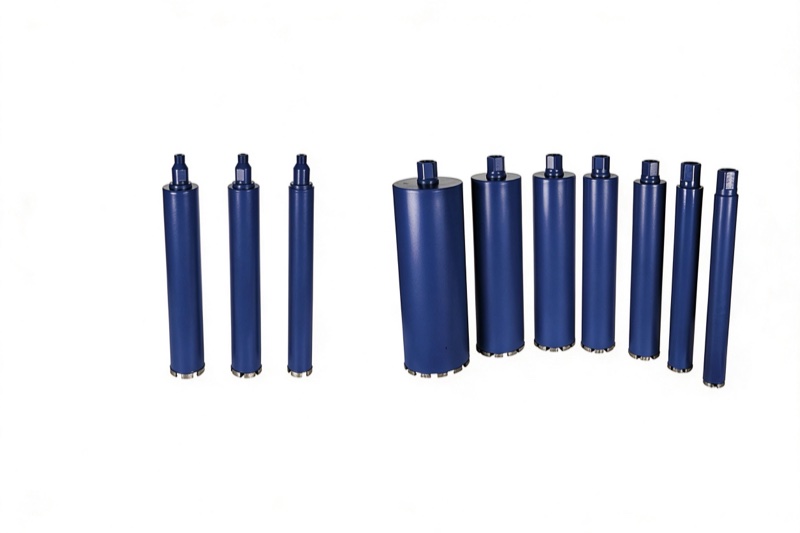
To drill a handrail anchor or cable hole through a concrete stair, use a small rig-mounted or handheld wet diamond core drill at 800-1400 RPM, anchored to the tread with a vacuum base or wedge bolts. A wet diamond core bit cuts 16-25 mm handrail anchor holes through 150-250 mm stair treads and risers cleanly. Concrete stairs are heavily reinforced with rebar in every step, so scan first, drill perpendicular to the tread, and use a reinforced-concrete segment bit when you hit steel. Free-handing a stair hole risks bit walk, rebar break-out, and a crooked handrail post.
A concrete stair is a dense, reinforced structure. Each tread and riser has top and bottom mesh, plus rebar around the openings. The surface is sloped and narrow, so a handheld drill has no flat place to rest. Drilling a handrail hole on a sloped tread means the bit has to stay perpendicular to the tread face, not vertical, and the anchor has to grip into the solid stair mass, not the hollow underside.
Common stair penetrations include handrail post anchors (16-20 mm wedge or sleeve anchors), cable rail through-holes (30-50 mm), and conduit runs along the stringer. Each job has a specific layout; the handrail height and post spacing are set by code, so the hole locations are fixed before drilling starts.
Mark the post locations on the tread with a pencil. Use a rebar detector to find the mesh. Stairs usually have rebar 30-50 mm below the tread surface; the anchor needs to set deeper than the mesh to grip solid concrete. If the detector shows a rebar exactly where the post hole needs to go, shift the hole 20-30 mm rather than drilling through the bar, which weakens the step.
A handheld drill on a sloped tread walks. Use a small core drill stand with a tilting column set to match the tread angle, anchored with wedge bolts into the stair or held with a vacuum base on a finished surface. If a stand is too large for the narrow tread, use a drill guide or a square template that the operator can hold against the riser to keep the bit perpendicular.
| Penetration | Bit diameter | Depth | Setup |
|---|---|---|---|
| Handrail post anchor | 16-20 mm | 100-150 mm | Drill guide or small rig |
| Cable rail through-hole | 30-50 mm | Full tread width | Rig, anchored |
| Conduit along stringer | 25-40 mm | Light depth | Handheld with guide |
| Drain hole through tread | 20-25 mm | Full tread | Drill guide |
Start with a small pilot hole to lock the bit. Bring the diamond core bit in at low RPM, perpendicular to the tread, with light feed. Once the annulus engages, increase RPM to 1000-1400 and feed steadily. Keep water flowing through a drip bottle or a water valve adapter; stair jobs often have no hose reel, so a gravity-fed bottle is standard.
When the bit hits rebar, the load rises. Slow feed and let the reinforced-concrete segment cut through. Do not force the drill; the bit will climb off-axis. When the hole reaches the required depth, withdraw while spinning. Blow out dust, set the wedge or sleeve anchor, and tighten to the manufacturer's torque spec. Over-tightening cracks the tread around the hole.
Cable rail posts need holes through the side of the stair or stringer for cables to pass. These are horizontal holes drilled from the side face. Use a rig clamped to the stair side, with a side-handle drill as backup. A long-shank hole saw reaches through a thick stringer without the chuck touching the concrete. Deburr the edge after drilling so the cable does not abrade against sharp concrete.
For 16 mm anchor holes, a rotary hammer works on light concrete stairs. For 25 mm and larger holes, or on reinforced stairs, a diamond core drill is cleaner and faster.
Set the anchor 10-15 mm deeper than the anchor's embedment spec. A 16 mm wedge anchor typically needs 100-125 mm depth in solid stair concrete.
Slow feed and let the bit cut through, or shift the hole 20-30 mm. Never drill through the rebar at high speed; it will stall the bit and spall the tread.
Perpendicular to the tread surface. The handrail post sits plumb, but the anchor hole drills straight into the tread, not at an angle to gravity.
Drilling a concrete stair is a guided, wet, small-bore coring job. Anchor the drill, keep it perpendicular to the tread, and feed steadily through the reinforcement. The handrail will mount straight and hold for years.
Written and reviewed by JOY TECH — an SGS & BV audited, CE/RoHS certified diamond tools manufacturer founded in 2004, exporting to 50+ countries.
Our factory and QMS are audited by SGS and Bureau Veritas. Products meet CE/RoHS requirements and every piece is 100% inspected before packing.
Verified Certificates
