Average response time: under 24 hours
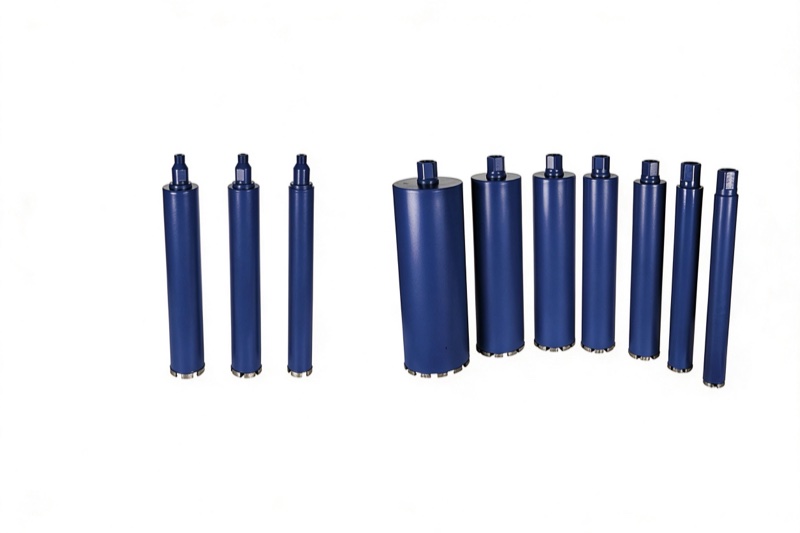
To drill a penetration through a reinforced concrete beam, use a rig-mounted diamond core drill with a reinforced-concrete segment bit, low RPM (300-600), and continuous water cooling. A segmented diamond core bit for reinforced concrete is designed to cut through rebar as it meets it; never use a regular concrete bit, which glazes and stalls on steel. Scan the beam first with a rebar detector, confirm the opening does not cut main tension or stirrup bars, and anchor the rig to the soffit with vacuum or bolts. Structural penetrations require an engineer's sign-off before drilling.
A floor slab or foundation wall has light rebar mesh at 150-300 mm spacing. A structural beam carries bending loads and is densely reinforced: main tension bars along the bottom, compression bars along the top, and stirrups every 100-150 mm wrapping the whole cage. A core hole through the beam will almost certainly intersect several bars. Cutting even one main tension bar can compromise the structure, so the opening must be located and approved before any drill touches the concrete.
Beam penetrations are common for MEP risers, ductwork, and cable trays in commercial buildings. Engineers usually call for openings in the neutral axis (middle third of the beam depth) and keep them smaller than one-third of the beam width. Larger openings require steel sleeve reinforcement or a post-installed epoxy frame.
Use a rebar detector (cover meter) to map the steel. Mark horizontal main bars, vertical stirrups, and any post-tensioning cables. Post-tensioned slabs and beams are the danger zone: cutting a PT cable can trigger a failure that ejects the tendon at high pressure. If the detector shows PT ducts, stop and contact the structural engineer.
Reinforced-concrete core bits use segmented crowns with a medium-hard bond and high diamond concentration. Each segment contains diamonds sized to cut both concrete and steel. The rig must be anchored to the beam soffit: wedge bolts into adjacent concrete, or a vacuum base on a smooth finished surface. Drilling overhead is torque-heavy, so never hold the drill handheld for a beam penetration.
| Beam reinforcement | Bit type | RPM | Feed |
|---|---|---|---|
| Light stirrups only | General segmented | 500-800 | Moderate |
| Main bars 12-20 mm | RC segment crown | 300-600 | Slow, steady |
| Dense cage / PT zone | RC bit, engineer approval | 250-400 | Very slow |
| High-strength concrete 50 MPa+ | Hard-bond RC crown | 300-500 | Slow |
When the crown hits a rebar, the drill load rises and RPM drops. Do not force the feed; the segments will burn. Reduce feed until the drill recovers, and let the diamond edge shave through the steel. It is normal for a 16 mm rebar to take 2-5 minutes to cut through, and for the barrel to emit sparks. Keep water flowing; the water washes steel swarf out and prevents the bit from welding itself to the bar.
If the bit stalls completely, withdraw it 10 mm, spin at low speed, and re-engage. Never restart a stalled bit by leaning on the feed handle. For deep beams, use a threaded extension tube so the rig stays anchored while the barrel reaches through the full depth.
Once the barrel breaks through, reduce feed and let the last few millimeters cut cleanly. The core plug will fall out of the bottom of the beam into a drop cloth or safety netting. Inspect the cut face: if the hole has cut a main bar, stop work and call the engineer. Usually the opening is fine, and you can install the sleeve, seal the annulus, and patch the soffit.
Protect the cut edges with a sleeve or edge trim to prevent chipping during pipe installation. For overhead work, a regulated water feed keeps slurry off the operator; for indoor jobs where water is forbidden, a dry vacuum system with a sealed shroud is the alternative, though it shortens bit life on rebar.
No. Structural penetrations can compromise load capacity. Always have the structural engineer locate and approve the opening before coring.
Stop immediately. The engineer must evaluate the remaining capacity and may require a steel collar, epoxy repair, or additional reinforcement before loading the beam.
A 150 mm hole through a 400 mm beam with light rebar takes 15-30 minutes. Dense reinforcement can stretch it to an hour.
Use a slurry-catching shroud or a plastic bag taped around the hole. Professional coring crews carry overhead collection bags to keep ceilings clean.
Drilling a reinforced concrete beam is a controlled structural operation. Scan for steel, get engineering sign-off, anchor a rig, and use a reinforced-concrete diamond segment bit at low speed. The result is a clean penetration that passes inspection without weakening the structure.
Written and reviewed by JOY TECH — an SGS & BV audited, CE/RoHS certified diamond tools manufacturer founded in 2004, exporting to 50+ countries.
Our factory and QMS are audited by SGS and Bureau Veritas. Products meet CE/RoHS requirements and every piece is 100% inspected before packing.
Verified Certificates
