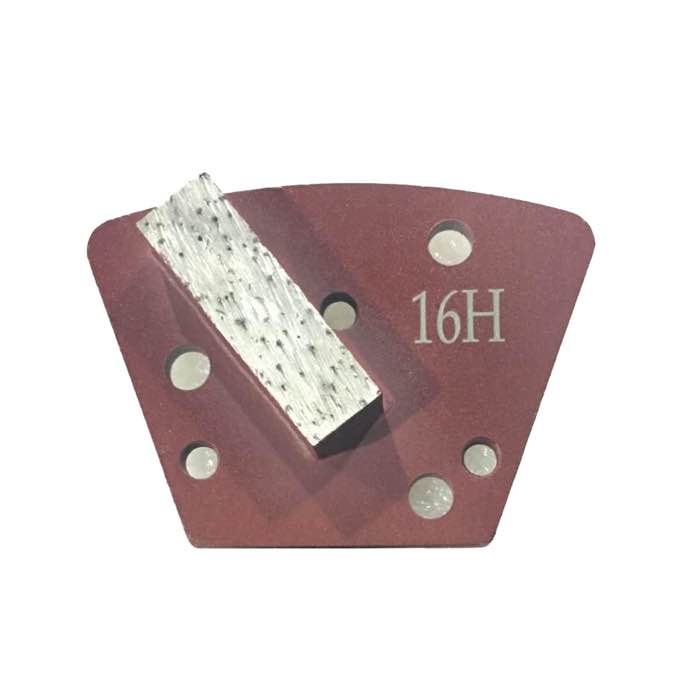
Budget USD 1.5–4.0 per square meter for diamond tooling on a standard concrete grinding job, depending on the grit sequence and the concrete. Break it down: metal-bond grinding discs cost USD 0.30–0.80/m², resin polishing pads USD 0.50–1.20/m², and occasional saw blades and core bits add USD 0.20–0.50/m². The formula is simple: cost of the tool divided by the square meters it grinds.
Cost per m² = (Purchase price of tool) / (Square meters the tool will grind)
For example, a grinding disc that costs USD 18 and grinds 40 m² costs USD 0.45/m². Multiply by the number of grit steps to get the total tool cost for the job.
| Tool | Price (USD) | Life on medium concrete | Cost/m² |
|---|---|---|---|
| 30/40 metal grinding disc | 15–22 | 30–50 m² | 0.40–0.70 |
| 80/100 metal grinding disc | 15–22 | 50–80 m² | 0.25–0.40 |
| 200 resin polishing pad | 8–12 | 60–100 m² | 0.10–0.18 |
| 400 resin polishing pad | 8–12 | 80–120 m² | 0.08–0.15 |
| 800–3000 resin pads | 9–13 | 100–150 m² | 0.06–0.12 |
Our trapezoid grinding discs and resin pads fall in the upper-life band, which lowers cost per m² even if the upfront price is mid-range.
Total tool cost: USD 506. Divide by 200 m² = USD 2.53/m². Labor, equipment, densifier, and margin stack on top — but the diamond tool line is now accurate.
The benchmarks in this article are starting points. Your real number comes from measuring. Each time you open a new disc or pad, write the date, job, and starting segment height on the box with a marker. When the tool is worn out, record the square meters ground. After ten jobs, average the numbers and you will have a cost model tuned to your concrete, your grinder, and your technique. Contractors who skip this step quote by guesswork and wonder why jobs lose money. Spend two minutes per tool, and your quotes will become more accurate than any supplier estimate.
Diamond tooling is only one line on a floor job. Densifier, patches, edge work, and cleanup all add cost. Track them separately so you understand where the money goes. Edge work with a hand grinder is always more expensive per square meter than the main floor, because a hand tool covers area slowly. If a job is 200 m² of floor plus 50 m of edges, price the edges at a higher rate. Good estimators break the quote into floor grinding, edge grinding, polishing, and densifier; the customer sees the math, and you stop absorbing surprises.
Update the model once a year as tool prices change and as you learn your real wear rates. A cost model that is never revisited becomes fiction; a model you update quarterly is one of the most valuable assets a flooring contractor owns.
A: Likely a bond too hard for your concrete, or running dry. Test one softer-bond disc and compare.
A: Only if the job includes cutting. For pure floor grinding, saw blades are a small fixed cost.
A: 10–20% is normal. Tools are a direct cost, not a profit center, but wastage is real.
A: Resin pads are cheap per m². The expensive step is metal grinding, not polishing.
Estimating tool cost per square meter is a simple division, but accuracy comes from tracking your own tool life on real jobs. Start with the benchmarks above, refine them after 3–5 jobs, and your quotes will stop leaking money. Contact JOY TECH for samples and a price list to build your model.
