Average response time: under 24 hours
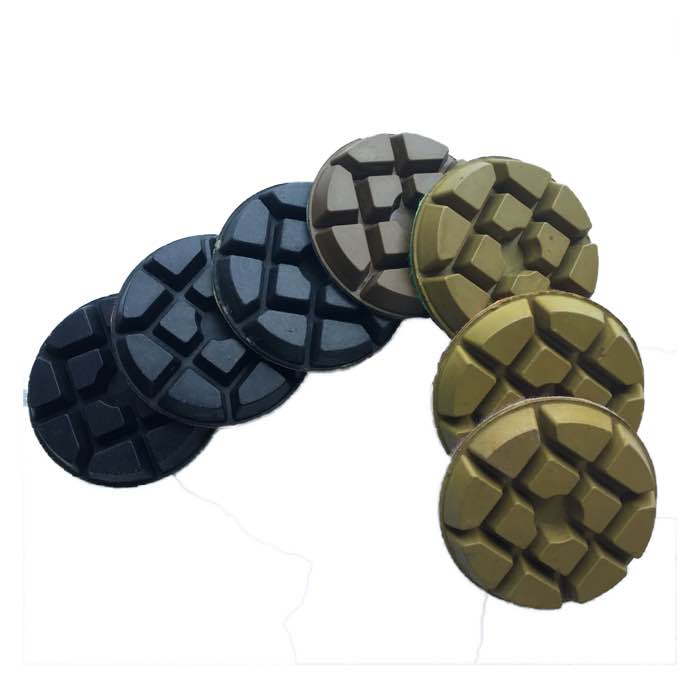
Haloing is the dark ring or blotch that appears around each polishing pass on concrete. It happens when the edge of a pad polishes more than the center, usually because of too much pressure, a worn or loaded pad, or inconsistent passes. To fix it, re-polish the affected area with overlapping, uniform passes using a clean resin polishing pad at the same grit, keep the machine flat, and use light even pressure until the color evens out. For the right tooling on this job, see diamond floor polishing pads, white resin polishing pads.
Haloing appears when the pad spends more time on the edge of a pass than the center. A tilted machine, extra pressure on one side, or a worn pad that cuts more at the rim all create a ring of deeper polish. The concrete in that ring reflects light differently and reads as a dark halo. It is most visible on medium-grit stages and on concrete with uneven hardness, and it is almost always an operator or tooling issue rather than a concrete defect.
Keep the machine flat and the pad level, overlap each pass by a third, and use consistent pressure across the whole floor. Check pads for wear and dress or replace them when the edges round. On resin stages, use light pressure and steady speed, and keep the pad wet if the system calls for water. Plan passes in straight lines rather than random circles, which leave visible edge marks. Prevention is easier than fixing a floor covered in halos.
Re-polish the haloed area starting one grit coarser than the stage where the halo appeared, then step back up. Work in overlapping passes at low pressure, keep the pad flat, and check the color after each pass. If the halo persists, the pad is loaded or worn: clean it with a pad conditioner, or replace it. On stubborn cases, re-grind the area with a coarse metal-bond segment and start the resin sequence again. The goal is a uniform color before you move to the final grits.
A: Dark spots are usually areas where the pad did not fully cut, where concrete was densified unevenly, or where moisture reached the surface. Re-polish the spot with clean tooling and light pressure, and confirm the densifier was applied evenly.
A: Yes, in most cases. Go back one or two grits, re-polish with overlapping uniform passes, and step back up. If the concrete itself is mottled, halos will be harder to fully remove.
A: Water trapped under a pad can soften the surface and create uneven color. Use the water method the pad system specifies, and dry the floor before evaluating the finish.
Haloing is a fixable polish defect caused by uneven pad contact. Prevent it with flat, overlapping, consistent passes, and fix it by stepping back a grit and re-polishing with clean resin tooling at light pressure. Master the passes and your polished floor will come out one even color from corner to corner.
Written and reviewed by JOY TECH — an SGS & BV audited, CE/RoHS certified diamond tools manufacturer founded in 2004, exporting to 50+ countries.
Our factory and QMS are audited by SGS and Bureau Veritas. Products meet CE/RoHS requirements and every piece is 100% inspected before packing.
Verified Certificates
