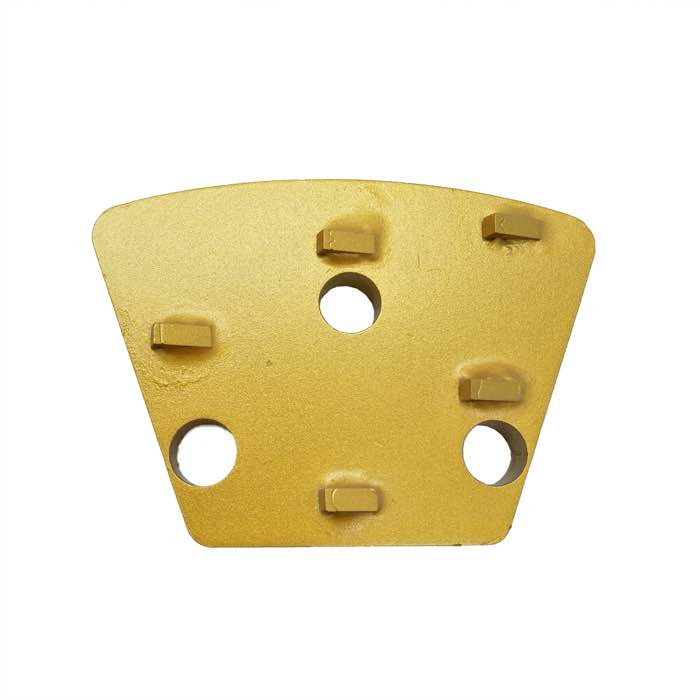
To grind down a 1 cm concrete high spot quickly, use the heaviest walk-behind grinder you can rent, fit it with a 16/18 or 30/40 grit single-bar or double-bar diamond shoe, and make repeated focused passes directly over the mark. Do not try to remove 10 mm in one pass; plan on 20-40 shallow passes, each taking 0.2-0.3 mm. Cross the spot in diagonal directions, check with a 3 m straightedge every five minutes, and feather the edges so the transition blends into the surrounding floor. For very large high spots, a scarifier or planer may be faster, but it leaves a gouged surface that you must then smooth with a grinder.
A common mistake is running the grinder over the entire floor at 30/40 grit hoping the high spot will vanish. It will not. The machine spends 95% of its time on low spots, barely cutting there, while the high spot gets only a fraction of contact time. Instead, park the machine directly on the high spot and work it in a tight figure-eight pattern until the straightedge tells you it is level.
Shoes like the WerkMaster Double Bar Segment (JOY-WMS-B2) double-bar segment and WerkMaster Single Bar Segment (JOY-WMS-B1) single-bar shoe are designed for this aggressive work. The Diamond Trapezoid Grinding Disc (JOY-TP-R3) round-button shoe is better saved for the blending pass afterward.
| High Spot Size | Best Tool |
|---|---|
| < 5 mm, isolated | Walk-behind grinder with bar segments |
| 5-15 mm, small area | Grinder; budget time per spot |
| > 15 mm, large pad | Shot blaster or planer first, then grinder to smooth |
| > 25 mm | Small jackhammer + grinder; diamond alone is uneconomic |
A: Plan on 30-60 minutes per 0.5 m2 spot with a 480 mm grinder. Larger machines cut that time in half.
A: For very small spots, yes, but it is tiring and leaves a bowl. A walk-behind grinder is worth the rental for more than two spots.
A: Yes, and fast. If you hit rebar, stop, excavate carefully, and dress the shoe on an abrasive block before continuing.
A: Yes. Concrete dust between the shoe and floor acts as a lubricant and slows the cut. Blow or vacuum between focused passes.
High-spot work is dusty and noisy. Post warning signs, cordon off the area, and require hearing protection and a P100 respirator for everyone within ten meters. If the job is inside an occupied building, schedule grinding for off-hours and use plastic dust barriers. For very high spots over twenty millimeters, do not waste a full set of diamond shoes; break the peak down with a small electric jackhammer first, then use the grinder only to level and feather. This single step often halves both the time and the tooling cost on bad slabs.
High-spot grinding is a focused, repetitive task: mark the highs, attack each one with aggressive bar-segment shoes, feather the edges, then blend the whole floor at a finer grit. Speed comes from the right shoe and a straightedge, not from running the machine faster.
