Switch from metal bond to resin pads at around 100-200 grit, once the previous scratch pattern is fully covered by the current grit. Going too early wears resin pads out instantly; going too late wastes expensive metal-bond time.
A clean scratch pattern is the cue. Run a single pass with the next grit, then inspect. When the previous grit scratches are completely covered and no directional marks remain, you are ready to move on.
Metal-bond diamonds cut aggressively and leave deep, directional scratches. Resin-bond pads cut more gently and refine the surface. If you switch too early, resin pads have to remove deep metal scratches and wear out almost immediately. If you switch too late, you waste time and money grinding on with expensive metal bonds past the point where they are productive.
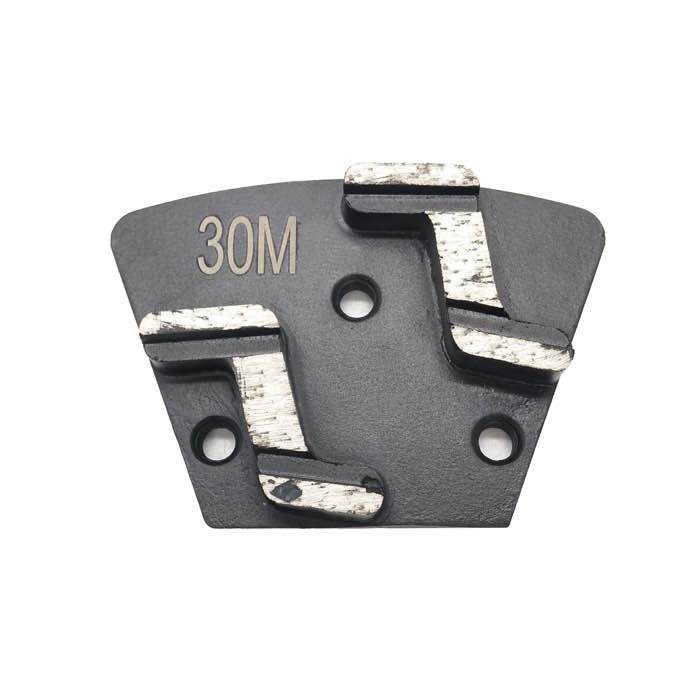
Clean the floor, turn the lighting low and rake a strong light across the surface. Consistent, uniform scratches of the same depth mean you are ready to move up. Patches where the old grit still shows through mean one more pass at the current grit. A double-S trapezoid disc (JOY-TP-S2) gives an even, predictable scratch pattern that makes the transition easy to judge, and a triple-round segment disc (JOY-TP-R3) handles the early heavy-removal stages with stable wear.
A: Only when the slab is already smooth and you are refining. On rough or ground-new concrete, skipping leaves a scratch pattern finer pads cannot resolve.
A: If segments glaze and stop cutting, the bond is too hard; if they wear flat in under half a set, it is too soft. Match bond to concrete hardness.
A: Dry grinding with a HEPA vacuum is standard on polished concrete jobs; wet grinding is mostly used for stone and edge work to control dust and heat.
A: Change the whole set together once segment height drops by half or the cut rate slows. Mixing new and worn plates causes uneven scratch patterns.
Choosing the right bond, grit and technique for your concrete job saves tooling cost and avoids rework. Match the tool to the slab, work in the correct grit sequence, and keep plates balanced — the floor will tell you when you are ready for the next step. Contact JOY TECH for tooling recommendations matched to your machine and concrete hardness.
